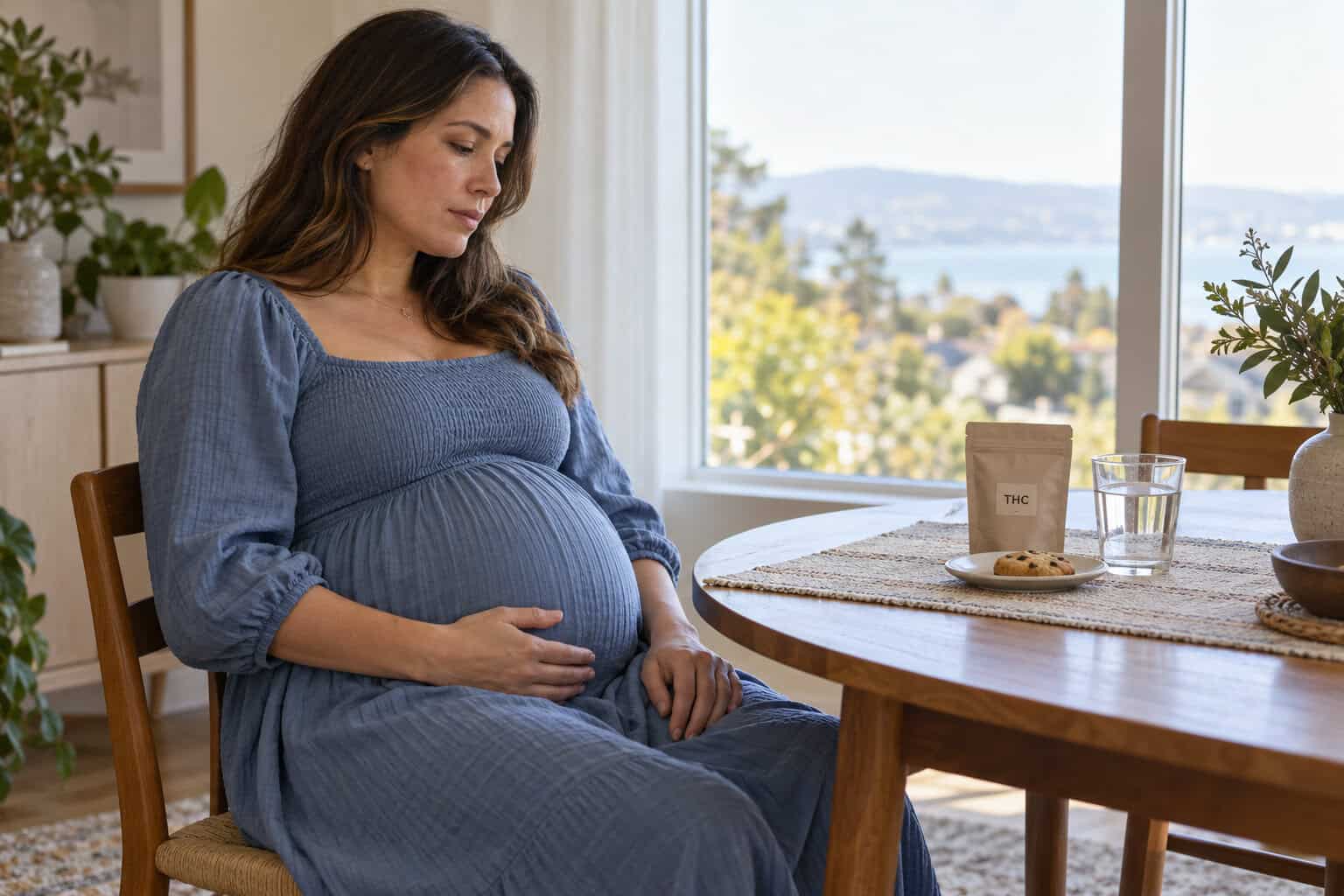
Almost everything known about cannabis in pregnancy comes from asking women what they used and then watching how their children grow up. That method has a built-in weakness. A pregnant woman who uses cannabis may also smoke tobacco, drink alcohol, live under more stress or have less money, and no amount of statistics fully separates those threads. A team at Oregon Health & Science University took the route that is impossible with people: they gave pregnant rhesus macaques a measured THC edible every day, gave a second group the same cookie without THC, and then followed the babies with brain scans, behavioral tests and a gene-level look at brain tissue.
The paper, “Maternal edible THC consumption alters offspring neurodevelopment and emotional behavior in rhesus macaques”, was accepted by the journal Neurobiology of Disease on 5 October 2026 and is so far available as a pre-proof: peer-reviewed and accepted, but not yet through final copyediting. It is the nearest thing to a controlled experiment on maternal THC edibles that exists for a primate. It is also a study of eight infants, and that number decides how much weight each result can carry.
Key Takeaways
Eight female rhesus macaques ate a daily cookie before conception, throughout pregnancy and while nursing; four cookies contained THC and four were placebo. At three months of age the THC-exposed infants spent 69.37% of observed time on their mothers, against 13.99% for control infants, and moved around less than half as much. At four months they called out significantly more when faced with a stranger or unfamiliar objects. Brain volumes did not differ at any point, but at six months diffusion scans showed a different white matter signal in the corpus callosum and two other regions. Brain tissue carried altered DNA methylation in 1,867 regions of the cerebellum and 2,109 regions of the prefrontal cortex, including 42 genes listed as autism candidates. With four animals per group, the study shows a consistent pattern across several kinds of measurement, not a settled estimate of risk for human pregnancies.
How the Maternal THC Study in Macaques Tracked Offspring Neurodevelopment
The design is simple to describe. Eight sexually mature female macaques at the Oregon National Primate Research Center lived in pairs on a standard diet. Each morning, before their regular food, they received a cookie. For four of them it contained research-grade THC; for the other four it was a placebo. The dose started at 0.5 mg per 7 kg of body weight per day and was raised slowly to 2.5 mg per 7 kg per day, following published acclimation guidance for medical cannabis patients. This build-up took about four months and was finished before breeding; the animals then stayed on the full dose through pregnancy and after birth, while they nursed.
That last detail matters. The authors built the model to mirror what they describe as real-world use: many women who use cannabis before pregnancy continue during it and during breastfeeding. So the infants were exposed in the womb and, potentially, through milk. The experiment cannot say which of those windows did what.
Each group ended up with one male and three female infants, born naturally at term, around day 165 of gestation. The fetuses were scanned by MRI twice before birth. After birth the infants were scanned at about one month and six months, watched in their home cages with their mothers on six occasions between day 1 and day 90, and put through two standard temperament tests at around four months. At six months — an age the authors equate to roughly two years in a human child — the animals were euthanized so that brain tissue could be examined directly, something no human study can do.
Why a Primate Model Is the Closest Evidence to Human Pregnancy
Most laboratory work on prenatal THC is done in rats and mice, and it has limits. Much of the brain development that happens in the human womb takes place after birth in rodents, their placentas are built differently, and THC is often given by injection rather than eaten. This site recently covered a review of 49 rodent studies on THC and social behavior, and the same caution applied there: a mouse is a starting point, not a stand-in.
Rhesus macaques sit much nearer. According to the authors, humans and rhesus share similar genomes, anatomy, reproductive physiology, placental structure, order of developmental stages and THC metabolism. A single baby, a long pregnancy, a mother who carries and nurses her infant for months: the basic shape of early life is recognizably the same.
The choice of an edible was deliberate too. Edibles are the second most common way cannabis is used in pregnancy, the paper notes, and they are popular with women generally: federal survey data show women are more likely than men to choose edibles, and edible use among American adults has been climbing. An edible also removes smoke from the picture. Whatever the study found cannot be blamed on combustion products, tobacco, alcohol, other drugs or a mother’s circumstances, because the two groups of animals lived the same lives apart from what was in the cookie.
Behavior: More Clinging, Less Exploring, More Calling Out
A young macaque normally starts life glued to its mother and then, week by week, ventures further. In the control group that is what happened. By day 90 control infants spent 13.99% of the observed session on their mothers. The THC-exposed infants spent 69.37% (p=0.0007). They also moved around less: 18.11% of the session against 43.16% for controls (p=0.03). They tended to nurse more, 34.45% of the time against 6.15%, but with so few animals that difference did not reach statistical significance (p=0.17). The mothers themselves groomed their infants about equally in both groups.
At around four months the infants were briefly separated from their mothers for two tests used to gauge anxious and inhibited behavior in both monkeys and young children. In the first, an unfamiliar person enters the room, first showing only a profile and later staring directly at the infant, which macaques read as a threat. In the second, the infant is shown four unfamiliar things in turn: a piece of kiwi, a toy with large eyes, a hanging bird toy and an apple slice sitting on a rubber snake. Observers who did not know which group an infant belonged to scored the responses.
THC-exposed infants vocalized significantly more in every one of those phases. During the quiet settling-in period before the tests there was no difference between the groups, which suggests the extra calling was a reaction to novelty and threat, not a general habit. The authors read the whole picture — staying close, exploring less, calling more — as signs of increased stress and anxiety.
One stress measure did not confirm it. Cortisol in hair, which reflects the previous three months, was somewhat higher in the THC group at six months (102.50 against 86.75), but the difference was not statistically significant (p=0.217).
Brain Scans: Same Size, Different Wiring Signal
Across four scans, from the womb to six months, the brains of the two groups grew alike. Whole brain, cortex, white matter, cerebellum, brainstem, ventricles: no region differed in volume. That contrasts with the group’s earlier study of fetal macaque brains, which found subtle growth differences that depended on age and sex. The authors think eight infants, only two of them male, were too few to detect an effect of that size.
The difference appeared in a finer measure called fractional anisotropy, or FA. It describes how strongly the movement of water in tissue is steered in one direction. In a tight bundle of nerve fibers water slides along the fibers, like liquid through a handful of drinking straws; in looser tissue it spreads every way, like water in a sponge. At one month the groups looked the same. At six months FA was higher in THC-exposed infants in the corpus callosum, the thick cable of fibers joining the brain’s two halves, as well as in part of the frontal white matter and in the left centrum semiovale.
Higher is not better here, and the authors say so directly: the signal probably does not reflect white matter “integrity” but a difference in how the tissue is maturing. In infant macaques the corpus callosum sheds a large share of its nerve fibers during the first six months, and the insulating coating of the fibers is still being laid down. A higher reading may mean that this pruning and insulating ran on a different schedule.
Two comparisons from human research show how hard the signal is to interpret. In a study of infant siblings of children with autism, those later diagnosed themselves had elevated FA at six months, followed by slower change afterwards. But an analysis of children around age ten from the ABCD cohort found lower FA in those exposed to cannabis before birth, and another ABCD analysis linked prenatal exposure to smaller gains in intracranial volume over two years. Different ages, doses and methods may explain the mismatch. What the scans support is that white matter development was altered, not which direction counts as harm.
Under the Microscope and in the Genes
Tissue examined by a neuropathologist who did not know the groups looked broadly similar. Rare clusters of microglia, the brain’s resident immune cells, turned up in the frontal cortex of two of the four THC-exposed infants and in none of the controls. Staining for a microglial marker in prefrontal white matter was higher in the THC group (0.62% against 0.37%), but that difference was not significant either (p=0.13).
The molecular results were more pronounced. The team mapped DNA methylation, small chemical tags on DNA that work like dimmer switches: they leave the genetic text unchanged but help set how actively a gene is read. In the cerebellum 1,867 regions differed between groups by at least 10%; in the prefrontal cortex, 2,109 regions did. A total of 338 genes were affected in both brain areas, far more than chance would predict, and 42 of them appear in a research database of autism candidate genes. That echoes the group’s 2023 finding in placenta and fetal tissue, where THC-related methylation changes were also enriched for such genes.
This is an overlap between gene lists, not a diagnosis; nobody has shown that the infants had anything resembling autism. Autism appears elsewhere in cannabis research in a very different role, as a condition in which cannabis extracts are being tested as a treatment for children and teens, and the two lines of work should not be merged.
Gene activity told a similar story in the cerebellum, where eight genes were clearly switched up or down. Among the wider set of genes showing a weaker signal, those that build ion channels and parts of the GABA receptor — the receptor that anti-anxiety drugs of the benzodiazepine class act on — tended to be less active. One methylation change, in the gene for the mu opioid receptor, tracked closely with how much each infant vocalized in the temperament tests (r=0.91). With eight animals a correlation like that is a lead to follow, not proof of a mechanism.
How This Fits With What Is Known in People
Human findings on anxiety are mixed, the authors acknowledge, though most point the same way. The largest study they cite followed 223,068 births in New South Wales, Australia and found that a mother’s cannabis use disorder during pregnancy or after birth was associated with a higher risk of anxiety disorders in her children. Some small studies found no link.
On birth outcomes the evidence is firmer. A 2025 meta-analysis in JAMA Pediatrics, led by Jamie Lo, the senior author of the macaque study, pooled 51 studies with 1,709,998 participants and found prenatal cannabis use associated with higher odds of low birth weight (odds ratio 1.75), preterm birth (1.52) and babies small for gestational age (1.57), all with moderate-certainty evidence. The American College of Obstetricians and Gynecologists, in its current clinical guidance, advises against cannabis use during pregnancy and recommends that clinicians ask every patient about it.
Because the macaque mothers kept eating THC while nursing, the study also touches the question of exposure through milk, which this site covered in a report on cannabis smoke chemicals found in the urine of breastfed infants.
What Eight Infants Can and Cannot Show
The limits are stated by the authors and deserve to be repeated plainly. There were four animals per group. With one male in each, the study could not test whether males and females respond differently, although the group’s earlier work suggested they do. Several results that sound striking — more nursing, more microglial staining, higher cortisol — did not reach statistical significance. Many of the gene-activity findings rest on a looser statistical threshold, and the pairwise behavior comparisons were not corrected for the number of tests run. Behavior and tissue were scored blind, but the person who outlined the brains on the MRI images was, in the paper’s words, not explicitly blinded to treatment group.
There was one dose and one schedule, using research-grade THC alone, not the mix of compounds in commercial edibles. Exposure covered pre-conception, pregnancy and nursing together, so no single window can be singled out. The animals were followed for six months, so nothing is known about whether the differences fade, persist or change with age. And the paper is a pre-proof whose wording may still be corrected.
Against that stands the consistency of the pattern. Behavior, imaging, tissue and two layers of molecular data, collected by different methods, lean the same way, and they extend what the same model showed earlier in the fetus. The authors conclude that the results raise clear concern about prenatal THC exposure and long-term behavior, and that larger cohorts are needed to study sex differences and later ages. The work was funded by the National Institutes of Health, March of Dimes and Silver Family Innovation; the authors declare no conflicts of interest.
FAQ
No. It shows that in a controlled experiment with eight rhesus macaque infants, daily maternal THC was associated with more anxious-looking behavior, a different white matter signal at six months and altered DNA methylation in the brain. Brain volumes did not differ. The sample is very small, the animals are not humans, and several measures did not reach statistical significance. It strengthens the case that prenatal THC can affect primate brain development without measuring the size of that risk in people.
The mothers started at 0.5 mg per 7 kg of body weight per day and were gradually moved up to 2.5 mg per 7 kg per day, a schedule the authors based on published acclimation recommendations for medical cannabis. The build-up took about four months before breeding, and the full dose then continued daily through pregnancy and nursing. Only this one regimen was tested, so the study says nothing about lower, higher or occasional doses.
Two reasons are given in the paper. Edibles are the second most common way cannabis is used during pregnancy, so the model reflects real behavior. And an edible delivers THC without smoke, which removes combustion toxins as an alternative explanation for any effect on the offspring.
U.S. cannabis law does not single out pregnancy, but it is layered. As of October 2026, a federal rule issued on April 28, 2026 places FDA-approved marijuana products and marijuana handled under state medical licenses in Schedule III, while all other marijuana remains in Schedule I; a proceeding on broader rescheduling was temporarily paused at the start of October 2026. States that allow medical or adult-use sales set their own rules, and many require product labels to carry a warning about use during pregnancy and breastfeeding. Separately, federal child-welfare law requires states to have procedures for health care providers to notify child protective services when a newborn is identified as affected by prenatal substance exposure, and states differ widely in how they define and act on that. The consequences therefore depend heavily on the state.
Legal Disclaimer
This article is for informational and educational purposes only. It reports on a preclinical study in animals and does not constitute medical, legal or professional advice, nor does it encourage the purchase, possession or use of cannabis or THC products. Cannabis laws differ between countries and, within the United States, between federal and state jurisdictions, and they change frequently. Questions about health during pregnancy or breastfeeding belong with a qualified health care professional, and questions about legal status with a licensed attorney in the relevant jurisdiction.