
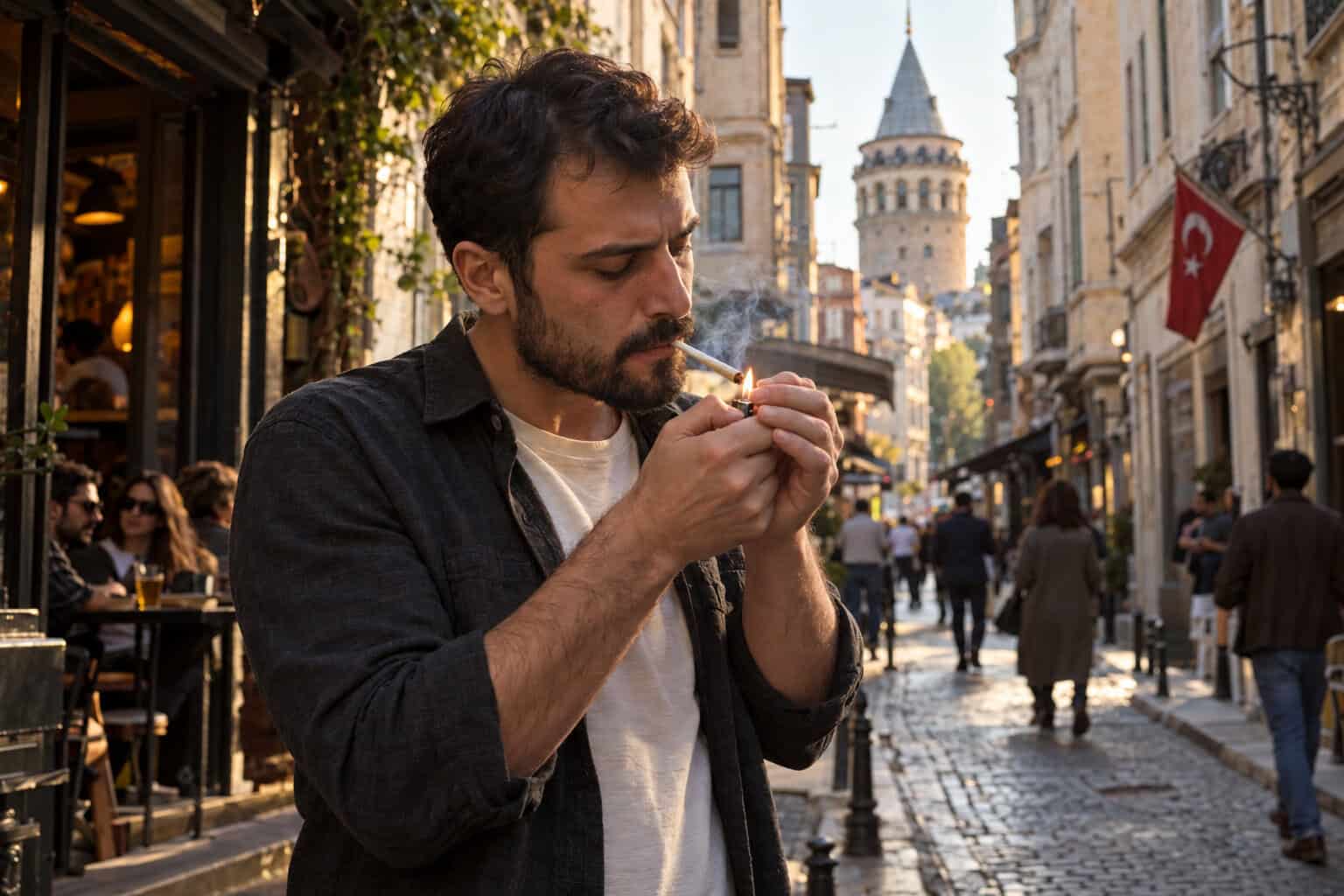
Ask three people in Turkey whether cannabis should be legal and you may discover they are not answering the same question. Someone who uses it talks about shame and the risk of buying from strangers. A doctor who treats addiction talks about clinic waiting lists and psychiatric wards. A defense lawyer talks about a client who was charged as a dealer for something that looked a lot like personal use. All three are talking about “legalization”, and each means something different by it.
That is the picture drawn by a fresh piece of research. The paper, “The Possibility of Legalising Cannabis in Türkiye: A Multi-Perspectival Interpretative Phenomenological Analysis of Users, Addiction Specialists and Legal Professionals”, was published online in the journal Drug and Alcohol Review on October 4, 2026 (DOI: 10.1111/dar.70274; PubMed record). Its author, Sadullah Seyidoğlu of the Department of Social Work at Siirt University, interviewed 25 people in the southeastern city of Diyarbakır and asked what a legal cannabis market would mean to them.
Key Takeaways
The study is qualitative: it is built on in-depth interviews with 25 people, namely 10 active cannabis users, 10 addiction specialists and 5 criminal lawyers, all in one city. It does not measure public opinion and cannot say how many people in Turkey support legalization. What it does show is that the three groups read the idea through completely different lenses. Users, according to the paper, emphasised “normalisation, reduced stigma and safer access”. Specialists pointed to mental health risks, limited treatment capacity and the danger of commercialisation. Lawyers focused on legal ambiguities, above all the unclear line between a user and a dealer. Meanwhile Turkish law is moving in a narrow direction: since 2025, low-THC cannabis products can be sold through pharmacies, while possession for personal use still carries two to five years in prison on paper. The practical conclusion is that Turkey does not have one legalization debate but three, and any reform would have to answer all of them at once.
Cannabis legalization in Turkey: how the study was done
The method has a long name, interpretative phenomenological analysis, but the idea is simple. Instead of handing out a questionnaire with boxes to tick, the researcher sits down with a small number of people, lets them talk at length, and then studies how each of them makes sense of the topic. “Multi-perspectival” means the same question is put to several groups who meet the issue from different sides. Think of it as describing a building by interviewing a tenant, a fire inspector and an architect: you will not learn how many people like the building, but you will learn what it looks like from each position.
Participants were found through purposive and snowball sampling. In plain terms, the researcher deliberately looked for people who fit each group and then asked them to recommend others. This is a standard way to reach people who have good reasons to stay out of sight, such as active users of an illegal drug. The interviews were semi-structured: there was a list of topics, but the conversation was free to go where the participant took it.
The paper states its motive directly. Research on cannabis policy mostly tracks what happens after a country changes the law, and much less is known about how legalization is imagined in what the author calls “strictly prohibitive contexts”. Turkey (officially Türkiye) is one of those.
Where Turkish law stands now
To understand why the three groups talk past each other, it helps to know the rules they live under.
Under Article 191 of the Turkish Penal Code, buying, accepting or possessing a drug for personal use is punishable by two to five years in prison. In practice, first-time defendants are usually sent into treatment and probation, and the case can be dropped if they comply. Article 188 covers supply: at least ten years for selling, and twenty to thirty years for production, import or export. A legal overview of these provisions notes that there is no fixed quantity separating the two articles. Courts weigh the amount together with packaging, scales, phone records and the suspect’s behavior, and Turkey’s Court of Cassation has said that a large quantity alone does not prove trafficking.
Cannabis use is rare by European standards. The most recent country report by the EU drugs agency that we could consult puts last-year cannabis use at 1.1% of adults aged 15 to 64, based on a 2017 survey, and at 1.8% among those aged 15 to 34. The same report counted 118,482 drug law offences in 2017, of which 91,876 concerned use or possession. Those figures are several years old and should be read as orientation, not as a current snapshot.
On the medical and industrial side, the law has moved. In July 2025 parliament amended Law No. 2313 on the Control of Narcotic Substances, and the change appeared in the Official Gazette on July 24, 2025. According to a summary by the Turkish law firm CBC Law, non-narcotic medical, health-support and personal care products derived from cannabis may now be sold only through authorized pharmacies, with retail and online sales explicitly prohibited. The Ministry of Agriculture and Forestry oversees cultivation, and the Ministry of Health handles licensing and an electronic tracking system. Trade press coverage of the vote noted that hemp cultivation was permitted in 19 of the country’s 81 provinces at the time. A follow-up Regulation on Cannabis Cultivation and Control was published in the Official Gazette on January 31, 2026.
None of this touches adult recreational use. Turkey has opened a pharmacy door for low-THC products and kept every other door shut. That is the backdrop against which the 25 participants were asked to imagine something much bigger.
Users: normalization, less stigma, safer access
For the ten active users, the paper reports, legalization meant “normalisation, reduced stigma and safer access”. Notice what is not on that list: cheaper cannabis, or more of it. In the paper’s summary, the users’ concerns are about social standing and safety, two things an illegal market cannot offer.
The stigma is documented elsewhere. A mixed-methods study of 512 university students in Istanbul, Ankara and Izmir, published in Frontiers in Public Health in June 2026, described cannabis use in Turkey as “illegal and highly stigmatized” and found that students who used it often did so to cope with distress. A person who expects judgment may be less likely to tell a doctor the truth or to seek help early.
“Safer access” is the argument heard in every country that has legalized: a regulated shop sells a tested product, a street seller does not. Evidence from California suggests the legal channel can indeed absorb most purchases. In a dataset of 178,836 adults, legal retail accounted for roughly 77% of purchases among past-month users, as we reported in our piece on cannabis use in California after legalization. Whether that would transfer to a country with far lower use and a different policing tradition is an open question.
Addiction specialists: mental health, treatment capacity, commercialization
The ten specialists looked at the same idea and saw their own workplace. The paper says they “highlighted risks to mental health and limited treatment capacity, expressing concern about commercialisation”.
The capacity argument deserves attention because it is practical, not ideological. If legal access brought even a modest rise in problem use, the people expected to absorb it are the same specialists who describe treatment capacity as limited. The EU agency’s report found that cannabis accounted for 6% of people entering drug treatment in Turkey in 2017.
The commercialization worry also has local echoes. In a commentary published in September 2026 in Thoracic Research and Practice, two Turkish chest physicians, Osman Elbek and Oğuz Kılınç, warned that an alliance between tobacco and cannabis companies “poses the danger of turning Türkiye into a country similar to those in North America, where cannabis use has become widespread”. A commentary in Addicta: The Turkish Journal on Addictions, written from the Turkish Green Crescent Society, called the pharmacy law a significant reform while listing unresolved questions, including which conditions qualify for treatment and what training prescribers will need.
International experience does not settle the argument either way. In Germany, a survey series covering 35,957 respondents found no statistically significant change in the trend of cannabis use after partial legalization, as described in our analysis of cannabis use in Germany after partial legalisation. Thailand shows the other risk: after a rapid commercial boom, the cabinet approved a medical-use-only law in September 2026, and 7,297 shops had already closed during 2025, a reversal we covered in our report on Thailand’s cannabis shop closures. A specialist in Diyarbakır who fears a market arriving faster than the rules has a real example to point to.
Criminal lawyers: the blurry line between user and dealer
The five lawyers came at the question from the courtroom. According to the paper, they “foregrounded legal ambiguities, particularly the distinction between users and dealers, evaluating legalisation in terms of legal clarity and justice”.
Given the law described above, this is easy to understand. The difference between Article 191 and Article 188 is the difference between probation with treatment and a decade or more in prison, and it rests on a judgment call about packaging, quantity and circumstances. For a lawyer, the central problem is not whether cannabis is good or bad. It is that two people in similar situations can end up with very different outcomes.
This also means the lawyers’ concern could, in principle, be addressed without legalization at all, for example through clearer statutory criteria. That is our reading, not a claim made in the paper. It matters because it shows how much the word “legalization” is carrying in this debate.
What this means for the prospects of legalization in Turkey
The study does not predict what Turkey will do, and neither can we. But read alongside recent legislation, it supports a few cautious observations.
First, the state’s direction is control, not liberalization. The 2025 law and the 2026 regulation both channel cannabis into tightly supervised medical and industrial uses. The region is not uniformly loosening either: neighboring Greece has tightened its rules on CBD products, as explained in our article on Greece’s full-spectrum CBD ban.
Second, the three groups would judge any reform by different yardsticks. Users would ask whether it reduces stigma and makes access safer. Specialists would ask whether treatment services are funded and whether advertising and corporate influence are restrained. Lawyers would ask whether the law finally says, in clear terms, who is a user and who is a dealer. A reform that satisfies one group could easily alarm another. The author’s own conclusion points the same way: the findings underscore “the need for context-sensitive, multi-actor policy discussions integrating legal, social and public health dimensions”.
Third, research interest is growing. A separate paper by Kemal Balica, Umut Kirli and Serap Annette Akgür, “Assessing Attitudes Toward Marijuana Legalization in Türkiye: An Analysis of Key Stakeholders”, appeared in Substance Use & Misuse in September 2026. Two studies in two months do not make a policy shift, but they suggest the question is no longer off limits for Turkish academia.
How strong is the evidence
This is a small qualitative study, and it should be read as one. Twenty-five people in a single city cannot represent a country of more than 80 million. Snowball sampling means participants recruited each other, so they may share views more than a random group would. The lawyer group had only five members. The paper has a single author, which in this kind of analysis means one person’s interpretation shaped the themes. And the participants were reacting to a hypothetical: what people expect from an imagined law and how they behave under a real one are different things.
Our account relies on the paper’s published summary, which reports the themes at headline level and does not include the participant quotations that give qualitative research its texture. The findings are best treated as a map of the arguments, not a measure of their popularity. No survey figure for or against legalization can be drawn from this work.
FAQ
Only in a narrow sense. A law passed in July 2025 allows non-narcotic, low-THC medical, health-support and personal care products derived from cannabis to be sold through authorized pharmacies under Ministry of Health supervision. Retail and online sales are prohibited, and whole-plant cannabis for smoking is not part of the scheme. Recreational use remains illegal.
No. A medical marijuana card issued by a US state has no legal standing in Turkey, and Turkish law treats bringing narcotics across the border as import under Article 188 of the Penal Code, which carries twenty to thirty years in prison. US federal law also prohibits carrying cannabis across the US border, whatever the law of the traveler’s home state says. Individual cases are a matter for a qualified lawyer, not for a general article.
No. It is not an opinion poll. The author interviewed 25 people chosen because of their role, in order to understand how they think about the issue. The study cannot tell us what share of the Turkish population is for or against.
It is a qualitative research method that studies how people make sense of an experience or idea in their own words. Researchers conduct long interviews with a small number of participants and then identify shared themes. It is good at explaining why people hold a view and poor at telling how common that view is.
Legal Disclaimer
This article is for informational and educational purposes only. It summarizes published research and publicly available legal information and does not constitute legal or medical advice. Cannabis laws differ widely between countries and change over time; possession, use, cultivation and sale of cannabis are criminal offences in Turkey and in many other jurisdictions. Nothing in this text should be read as encouragement to use, buy, grow or transport cannabis. Readers should consult a qualified lawyer or healthcare professional about their own circumstances and check the laws that apply where they live or travel.


