
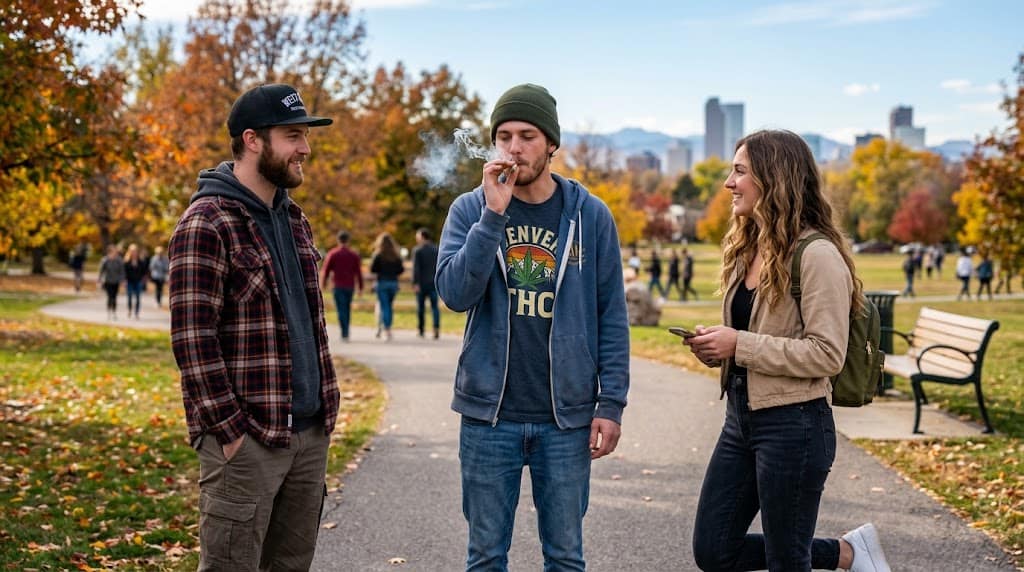
If you picture the typical new cannabis consumer in America as a twenty-something in a legal state, the largest survey dataset ever assembled on the question says you are looking in the wrong direction. Over eight years, the groups whose cannabis use grew fastest were retirees and homemakers, women, married couples, college graduates, former smokers — and residents of states where cannabis was still illegal. Young men in recreational states were already using; the growth came from everyone else.
That is the central finding of a new analysis of the CDC’s Behavioral Risk Factor Surveillance System published online on 25 September 2026 in Addictive Behaviors by Ray M. Merrill, Benjamin J. Edvalson and Elle Crockett of Brigham Young University. The team pooled responses from 952,905 adults across 38 states and territories that asked about cannabis between 2016 and 2024. The paper is open access at https://doi.org/10.1016/j.addbeh.2026.108863.
Key Takeaways
Past-month cannabis use among U.S. adults in the participating jurisdictions rose from 7.5% in 2016 to 15.9% in 2024, and the study’s modelled trend line — which smooths out year-to-year noise — puts the increase at 92%, or an estimated annual percent change of 8.5%. Every single subgroup the researchers looked at went up, but the relative gains were steepest where use had been rarest: among adults aged 55 and over the rate more than doubled, from 3.8% to 9.2%; among women it went from 6.1% to 14.4%; among homemakers and retirees from 3.1% to 8.7%. Use in states that permitted both medical and recreational cannabis grew slowly, by about 3% a year, while use in states where cannabis was illegal grew more than twice as fast. Among people who did use, frequency also crept upward, from an average of 15.7 days a month to 17.1, and four in ten past-month users reported using on 25 or more of the last 30 days. The study is cross-sectional and self-reported, covers only the 38 jurisdictions that chose to ask the question, and cannot say why any of this happened — the authors are explicit that legalization, changing attitudes and medical motivations are hypotheses, not demonstrated causes.
BRFSS Cannabis Use Trends: What the CDC Survey Is and Why This Dataset Is Unusual
The Behavioral Risk Factor Surveillance System is the world’s largest ongoing telephone health survey. Every year, state health departments call a random sample of adults and ask about smoking, drinking, exercise, chronic conditions and preventive care. The core questionnaire is the same everywhere. Cannabis, however, is an optional module: each state decides whether to include it, and many do not.
That is both the strength and the weakness of this study. The strength is scale — nearly a million respondents is an order of magnitude beyond most cannabis surveys. The weakness is that the map of who asked the question changed every year. Colorado asked only in 2016. Missouri and the District of Columbia joined only in 2024. Minnesota asked in seven of the nine years, Maryland in four. Of 961,220 people who were asked the cannabis question, 8,315 (0.87%) answered “don’t know” or refused and were dropped, leaving the final sample of 952,905.
The researchers handled the shifting participation with a sensitivity check: they recalculated the trend using only states that had asked the question for at least two, three or four years. The annual growth rate barely moved — 8.4%, 9.0%, 8.8% and 8.5% across the four thresholds — which suggests the upward trend is not an artefact of which states happened to join when. Respondents from participating jurisdictions made up 19.1% of all BRFSS respondents over the period and were slightly older and slightly more likely to be non-Hispanic White than the national survey pool.
The Headline Number: A 92% Increase in Eight Years
The raw, survey-weighted figures show past-month use climbing from 7.5% in 2016 to 9.5% in 2017, 11.1% in 2018 and 12.6% in 2019, dipping to 10.5% in 2020 — the pandemic year, when the mix of participating states also changed — and then rising again to 11.8%, 14.9%, 14.8% and finally 15.9% in 2024.
To turn nine bumpy data points into a single growth figure, the authors fitted a log-linear regression, essentially drawing the smoothest exponential curve through the points and reading off its slope. The result is an estimated annual percent change of 8.5%, with a 95% confidence interval of 5.7% to 11.4%. Compound that over eight years and modelled prevalence rises from 8.5% to 16.3%, an increase of 92%.
For context, the authors cite an earlier analysis of the National Survey on Drug Use and Health by Weinberger and colleagues that found a 55% rise in past-month cannabis use between 2004 and 2017. The two studies use different surveys and different years and are not directly comparable, but together they describe two decades in which current cannabis use in the United States has grown substantially and without pause.
The state-level picture is wide. In 2024, past-month use was 24.7% in Vermont, 24.4% in Maine and 22.5% in Oregon, against 10.4% in Mississippi and 10.7% in South Carolina. Puerto Rico, which asked only in 2017 and 2018, reported 3.7% and 4.9%.
Who Grew Fastest: The Catch-Up Effect
The paper’s core question was whether groups that historically used less cannabis grew faster in relative terms. The answer, across almost every characteristic measured, was yes.
Take age. Adults aged 18 to 34 already had the highest use in 2016, at 15.8%, and rose to 25.5% by 2024 — an annual growth rate of 6.2%. Adults aged 35 to 54 went from 7.6% to 17.2%, growing at 10.8% a year. Adults 55 and over started lowest, at 3.8%, and grew fastest, at 11.6% a year, reaching 9.2%. The oldest group still uses least, but the gap is closing.
The same pattern holds for sex. Men went from 11.1% to 18.3% (6.4% a year); women from 6.1% to 14.4% (11.4% a year). Married or cohabiting adults grew at 11.1% a year, from 5.7% to 13.1%, while never-married adults — who started at 16.8% — grew at only 5.0%. Homemakers and retirees posted the single steepest growth rate in the entire study, 13.7% a year, albeit from a base of 3.1%. College and technical-school graduates grew at 10.8% a year, from 5.8% to 13.2%.
Tobacco status tells the same story from another angle. Daily cigarette smokers were the heaviest cannabis users throughout — 20.8% in 2016, 33.0% in 2024 — but grew at only 5.9% a year. Former smokers grew at 12.1% a year, from 8.2% to 20.6%, and never smokers at 10.6%, from 5.1% to 11.5%.
The authors offer a plain arithmetical explanation: groups near the ceiling have less room to grow in relative terms, while groups near the floor can double from a small base. They add a second hypothesis, drawn from earlier work by Han and Palamar on cannabis use among older adults: that older people, women and married adults may increasingly be using cannabis for symptom management — pain, sleep, anxiety — rather than recreation. But the BRFSS did not ask why anyone used cannabis, so this remains a hypothesis. Earlier survey work on why Americans say they use cannabis found motivations split roughly evenly between medical and recreational, which is consistent with, but does not prove, the interpretation.
Legal Status: Illegal States Grew Faster Than Legal Ones
This is the finding most likely to be misread, so it deserves careful phrasing.
In jurisdictions that permitted both medical and recreational cannabis, past-month use rose from 13.0% to 16.4% over the period — an annual growth rate of just 3.0%. In medical-only jurisdictions it rose from 7.2% to 12.9%, growing at 7.5% a year. In jurisdictions where cannabis was illegal, it rose from 6.8% to 11.7%, growing at 7.1% a year.
At any given moment, people in legal states were far more likely to use cannabis: after adjusting for age, sex, education, smoking, drinking and everything else in the model, the odds of past-month use were 2.28 times higher in recreational-plus-medical jurisdictions than in illegal ones, and 1.18 times higher in medical-only jurisdictions. But the growth was slowest where use was already highest.
What this does and does not mean matters. It does not mean legalization suppresses cannabis use. Legal status was classified year by year for each jurisdiction, and a state that legalized mid-period moved between categories, so the “illegal” group in 2024 is not the same set of states as in 2016. The study did not test whether legalization changed the trajectory of any particular state. The authors point to separate quasi-experimental work by Hawkins and colleagues that does attempt to isolate the effect of recreational legalization on adult use, and they state directly that their own findings “should not be interpreted as evidence that legalization caused the observed changes.”
The simplest reading is that cannabis use in America has been rising everywhere, and that the rise has been more visible in the places that started from a lower baseline — which fits the broader catch-up pattern in the paper. It is also consistent with what single-state data show: an eight-year study of California, a saturated market long before retail opened, found that adult use barely moved after legal shops arrived, while the demographic profile of users shifted toward older adults.
Who Uses Most, Regardless of Trend
Growth rates describe change. Adjusted odds ratios describe who is using now, with all other factors held equal. The largest associations in the model were with tobacco, age, binge drinking and legal status.
Compared with people who had never smoked cigarettes, daily smokers had 4.25 times the odds of past-month cannabis use, occasional smokers 3.43 times and former smokers 2.52 times. Binge drinkers — five or more drinks on one occasion for men, four or more for women — had 2.40 times the odds of non-binge drinkers. Adults aged 35 to 54 had roughly half the odds of 18-to-34-year-olds, and adults 55 and over had less than a third. Women had 0.79 times the odds of men. Non-Hispanic Black adults had 1.36 times the odds of non-Hispanic White adults; Hispanic adults 0.68 times.
How Often: The Rise in Near-Daily Use
Prevalence tells you how many people used at all. Frequency tells you how they used. Among respondents who reported any past-month use, 40.8% said they had used on 25 to 30 of the last 30 days, and 47.1% on 20 or more days — the threshold epidemiologists use for “daily or near-daily” use, as set out in a 2025 CDC report on routes of cannabis use drawn from the same survey.
The growth in prevalence was almost identical across frequency bands: the annual increase was 8.5% for anyone using at least once, 9.8% for those using 10 or more days and 9.7% for those using 25 or more days. In plain terms, the rise was not driven by a wave of occasional experimenters; heavy users increased at essentially the same pace as light ones.
Among all past-month users, the average number of days of use rose from 15.7 in 2016 to 17.1 in 2024, a small but statistically significant annual increase of 1.1%. Here, too, older adults moved fastest: frequency grew at 1.3% a year among 18-to-34-year-olds, 2.3% among 35-to-54-year-olds and 2.5% among those 55 and over. Age was the only characteristic that significantly modified the frequency trend.
One curiosity in the frequency data: binge drinkers were much more likely to use cannabis at all, but among users they averaged 1.68 fewer days a month than non-binge drinkers. Heavy drinkers, by contrast, were both more likely to use and used on 1.27 more days. The authors decline to interpret this, noting that the survey did not collect information on motivations, psychological distress or patterns of combined use.
The shift toward older, more frequent users has a pharmacological dimension the survey cannot capture. Older bodies process cannabinoids differently, and modelling of CBD exposure in adults over 65 suggests the same dose can produce substantially higher blood levels in an 80-year-old than in a 30-year-old. As the BRFSS data show the over-55 group using more, and more often, that gap between who is studied and who is using becomes harder to ignore.
What the Study Cannot Tell You
The authors list their limitations plainly, and they are worth restating. The design is cross-sectional: each year is a fresh snapshot of different people, so the study cannot track individuals over time or establish cause. All data are self-reported over the telephone, and reporting cannabis use in a state where it is illegal may carry a stigma that suppresses honest answers — which could, in principle, mean the “illegal state” figures understate real use. Median response rates ranged from 44% to 49% across the years.
The cannabis module asked only about “marijuana or cannabis,” with no distinction between THC-dominant flower, CBD products, edibles or hemp-derived intoxicants. A person taking a CBD oil for sleep and a person smoking high-potency flower daily are counted identically. Only 38 of the more than 50 U.S. jurisdictions ever asked the question, and whether the states that chose to ask differ systematically from those that did not is unknown. Household income was dropped from the analysis because 31% of respondents did not report it.
None of this undermines the direction of the trend, which survived every sensitivity test the authors ran. It does limit what can be built on top of it. Similar caution applies to European data: a recent study of cannabis use in Germany after partial legalisation faced the same problem of separating a legal change from a trend that was already under way.
FAQ
Past-month use among adults in the 38 participating jurisdictions rose from 7.5% to 15.9% in the raw survey data. The study’s modelled trend, which smooths year-to-year fluctuations, estimates a 92% increase, equivalent to 8.5% growth per year.
In relative terms, the steepest increases were among adults aged 55 and over, women, married or cohabiting adults, homemakers and retirees, college graduates, former and never smokers, and residents of jurisdictions where cannabis was illegal or medical-only. These were all groups that started from a low baseline. Younger adults, men and daily smokers still use the most, but their growth was slower.
No, and the authors say so directly. Use was higher at any given time in legal jurisdictions, but it grew fastest in jurisdictions where cannabis was illegal. The study did not test whether legalization changed any state’s trajectory, and its design cannot establish cause and effect.
It depends where you are standing. Under federal law, cannabis remains a controlled substance regardless of state rules, and its federal classification has been the subject of an ongoing rescheduling process whose current status readers should verify. Individual states have taken very different paths: some permit adult recreational use, some permit medical use only, and some prohibit it entirely. Possession limits, age thresholds and rules on home cultivation vary from state to state, and local governments can restrict commercial activity even where state law allows it. Anyone relying on the legal status of cannabis should check the current law in their specific state and municipality.
Legal Disclaimer
This article is journalistic coverage of published scientific research and is provided for informational purposes only. It does not constitute medical, legal or professional advice, and nothing in it should be read as encouragement to use cannabis or any other substance. The study described is observational and self-reported and cannot establish cause and effect. Cannabis laws differ substantially between countries, states and municipalities and change frequently; readers are responsible for knowing the rules that apply where they live. Anyone with questions about their health, medication or legal position should consult a qualified professional.

