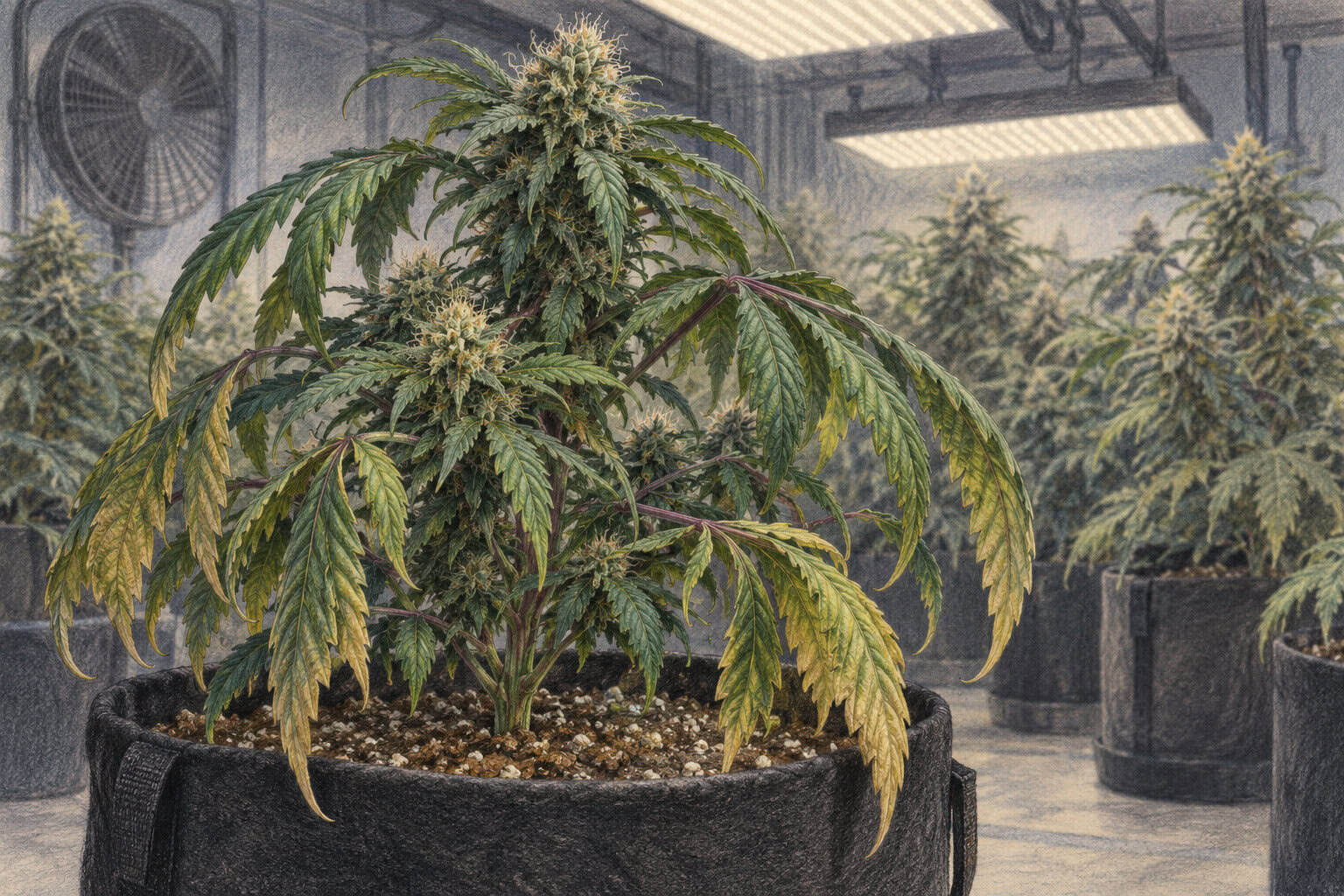
Every indoor grower has heard the theory. Stress the plant a little near harvest, the story goes, and it will “defend itself” by packing more cannabinoids into the flower. Some growers cut irrigation in the final weeks on that basis; others refuse to let the substrate dry out at all, reasoning that a thirsty plant is a smaller plant. Until recently there was little controlled data to settle the argument for CBD-dominant cannabis grown under lights, and the handful of published trials pointed in different directions.
A new study from the University of Hohenheim in Stuttgart, published on 3 September 2026 in Frontiers in Plant Science, tested the question directly. Danilo Crispim Massuela and colleagues grew two high-CBD genotypes indoors, imposed either a repeated moderate water deficit or a single severe drought at three different points in flowering, and measured everything from leaf water content to final CBD yield. The paper is open access under DOI 10.3389/fpls.2026.1930650. Its headline is in the title: less water, same buds. Moderate deficit irrigation cut water use without costing biomass or CBD, severe drought was consistently harmful, and neither regime made the plants produce more cannabinoids.
Key Takeaways
Moderate drought stress applied three times during flowering reduced water consumption in indoor cannabis without any statistically significant loss of inflorescence biomass, CBD concentration or CBD yield in either of the two genotypes tested. The plants under moderate deficit kept leaf water content and osmolality at control levels, meaning the main fan leaf never actually wilted. Severe drought, in which water was withheld until leaves drooped by more than 50 degrees, sharply reduced transpiration and photosynthesis, more than halved leaf area in the taller genotype when applied late, and offered no agronomic benefit at all. The dramatic rise in leaf-level water-use efficiency under severe stress was a survival reflex, not a productivity gain. The most consequential variable in the whole experiment was not irrigation but genotype: the vigorous Terra Italia produced roughly twice the flower biomass and around five times the CBD yield of the compact Kanada under every watering regime. The study covered two CBD-dominant genotypes over a single flowering cycle, so its conclusions should be read as a well-designed first answer rather than a general rule for all cannabis.
What moderate drought stress means for indoor cannabis yield in this trial
The experiment ran from March to June 2022 in a controlled cultivation room at Hohenheim’s Phytotechnikum greenhouse complex. Eighty-eight plants were grown from cuttings, 44 of each genotype, in 4.5-litre pots filled with a peat-based substrate and topped with gravel to limit evaporation. After 15 days of vegetative growth under 18 hours of light, the photoperiod was cut to 12 hours and the plants flowered for 64 days, with the final harvest at 79 days after planting.
The two genotypes were chosen for their contrasting build. Kanada, supplied by the Swiss breeder AiFame, is compact, matures early and builds most of its leaf area before flowering. Terra Italia, from Female Seeds in Amsterdam, is taller, more vigorous, later to mature and carries a much larger canopy. Both are chemotype III, meaning CBD-dominant with low THC, and both were cloned from a single mother plant per genotype to keep genetics as uniform as possible.
Irrigation was the variable. Control plants received 50 to 300 millilitres of water a day by drip, enough to keep the substrate between 60 and 80 percent of its container capacity, the horticultural equivalent of field capacity. In the moderate stress treatment, the drip line was removed and the substrate was allowed to dry until pots reached their drying plateau. The paper describes the target as 20 to 30 percent of container capacity and reports the observed plateau at around 40 percent, at which point plants received a small daily top-up of 50 to 150 millilitres, just enough to prevent visible wilting. This cycle was repeated at three flowering stages: early, at 46 days after planting when trichomes appear; mid, at 60 days when flowers begin to ripen; and late, at 79 days, the usual harvest point for these genotypes. Between cycles the moderate-stress plants went back to full watering.
Severe stress was different in two ways. Water was withheld entirely, with no top-up, until the largest fan leaf on the plant had drooped by more than 50 degrees relative to the stem, a wilting indicator borrowed from earlier Canadian work. And each plant experienced it only once, at one of the three stages. Every drought event, moderate or severe, lasted around 140 hours before pots were rewatered and plants harvested four hours later.
The plants noticed the drought
The first thing the authors needed to establish was that the stress was real, and here the data are unambiguous. Under severe drought, the relative water content of the fan leaf fell by 1.9 to 23.2 percent in Kanada and by 5.2 to 66.5 percent in Terra Italia compared with well-watered controls. Osmolality, a measure of how concentrated the dissolved solutes in the leaf sap have become, rose sharply in every severe treatment, which is the plant pulling water into its cells to hold turgor.
Under moderate stress, neither value differed significantly from control. That is the crucial mechanistic point. A plant on a small daily top-up was living in a drier pot, but its main leaves were not actually short of water in the tissue where it matters.
Gas exchange told the same story from the outside. Transpiration ran at 2.0 to 3.3 millimoles per square metre per second in well-watered plants and fell to nearly zero under severe drought, with moderate-stress plants scattered anywhere between 0.2 and 2.8. Photosynthesis dropped five- to ten-fold as the pot dried, and below roughly 30 percent of container capacity almost no photosynthesis or transpiration occurred at all. The stomata, the pores through which leaves take in carbon dioxide and lose water, had simply closed.
Why the water-use-efficiency number is a trap
Growers who follow this literature will have seen the claim that drought improves water-use efficiency, and in a narrow sense the Hohenheim data confirm it. Intrinsic water-use efficiency at the leaf level, calculated as photosynthesis divided by stomatal conductance, doubled or tripled in severely stressed plants once container capacity fell below 30 percent.
The authors are careful to explain why that figure should not be celebrated. When stomata close, water loss drops faster than carbon uptake does, so the ratio improves even as the absolute amount of carbon being fixed collapses. The plant is prioritising hydraulic safety over growth. It is more efficient in the way a car idling at a red light is more fuel-efficient than one on the motorway: it is using very little, but it is also not going anywhere. Moderate-stress plants showed no significant change in this ratio because their stomata never had to slam shut.
There is a second, quieter warning in this section of the paper. Individual plants responded very differently to the same water status, even though they were clones from the same mother. The authors point out that this heterogeneity is a problem for anyone producing under Good Manufacturing Practice, where the permitted variation in cannabinoid content within a batch is tightly limited. Deliberately applying drought would make batches less uniform, not more.
Two genotypes, two strategies for surviving thirst
Leaves were the organ that responded most to drought, and the two genotypes coped in opposite ways. Kanada, having built roughly 1,108 square centimetres of leaf area per plant by the end of vegetative growth, simply held onto it, maintaining 923 to 1,207 square centimetres through flowering with no significant reduction under any drought treatment. The authors read this as a conservative strategy: keep the machinery, reallocate resources.
Terra Italia did the opposite. Faced with severe stress late in flowering, it shed leaves. At the 79-day harvest, plants in the severe-late treatment carried 879.6 square centimetres of leaf area, less than half the 1,838.7 of the controls and significantly less than the 1,584.6 seen after severe stress at mid-flowering. Dropping big fan leaves reduces the surface through which water escapes, and the later the stress arrived, the more aggressively the plant abandoned canopy.
This is the kind of genotype-by-environment interaction that also shows up in our coverage of temperature and sex expression in cannabis plants, where the same stressor produces different outcomes depending on genetic background. It is a recurring lesson in cannabis agronomy: the plant’s response to a stress is not a property of the stress alone.
Flower biomass barely moved
Given that severe drought shut down photosynthesis and, in one genotype, stripped away half the leaves, the obvious expectation is a heavy yield penalty. It did not materialise.
For Terra Italia, final inflorescence dry matter at harvest was 13.3 grams per plant in the control, 12.3 under moderate stress and 12.9, 13.1 and 13.4 under severe stress applied early, mid and late. None of those differences was statistically significant. For Kanada the picture was more textured. Control plants produced 5.5 grams of dry flower, and so did those stressed severely at mid-flowering with 5.3 grams, but moderate stress and severe stress applied early or late produced 7.1, 7.2 and 7.4 grams, a difference the within-genotype comparison flagged as significant. The authors are explicit that this modest gain was specific to the compact genotype and not a consistent effect across the two, and the overall treatment effect on inflorescence biomass across the experiment was not significant.
Their explanation for why flowers were spared is one of the more interesting parts of the paper. All the physiological measurements were taken on the largest mature fan leaf. But during flowering, the small sugar leaves inside and around the inflorescence probably supply most of the carbon the bud actually uses, and those leaves did not wilt even in the severe treatments. The plant, in other words, appears to protect its reproductive tissue first, redirecting water and nutrients from the big leaves toward the flowers. The authors note that nobody has yet measured sugar-leaf physiology under drought, and they flag it as the priority for follow-up work.
No cannabinoid bonus
The eustress hypothesis, the idea that a mild stress triggers a protective surge in secondary metabolites, is the intellectual basis for deliberately drought-stressing cannabis. The Hohenheim data do not support it.
In Kanada, total CBD concentration in control flowers rose from 2.9 percent at the end of vegetative growth to a peak of 4.5 percent at mid-flowering and then fell back to 3.4 percent by harvest, a dilution effect as biomass kept growing. In Terra Italia it climbed from 3.4 percent to 9.3 percent by mid-flowering and stayed there. Under moderate stress the harvest concentrations were 3.9 percent for Kanada and 9.3 percent for Terra Italia, increases of 14.7 and 2.2 percent over control that the statistics did not distinguish from noise.
Because CBD yield is concentration multiplied by biomass, yield followed biomass. Kanada’s CBD yield at harvest was 187.4 milligrams per plant in the control against 273.5 under moderate stress, but Terra Italia’s was 1,243.6 milligrams in the control and 1,124.2 under moderate stress. The gap between genotypes, roughly fivefold, dwarfed anything irrigation did.
The authors offer a thoughtful reason why cannabis may not convert drought into a metabolic gain. A species only develops a reliable stress-to-metabolite pathway if that stress was a recurring selective pressure in its evolutionary history. What they observed, leaf shedding and fan-leaf deformation while young tissue stayed intact, looks like a plant built to survive drought rather than one wired to answer it with more trichome chemistry. They suggest that other elicitors, such as light spectrum, may be more promising, a line of evidence we have followed in the red and UV-A light hemp yield study, and that the interaction of deficit irrigation with light and vapour pressure deficit is the obvious next experiment.
How this fits the earlier literature
The Hohenheim results land in the middle of a small but contradictory body of work. The most-cited trial in the field, by Caplan, Dixon and Zheng in 2019, reported that a single severe drought late in flowering raised THCA and CBDA concentrations by 12 and 13 percent and inflorescence dry weight by 30 percent. That paper is the source of the grower folklore. A 2023 study by Duong and colleagues on two industrial hemp varieties found no effect of severe drought on CBD concentration but substantial losses in flower biomass. And in 2024, Morgan and co-authors reported that severe drought cut both yield and cannabinoid content in floral hemp while moderate deficit reduced irrigation demand without significant losses, the result the German team’s design was built to test more granularly.
The new paper strengthens the moderate-deficit side of that ledger and adds two things the earlier trials lacked: repeated stress cycles rather than a single event, and a link from substrate water status through leaf physiology to final yield within the same plants. It also sits alongside recent work from Padua, where Cappello Fusaro and colleagues found that water stress effects on cannabinoids in CBD-dominant cannabis are weak and heavily genotype-dependent, and a 2026 review by Khabbazi and co-authors in the same journal that maps the gaps in cannabis drought research.
Why water matters for indoor cultivation at all
Indoor cannabis has a resource problem that predates any argument about eustress. Energy use is the headline, quantified since Mills’ 2012 estimate of the carbon footprint of indoor production, but the authors note that the water footprint of controlled-environment cannabis remains essentially unmeasured in the literature because it varies so much with genotype and system. Every watt spent on dehumidification is, in effect, spent removing water that was put into the plant in the first place, and rooms full of transpiring plants run close to saturation, as the sensor logs from an Oklahoma cultivation facility air-quality study showed in detail.
Against that background, a watering regime that cuts consumption without touching yield is worth having even if it does nothing for potency. The paper does not put a litre figure on the saving, which is a limitation: the reduction comes from the days the drip was off and the smaller top-ups, and the authors call for a direct comparison between recurrent moderate stress and constant low-level deficit irrigation to find the most efficient schedule.
What the study cannot tell you
The authors list their limitations plainly. Two genotypes, both CBD-dominant, grown indoors over one flowering cycle. Physiology measured on mature fan leaves rather than the sugar leaves that may actually feed the flowers. No THC-dominant or balanced chemotypes, no terpene or flavonoid data, no multi-cycle test of whether plants acclimate to repeated stress. Air temperature in the room ranged from 18.2 to 39.0 degrees Celsius and humidity from 11.4 to 76.1 percent, which the authors describe as comparable to standard greenhouse conditions but which is wider than a tightly controlled commercial facility would tolerate. The work was funded by the German Federal Ministry for Economic Affairs and Energy through its innovation programme for small and medium enterprises, and the authors declare no commercial conflicts.
What survives those caveats is a practical, unglamorous conclusion. For an indoor CBD grower, the lever that moves yield is choosing the right genotype and harvesting when its cannabinoid curve peaks, which for Kanada was mid-flowering and for Terra Italia was later than the 79-day cut. That is also why investment in structured seed genetics keeps drawing capital. Irrigation is a lever for saving water, not for making more CBD, and the version of that lever worth pulling is the gentle one.
Frequently Asked Questions
Not in this study. Total CBD concentration at harvest was numerically higher under moderate stress, by 14.7 percent in Kanada and 2.2 percent in Terra Italia, but neither difference was statistically significant. CBD yield per plant tracked flower biomass, and biomass was unchanged in the vigorous genotype and only modestly higher in the compact one. The authors conclude that drought is not a reliable way to stimulate cannabinoid biosynthesis in CBD-dominant cannabis.
Moderate stress meant letting the pot dry to a low plateau and then giving 50 to 150 millilitres a day, enough to stop the leaves wilting, repeated at three flowering stages. Severe stress meant withholding water completely until the largest fan leaf drooped more than 50 degrees, applied once. Moderate-stress plants kept normal leaf water content and osmolality; severely stressed plants lost up to 66.5 percent of their relative water content and shut down photosynthesis.
The Hohenheim data say no. Severe late drought did not raise CBD concentration in either genotype, cut leaf area in Terra Italia to less than half of control, and produced no yield advantage over moderate stress. The large increase in leaf-level water-use efficiency under severe stress reflects closed stomata and suppressed carbon uptake, not productivity. The authors describe severe drought as consistently detrimental and recommend avoiding it.
It depends on the state and on what is being grown. Cannabis remains a federally controlled substance, and commercial cultivation is lawful only under a state licence where such programmes exist. Hemp containing no more than 0.3 percent delta-9 THC on a dry-weight basis may be grown under a USDA-approved state or tribal plan. Some licensing states attach environmental conditions to cultivation permits, including requirements on water sourcing and use; California, for example, requires cannabis cultivators to document their water source as part of licensing. Anyone considering cultivation should confirm the current rules in their own state before planting.
Legal Disclaimer
This article reports on published agronomic research for informational and educational purposes only. It does not constitute agronomic, legal or medical advice, and nothing in it should be read as a recommendation to cultivate, purchase or use cannabis or any cannabis-derived product. The cultivation of cannabis, including CBD-dominant varieties, is subject to licensing and is prohibited in many jurisdictions; laws differ substantially between countries and, within the United States, between federal and state law. Readers are responsible for determining the legal status of cannabis and hemp cultivation where they live before taking any action. The findings described here come from a single indoor trial of two genotypes over one flowering cycle and should not be generalised to other varieties, chemotypes or growing systems without further evidence.