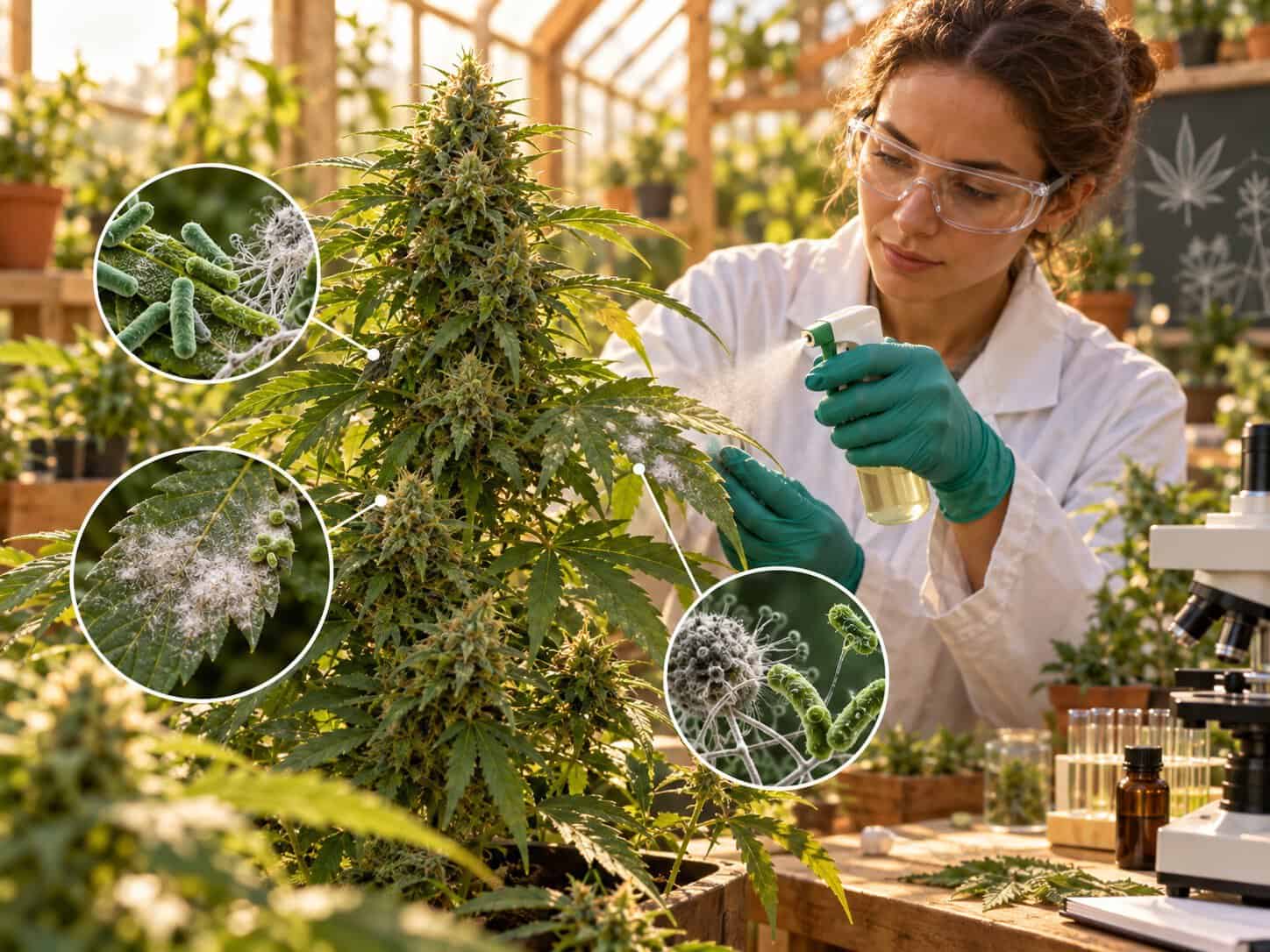
Ask any commercial grower what keeps them awake and the answer is rarely the plants they can see. It is the ones they cannot — the roots browning quietly in a coco block, the first grey fuzz deep inside a dense cola three days before harvest. Fungi and oomycetes do more damage to cannabis than any other biological threat, and the usual answer in other crops, a fungicide spray, sits awkwardly in a plant that gets smoked, vaporised or extracted. Residue testing is unforgiving, registered products are scarce, and repeated chemical treatments push pathogens toward resistance. That is why so much attention has moved to bacteria and fungi that fight other fungi.
A new narrative review published on 9 September 2026 in the International Journal of Molecular Sciences takes stock of where that field actually stands. Written by Tiziana M. Sirangelo of ENEA, Italy’s National Agency for New Technologies, the paper gathers the cannabis-specific literature on microbial biological control agents — BCAs, in the jargon — and proposes a structured, omics-guided framework for finding and validating better ones. The full paper is open access: “Towards an Omics-Guided Framework for Microbial Biological Control of Fungal and Oomycete Diseases in Cannabis sativa“. The searches behind it were run in Scopus and PubMed and completed on 26 August 2026.
Key Takeaways
Microbial biological control works in cannabis, but only in narrow, well-defined circumstances that have rarely been reproduced. A handful of Bacillus, Pseudomonas and Trichoderma strains and several commercial products have measurably reduced root rot, powdery mildew and grey mould in controlled trials, and in one case the exact molecules responsible were pinned down. Beyond that, the evidence thins fast: most studies used one pathogen isolate, one cannabis genotype and one growing environment, so nobody can say whether a strain that protects one cultivar in a growth chamber will protect a different cultivar in a commercial room. The review argues that genomics, microbiome profiling and metabolomics can close that gap by making strain selection traceable rather than lucky — while being unusually blunt that omics data on their own prove nothing without functional experiments. It also raises a problem the industry tends to skip: a microbe good enough to survive on flowering buds until harvest may itself push the finished product past its microbial limits.
Why biological control of cannabis fungal diseases is harder to prove than it looks
Biological control sounds simple. Introduce a friendly microbe, let it outcompete or attack the pathogen, harvest a clean crop. In practice, whether it works depends on at least four moving parts interacting at once: which cannabis genotype you grow, which pathogen isolate arrives, which microbes already live in the substrate and on the leaves, and what the environment is doing that week.
Change any one of them and the result can flip. That is the central argument of the review, and it explains why a field with plenty of encouraging papers still has almost no strain a grower can rely on. Efficacy is not a fixed property of a bacterium, the way potency is a property of a chemical. It is something that emerges from a relationship — and relationships are context-dependent.
The regulatory squeeze makes the stakes higher. Few conventional fungicides are registered for cannabis anywhere, residues are tested aggressively, and enforcement actions over contaminated product are routine — as when unsafe pesticide levels were found in Maine’s medical cannabis supply. Growers are being pushed toward biological tools by policy as much as by preference.
The four problems that do most of the damage
The review organises cannabis pathogens into groups that behave very differently, which matters because a microbe that fights one may be useless against another.
Fusarium species attack roots, crowns and vascular tissue, causing damping-off in propagation, wilt in vegetative growth, and in some cases bud rot in flower. The main culprits are the F. oxysporum and F. solani species complexes, with F. proliferatum linked to crown and stem rot and pith necrosis. Some cannabis-derived Fusarium species can produce mycotoxins, which turns a yield problem into a product-safety problem.
Pythium species — P. myriotylum, P. dissotocum, P. aphanidermatum — are oomycetes, not true fungi, and they thrive where roots sit wet. Hydroponic and greenhouse systems are their natural home. If you are running the same substrate across cycles, the accumulated soil biology matters: our piece on whether cannabis soil can be reused covers what builds up in the root zone over time.
Powdery mildew, mostly caused by Golovinomyces ambrosiae, is an obligate biotroph. It cannot survive without living plant tissue, which means it feeds through structures called haustoria pushed into living leaf cells. That single fact has a large practical consequence: you cannot screen candidate microbes against it in a Petri dish, because the pathogen will not grow there without a host.
Botrytis cinerea, grey mould or bud rot, is the opposite — a necrotroph that kills tissue and eats the remains. It does its worst during flowering, when compact inflorescences create a pocket of trapped humidity that is close to ideal for spore germination. Canopy structure is part of the disease equation, which is why planting decisions matter: research on cannabis planting density and yield has direct implications for how much still, humid air sits inside your canopy. Room-level conditions matter just as much, and the Oklahoma grow-room air quality study showed how much temperature and humidity can swing inside a working facility.
Beyond these four sit Rhizoctonia solani, Sclerotinia species, Sclerotium rolfsii and Neofusicoccum parvum, all less studied and none with a validated biological answer.
How a helpful microbe actually fights a harmful one
The review splits the mechanisms into two families, and the distinction is not academic.
The first is direct antagonism. The beneficial microbe physically occupies the space and eats the food the pathogen needs, produces antifungal compounds, or attacks the pathogen outright. Bacillus strains are associated with lipopeptides — surfactins, iturins, fengycins — that disrupt fungal membranes. Pseudomonas strains make phenazines, pyrrolnitrin, pyoluteorin and 2,4-diacetylphloroglucinol. Fungal agents such as Trichoderma go further and parasitise their targets, coiling around fungal threads and dissolving them with chitinases and glucanases.
Cannabis has one genuinely clean demonstration of this. Working with Pseudomonas protegens Pf-5, researchers deleted the genes required for pyoluteorin and for 2,4-diacetylphloroglucinol, then restored them, and measured what happened to grey mould on cannabis leaves. Both compounds turned out to be major contributors to the protection Pf-5 provides against Botrytis cinerea. That is not correlation; it is causation, established by removing the suspected cause and watching protection weaken.
The second family is host-mediated protection. Here the microbe never touches the pathogen. It is applied to the roots, the plant’s immune system registers it, and defences elsewhere in the plant become faster or stronger when an attack later arrives — a state called priming. It is an attractive idea, and cannabis evidence for it is honestly reported as weak. When Pseudomonas and Bacillus strains were applied to cannabis roots and the leaves were later challenged with B. cinerea, neither systemic disease reduction nor enhanced defence-gene expression was reproducibly detected. The study’s lasting contribution was a set of five defence markers — ERF1, HEL, PAL, PR1 and PR2 — that were strongly and persistently switched on locally at infection sites, giving later researchers something concrete to measure.
What has actually worked in cannabis
Stripped of hype, the record summarised in the review looks like this.
Against Fusarium oxysporum damping-off and Pythium myriotylum root and crown rot, several commercial microbial products significantly reduced disease when applied before the pathogen arrived: Lalstop, RootShield, Asperello and Stargus all cut F. oxysporum severity, and RootShield and Lalstop performed best overall against P. myriotylum.
Against powdery mildew, repeated foliar sprays of Rhapsody ASO (Bacillus subtilis QST 713) and Stargus (B. amyloliquefaciens F727) consistently reduced disease on a susceptible cultivar, while Actinovate, based on Streptomyces lydicus WYEC 108, gave smaller and more variable results. The same work found large differences in disease severity between cannabis genotypes, which is a reminder that genetics may be doing more work than the spray.
Against grey mould, several Bacillus and Pseudomonas strains inhibited the pathogen in vitro and reduced lesion severity on cannabis leaves. Trichoderma asperellum applied to detached inflorescences 48 hours before inoculation also reduced bud rot development — with a catch discussed below.
Notice what all of this has in common: growth chambers, greenhouses, detached tissue, a single pathogen isolate. Almost none of it is open-field or full-cycle commercial data.
The three bottlenecks the review identifies
First, reproducibility. Efficacy varies with strain, pathogen, genotype, application method and environment, and has rarely been tested across more than one of each. A single-isolate test tells you almost nothing about breadth. Work in other crops has shown just how large this effect can be: in a matrix of 98 Botrytis cinerea strains tested against 90 plant genotypes across eight host species, the strain-by-host interaction alone accounted for roughly 16% of the variation in lesion size.
Second, mechanism. Only two cannabis studies have gone beyond association to test a mechanism directly. For everything else, we know something helped without knowing why — which makes it impossible to predict when it will stop helping.
Third, application fitness. Disease control is necessary but not sufficient. The product still has to pass its cannabinoid specification and its microbiological limits.
What omics adds — and what it does not
The framework proposed in the review runs in stages: characterise the host genetics, profile the microbiome of healthy versus diseased plants, use those patterns to guide which microbes to try to culture, sequence the isolates you recover, screen them for virulence and toxin genes before they ever touch a plant, sequence the pathogens to build a representative challenge panel, then test in planta across contrasting genotypes and isolates.
The enabling resources exist. A cannabis pangenome now spans 181 newly assembled plus 12 previously published genomes across 144 biological samples. The first genome of Golovinomyces ambrosiae runs to 155.2 Mb with 6,995 high-confidence gene models and 169 predicted candidate effectors. Genome analysis of three Bacillus strains used in cannabis work revealed 18 biosynthetic gene clusters of potential biocontrol interest.
The review is careful about what this buys you. Detecting a gene cluster shows genetic capacity, not activity. The absence of a known virulence gene is not evidence of safety. And there is currently no cannabis evidence that omics-guided workflows are faster, cheaper, or better than conventional screening — only that they make the reasoning traceable. Omics is framed as an addition to plant pathology, not a replacement for it.
The trade-off nobody advertises
Here is the part that should give commercial producers pause. A biocontrol agent sprayed on flowers has to survive on flowers to keep working. Persistence is the feature. But viable cells and spores that persist until harvest end up in the finished product.
That is not hypothetical. When Trichoderma asperellum reduced bud rot on detached cannabis inflorescences, prolific growth and sporulation of the antagonist itself were observed on the treated bud tissue. Meanwhile, the European Pharmacopoeia criteria for non-sterile preparations for inhalation set a Total Aerobic Microbial Count of 10² CFU/g and a Total Yeast and Mould Count of 10¹ CFU/g — maximum acceptable counts of 200 and 20 CFU/g respectively.
Crop chemistry is exposed too. Microbial inoculants have been shown to shift concentrations of CBDVA, CBDV, CBG, CBD and CBGA across five cannabis cultivars, with the direction of the effect depending on cultivar. For a standardised product, an unplanned change in the cannabinoid profile is a compliance failure regardless of how healthy the plants look. The review’s recommendation is unusually firm: harvest-stage microbial load and cannabinoid profile should be treated as stop criteria, evaluated from the first in planta trial, not as a quality check at the end. The same logic already applies to other contaminants — see our coverage of heavy metals turning up in healthy-looking buds.
How much weight this paper can carry
This is a narrative review by a single author, not a systematic review or meta-analysis. No new experimental data were generated. Studies were selected from two databases with cannabis-specific work prioritised, and the author is explicit that the proposed pipeline is a prospective roadmap: the complete sequence has never been run end to end in cannabis. The synthetic microbial communities discussed in the final stages are extrapolated from other crops — no disease-suppressive consortium has been validated for any of the cannabis pathosystems covered.
Read it as a map of what is missing rather than a set of instructions. On that basis it is a useful document: it names the gaps precisely enough that someone could go and fill them.
Frequently Asked Questions
Not consistently, on current evidence. Several microbial products have significantly reduced disease severity in controlled trials, but reductions are typically partial rather than complete, and they depend on preventive application before the pathogen establishes. They are best understood as one component of integrated management alongside sanitation, clean propagation material, humidity control and airflow — not as a drop-in replacement.
Pesticide products are registered federally by the EPA, but because cannabis remains a federally controlled substance, the EPA has not established federal tolerances or cannabis-specific labels for it. In practice, states with legal markets publish their own lists of allowed products, typically built around minimum-risk and exempt active ingredients, which include many Bacillus and Trichoderma strains. Hemp is treated differently: since 2019 a defined set of pesticide products has carried hemp on the label. Rules differ by state and change often, so the state regulator’s current allowed-product list is the only reliable reference.
Growth promotion and disease suppression are separate outcomes. A product that improves root development or biomass may do nothing against a pathogen, and the review treats plant growth promotion as a complementary benefit rather than a proxy for biocontrol. Products with documented disease-suppression trials against your specific pathogen are a different proposition from generic microbial supplements.
For some pathogens they can, as a first filter. But in vitro inhibition frequently fails to predict what happens on a plant, where the microbe must also colonise tissue, persist, compete with resident organisms and function under real humidity and temperature. Powdery mildew cannot be tested this way at all, because it only grows on living tissue. The review is direct that candidates should advance on reproducible disease suppression in host-based assays, not on plate results.
Legal Disclaimer
This article is provided for informational and educational purposes only and does not constitute agricultural, legal, medical or regulatory advice. Cannabis cultivation and the use of crop-protection products, including microbial biological control agents, are governed by national, state and local law and vary substantially between jurisdictions. Nothing here should be read as an endorsement of any product, or as guidance to cultivate cannabis where doing so is unlawful. Product registration status, permitted active ingredients and microbiological and residue limits change frequently; growers and licence holders should consult their competent regulatory authority and current published requirements before applying any product. The studies described are research findings, not product recommendations, and reported results were obtained under experimental conditions that may not reflect commercial production.