
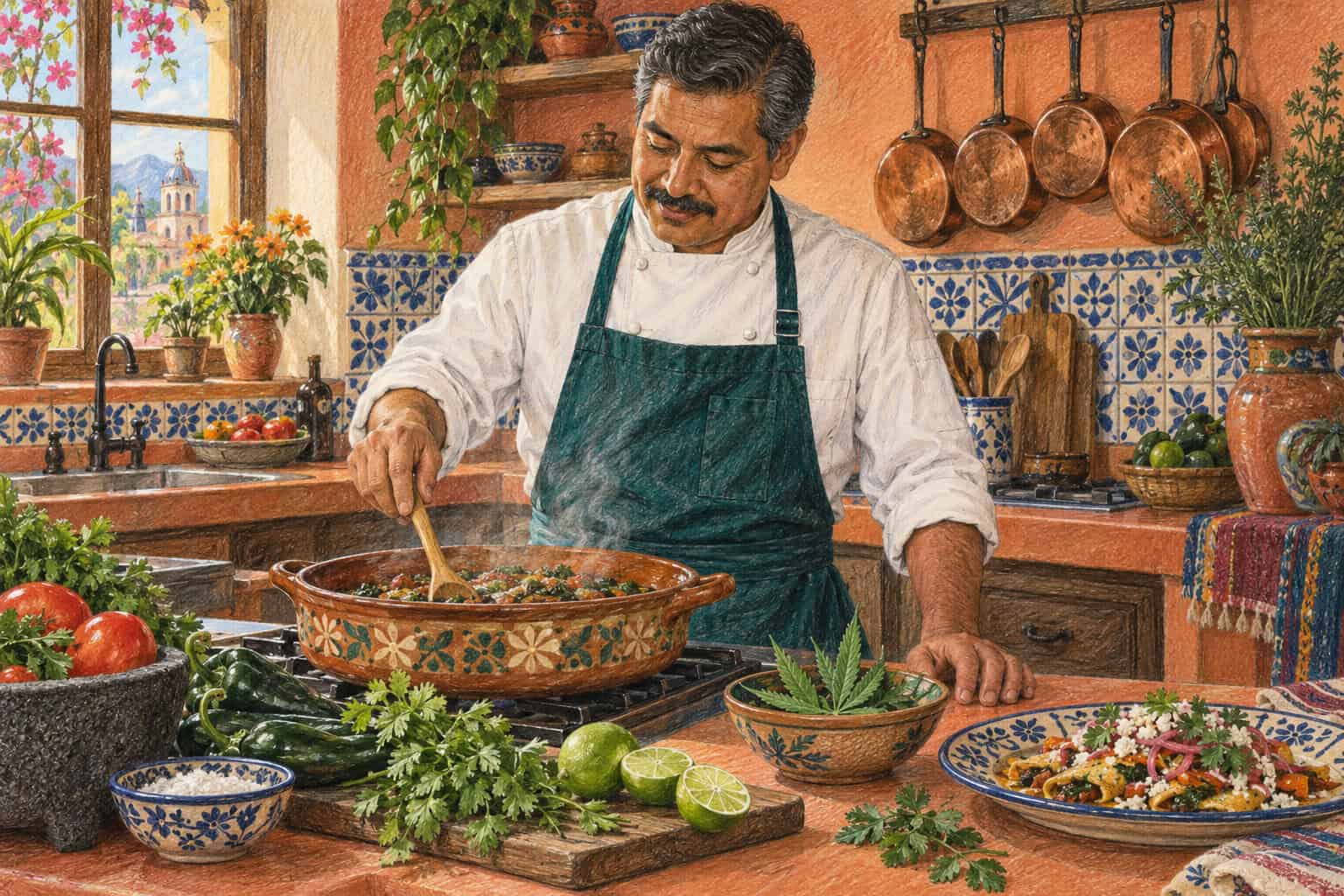
Imagine holding a government permit that lets you grow, possess and smoke cannabis at home, but forbids you from stirring the same plant into a pot of soup. That was the situation for at least one Mexican permit holder until 10 September 2026, when Mexico’s Supreme Court decided that the line made no sense. Preparing food with cannabis for your own use, the justices concluded, is ordinary cooking, not the manufacture of a regulated health product.
The decision resolved a case known as recurso de inconformidad 13/2025 and is summarised in the official press release of the Suprema Corte de Justicia de la Nación. It reached a European audience through an analysis by the German outlet Hanf Magazin. This article looks at what the ruling actually changes, what it does not touch, and why a court-made cannabis policy produces a strange contrast with the tightly dosed edibles markets of the United States and Canada.
Key Takeaways
Mexico’s Supreme Court ruled seven votes to two that a personal-use cannabis permit issued by the federal health regulator, Cofepris, may include preparing cannabis in prepared and semi-prepared food, as long as the food is eaten only by the permit holder. The ruling creates no market: selling, giving away or serving cannabis food to anyone else remains prohibited. The court left in place Cofepris’s ban on using cannabis in medicines, herbal remedies, dietary supplements, cosmetics, medical devices and vapes. Strictly, the order applies to one applicant, though it sets the interpretation for future permits. Mexico now has a system in which homemade edibles can be lawful for a permit holder while no commercially dosed edible can be sold, which is the reverse of the model used in US states and Canada. The health evidence on edibles points to a specific risk: effects start 30 to 90 minutes after eating, and a Colorado study found edibles accounted for far more emergency visits than their share of sales would predict.
What Mexico’s Supreme Court decided about cooking with cannabis for self-consumption
The case began with an ordinary administrative request. On 24 May 2024, an individual asked Cofepris for authorisation to carry out the activities needed for personal, recreational use of cannabis and THC. According to a timeline reported by Eureka Medios, the regulator did not respond, so the applicant filed a non-compliance complaint (denuncia por incumplimiento 2/2024), arguing that Cofepris was ignoring an earlier Supreme Court ruling.
A district court ordered Cofepris to issue the permit. Cofepris did, but attached a long list of exclusions. The holder could not prepare cannabis in food, medicines, herbal remedies, medical devices, supplements, cosmetics or vaping products. On 4 July 2025 the district court declared its judgment fulfilled. The applicant disagreed, arguing that the food ban was a restriction the Supreme Court had never authorised, and filed the appeal that became case 13/2025.
The full court, sitting as the Pleno, sided with the applicant on food and with Cofepris on everything else. It revoked the order declaring the judgment fulfilled and told Cofepris to issue a new authorisation that allows cannabis to be prepared in food intended solely for the holder. Ministers Yasmín Esquivel Mossa and María Estela Ríos voted against, according to Canal 44.
Where the court drew the line between a kitchen and a factory
The reasoning rests on a distinction most people apply without thinking. Baking a cake for yourself requires no licence. Baking cakes to sell to strangers does, because buyers rely on the seller to get the ingredients and the hygiene right. The court applied the same logic to cannabis.
Food made at home for your own plate falls on the kitchen side. Medicines, herbal remedies, supplements, cosmetics, medical devices and vaping devices fall on the factory side, because in Mexico each of those categories is subject to its own sanitary regime, and the court considered it reasonable for Cofepris to keep them off limits.
The general conditions attached to recreational permits also remain. Permit holders may not consume in front of minors, may not affect third parties and may not drive or operate dangerous machinery under the influence. Most importantly, the ruling does not authorise selling, distributing or supplying cannabis food to anyone else. A legally baked brownie becomes an unlawful one the moment it is handed to a friend.
Why Mexico’s cannabis policy is written by judges
Readers in the United States are used to cannabis reform arriving through ballot measures and state legislatures. Mexico took a different route: almost every step has come from the Supreme Court.
The decisive moment was 28 June 2021, when the court approved General Declaration of Unconstitutionality 1/2018. With eight votes, it struck down the parts of articles 235, 237, 245, 247 and 248 of the General Health Law that absolutely barred the health ministry from authorising recreational use. The court held that a total ban was an unnecessary and disproportionate restriction on the constitutional right to the free development of one’s personality.
The practical result was an individual permit system. Anyone who wants to sow, cultivate, harvest, prepare, possess or transport cannabis for personal use needs a Cofepris authorisation. Congress was expected to write a comprehensive law, but no regulated market exists. So every detail of what a permit covers ends up being argued in court.
The cooking decision is part of a pattern. In June 2026 the court heard a complaint from nine people who had received a single collective permit instead of individual ones and said it made proving lawful possession harder. That time, as El CEO reported, the justices sided with Cofepris by eight votes. Taken together, the two rulings suggest a court willing to widen what a permit allows when a restriction has no health rationale, but unwilling to police every administrative choice the regulator makes. This mirrors a trend visible elsewhere, where courts rather than lawmakers are defining the everyday edges of cannabis law, as in the New York marijuana odor search case now before the state’s Court of Appeals.
The North American paradox: legal homemade food, no legal dosed products
Here is where Mexico’s model looks unusual from north of the border. In Canada and in US adult-use states, regulators allow edibles to be sold but put hard limits on how much THC they contain.
When Canada legalised edibles, the Health Canada rules on new cannabis products capped THC at 10 mg per package, required child-resistant plain packaging and banned producing food and cannabis in the same facility. At the time, as a technical summary by the testing company Intertek noted, states such as Colorado and California instead set 10 mg of THC as a serving size, with a maximum of 100 mg per package. Both approaches share one idea: if people are going to eat cannabis, the dose should be known and limited.
Mexico now has the opposite arrangement. No commercial edible, dosed or otherwise, can be sold. But a permit holder may cook with cannabis at home, where the THC content of each portion depends on the plant, the recipe and the cook’s arithmetic. Even labelled products are not always accurate: a Massachusetts audit found 13 of 63 products failed potency checks. Home preparation has no label at all, and heat itself changes cannabinoid content in ways that are hard to predict, as a study on how baking affects cannabinoids in hemp bread showed.
None of this means the court was wrong. It ruled on rights, not on product safety, and it was not asked to design a market. But it does mean that dosing responsibility in Mexico sits entirely with the individual.
What the science says about eating cannabis
Eating cannabis works differently in the body from smoking it. When THC is inhaled, it passes through the lungs into the blood and reaches the brain within minutes. When it is swallowed, it travels through the stomach and liver first, and the liver converts part of it before it reaches the brain.
A widely cited review of cannabinoid pharmacokinetics, published by Franjo Grotenhermen in Clinical Pharmacokinetics, sets out the timing: after oral intake, psychoactive effects begin after a delay of 30 to 90 minutes, peak at two to three hours, and can last four to twelve hours depending on dose. Think of it like a slow kettle. If you do not know it takes time, you keep turning up the heat, and in cannabis terms that means eating a second portion before the first has taken effect.
That delay shows up in hospital data. An observational study in Annals of Internal Medicine reviewed 9,973 emergency department visits at a large academic hospital in Colorado between 2012 and 2016. Of these, 2,567 (25.7%) were at least partly attributable to cannabis, and 238 of those (9.3%) involved edibles. Between 2014 and 2016, edibles accounted for 10.7% of cannabis-attributable visits, while representing only 0.32% of the state’s cannabis sales measured in kilograms of THC. Edible-related visits were more often for acute psychiatric symptoms (18.0% vs 10.9%), intoxication (48% vs 28%) and cardiovascular symptoms (8.0% vs 3.1%).
The authors are clear about the study’s limits: it was retrospective, based at a single centre, relied on self-reported exposure and had little dose information. It does not prove edibles are inherently more toxic than smoked cannabis. It shows that, in real-world use, they produce more acute problems than their market share would suggest, and difficulty judging the dose is the leading explanation. US survey data suggest edibles are a growing part of how people consume, as our coverage of changing consumption patterns from brownies to vapes shows, and researchers are still looking for objective ways to measure edible intake, such as the first breath test for THC after edibles.
What changes in practice, and what does not
The immediate effect is narrow. Cofepris must issue a new authorisation to one applicant. Because the ruling clarifies what the verb “prepare” means within the 2021 Declaration, it will shape how future permits are read, but how quickly Cofepris adjusts its standard wording will only become clear from the next permits it issues.
For anyone without a permit, nothing changes. Cannabis activities outside a Cofepris authorisation remain governed by the General Health Law and the Federal Penal Code. Nothing in the ruling allows restaurants, bakeries or shops to offer cannabis products, and nothing creates a legal supply chain from which a permit holder could buy cannabis.
The broader principle may travel further than the case itself. If a state recognises a right to consume a substance in private, it becomes hard to justify banning a method of consumption that involves no smoke and no third parties. That argument says nothing about whether cannabis is safe. It is an argument about where personal choice ends and the state’s duty to regulate products begins.
Frequently Asked Questions
Not in the sense of a regulated market. Since 2021, adults can obtain an individual personal-use permit from Cofepris, and the Supreme Court has gradually defined what that permit covers. There is still no legal retail sale of recreational cannabis in Mexico.
No. The ruling only expands what an individual Cofepris permit allows; it does not create a general right for visitors, and a US state medical card or adult-use status has no legal effect in Mexico. Separately, carrying cannabis across an international border remains illegal under US federal law, regardless of the laws of the state where a person lives or of any Mexican permit.
The main reason is the delayed onset. Oral THC typically takes 30 to 90 minutes to be felt and peaks after two to three hours, so people may eat more before the first dose takes effect. A Colorado hospital study found edibles made up 10.7% of cannabis-attributable emergency visits while accounting for 0.32% of sales, though the study had important limitations.
No. The court upheld Cofepris’s restrictions on medicines, herbal remedies, dietary supplements, cosmetics, medical devices and vaping devices. Only prepared and semi-prepared food made for the permit holder’s own consumption was added to what the permit may cover.
Legal Disclaimer
This article is for informational and journalistic purposes only. It describes a court decision and the state of scientific research and does not constitute legal or medical advice. It does not encourage or recommend the purchase, cultivation, preparation or use of cannabis or cannabis products. Cannabis laws differ between countries and states and can change, and the effect of a court ruling depends on the facts of the specific case. For questions about your legal situation, consult a qualified lawyer licensed in your jurisdiction. For health questions, consult a licensed healthcare professional.


