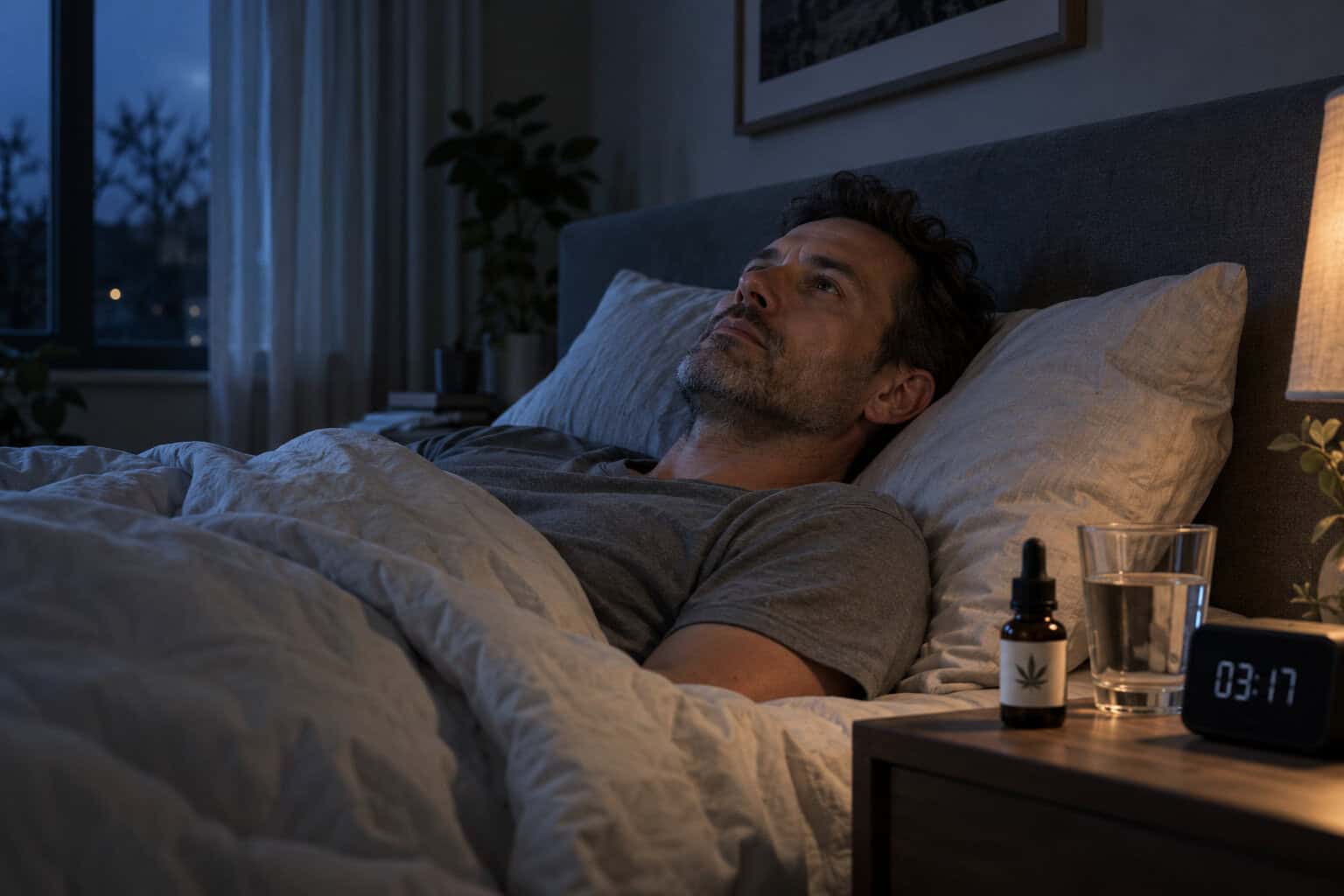
For years, trouble sleeping has been one of the most common reasons people give for using cannabis. Ask around in any country with a medical cannabis programme and insomnia will be near the top of the list, alongside pain and anxiety. The appeal is easy to understand: conventional sleeping pills come with grogginess, memory problems and a real risk of dependence, and the treatment that works best — cognitive behavioural therapy for insomnia — is often unavailable, expensive or has a waiting list measured in months. Into that gap stepped cannabis, carried by millions of personal testimonies and very little else.
Now the most demanding evidence reviewers in medicine have looked at the question and come back with an uncomfortable answer. The Cochrane review of medical cannabis for insomnia, published on 13 October 2026 in the Cochrane Database of Systematic Reviews, found that the research that exists is too thin and too inconsistent to say whether cannabis helps people sleep. The team was led by Lucia B. Varela and Luis I. Garegnani at the Cochrane Associate Centre of the Hospital Italiano de Buenos Aires, working with colleagues at the University of Manitoba, and it builds on a protocol registered in April 2025 that set out in advance what the authors would look for — a detail that matters, because it stops a research team from quietly changing the question once the results come in.
Key Takeaways
The review pulled together nine randomised trials involving 537 adults between the ages of 18 and 76, and concluded that medical cannabis may have little to no clinically meaningful effect on sleep quality, total sleep time or how people function during the day. It may improve quality of life, but the certainty behind that finding is very low. It probably causes slightly more unwanted effects than placebo, mostly mild ones such as dry mouth and dizziness. Crucially, none of this means cannabis does not work for insomnia — it means the trials conducted so far are too small, too short and too varied in design to answer the question either way, and the authors are explicit that their conclusions describe the state of the evidence rather than the state of the drug. The longest trial followed participants for just twelve weeks, so nothing at all is known from this body of work about taking cannabis for sleep over months or years.
What Was Actually Tested
The nine included trials did not test “cannabis” as a single thing. They tested a scattered collection of pharmaceutical-grade products that happen to share a plant of origin. Some used tetrahydrocannabinol (THC) on its own, some used cannabidiol (CBD) on its own, and some used combinations of the two in various ratios. The formats were oils, capsules and a gel.
That list is worth pausing on, because of what is absent from it. Nobody in these trials smoked anything. Nobody vaped flower bought from a shop. There were no edibles in the consumer sense, no gummies, no high-THC concentrates. Every product was a regulated medical preparation given at a measured dose under clinical supervision. Whatever the review says, it says about that narrow category — and it says nothing about the dried flower that most people actually use when they reach for cannabis at bedtime.
This is also why the review cannot hand anyone a dose. Readers hoping for a number — so many milligrams of THC, such-and-such a CBD ratio, taken this long before bed — will not find one, and the honest reason is that the trials were too heterogeneous to pool into a meaningful dosing signal. Different cannabinoids, different ratios, different delivery routes and different measurement scales across nine small studies produce a set of results that cannot be stacked on top of each other. The review team flagged exactly this: the variety of products used made the studies hard to compare, and that variation is one of the reasons confidence in the pooled findings is low.
The Numbers Behind the Verdict
The comparison structure was straightforward. Eight of the nine trials put medical cannabis against a placebo. One compared it with amitriptyline, an older antidepressant that is widely prescribed off-label at low doses for sleep.
On the outcome most people care about — sleep quality and satisfaction with sleep — seven studies covering 374 participants found that cannabis may make little to no difference compared with placebo. On total sleep time, six studies covering 194 participants pointed the same way. On daytime functioning, the tiredness and fogginess and irritability that make insomnia a problem rather than a curiosity, five studies covering 144 participants again found little to no meaningful effect.
The one outcome that moved was quality of life, where three studies with 95 participants between them suggested an improvement. But the review graded the certainty of that finding as very low, which in Cochrane’s vocabulary means the true effect could plausibly be quite different from what was measured. A positive signal resting on 95 people across three small trials is a hypothesis, not a result.
Note how the participant counts shrink as you move down that list. Seven studies, then six, then five, then three. Not every trial measured every outcome, which is itself part of the problem: when nine research teams each pick their own endpoints and their own scales, the evidence base fragments into pieces too small to carry weight.
Side Effects and the Odd Arithmetic
Three studies with 98 participants reported on unwanted effects, and here the review found cannabis may cause slightly more of them than placebo — with low certainty attached.
The raw figures reported in the Cochrane summary are worth setting out plainly, because they are not a simple two-column comparison. Thirty-seven people experienced unwanted effects while taking medical cannabis. None experienced them while taking placebo. Fourteen people had unwanted effects during both the cannabis phase and the placebo phase, and forty-seven had none during either. That pattern — people appearing in more than one condition — reflects crossover designs, where the same participant takes both the active product and the dummy at different points in the trial. It is a sensible way to run a small study, and it also explains why the arithmetic does not look like a tidy head-to-head tally.
The effects themselves were the familiar ones: dry mouth, dizziness, memory lapses, increased appetite, tiredness, and in some people anxiety. Cochrane’s background material notes these can affect up to 80% of people using medical cannabis across conditions generally. They are rarely dangerous. They are also not nothing, particularly for an older adult who gets up in the night.
Why the Certainty Is So Low
Cochrane does not simply count studies and declare a winner. Every finding carries a certainty rating, and in this review the ratings were low to very low across the board. Four things dragged them down.
Size. Most of the trials enrolled fewer than fifty people. A study that small can miss a real effect entirely, or produce an impressive-looking one by chance.
Duration. Most lasted a few weeks. The longest ran twelve. Insomnia is frequently a chronic condition, and tolerance to the sedating effects of THC is well documented, so a three-month ceiling leaves the central practical question — does it still work in a year? — completely untouched.
Inconsistency. Different products, different doses, different sleep measurement instruments. Some trials used subjective questionnaires, others more objective measures, and the mixture makes pooling unreliable.
Applicability. Many trials excluded older adults and people with other health conditions. That is close to excluding the people most likely to have insomnia in the first place — insomnia is most common in older adults and in women, and frequently travels alongside chronic pain, depression or anxiety. Positively, the included trials did enrol more women than men, which is unusual and welcome in a field that has historically skewed male.
The evidence was current to 5 April 2025, drawn from CENTRAL, MEDLINE, Embase, Global Index Medicus and two clinical trial registers, with reference checking and author contact on top. The review had no dedicated funding, meaning no commercial sponsor had a stake in the answer.
Senior author Luis Garegnani summed it up for the Cochrane press announcement: “The evidence is too weak and uncertain to draw firm conclusions.” His co-authors made the same point in the other direction — this does not establish that cannabis is ineffective for insomnia, only that the research cannot currently tell us.
What This Means If You Are Not a Researcher
There is a trap in reading a review like this, and it has two sides.
One side is treating “insufficient evidence” as a debunking. It is not. Thousands of people report that cannabis helps them sleep, and nothing in this review contradicts their experience. Absence of proof genuinely is not proof of absence, and small trials are especially prone to missing modest real benefits.
The other side is treating “insufficient evidence” as a technicality that can be waved away because the plural of anecdote feels persuasive. Sedation is not the same as restorative sleep. A substance can reliably make you feel drowsy, shorten the time it takes to drop off, and still leave sleep architecture — the cycling through deeper and REM stages that does the actual biological work — worse rather than better. That gap between felt effect and measured benefit is precisely what controlled trials exist to detect, and it is exactly where the current evidence is silent.
The practical upshot is that cannabis for insomnia remains an open question rather than an answered one, and anyone choosing it is making a decision under uncertainty rather than following evidence. The review’s own recommendation is aimed at researchers: run adequately powered trials, follow people for longer, standardise the outcomes so results can be compared, report harms in detail, and recruit populations that actually resemble the people with insomnia — including older adults, people with coexisting conditions, and reporting broken down by sex and age.
Comparable gaps show up elsewhere in cannabis medicine. A recent review of cannabinoids for rheumatoid arthritis pain screened 593 records and found just a single randomised trial. Research into a cannabinoid extract for endometriosis pain rests on a pilot study of 27 women. A retrospective study of cannabidiol in adults with epilepsy covered 37 patients. The pattern is consistent: enormous public interest, decades of use, and a clinical evidence base still being assembled study by small study. Our science-based guide to CBD covers where the cannabinoid research stands more broadly, and testing of CBD oils sold across Europe found that around half of 186 bottles did not match their labels — a reminder that product content is its own source of uncertainty outside the controlled conditions of a trial.
Frequently Asked Questions
No. It says the available studies are too small, too short and too inconsistent to determine whether it works. The authors specifically distinguish between evidence of no effect and absence of reliable evidence, and this review is the second of those.
Pharmaceutical-grade preparations containing THC, CBD or combinations of both, administered as oils, capsules or a gel. No trial tested smoked or vaporised cannabis flower, so the findings do not extend to the products most consumers use.
Cannabis remains a Schedule I controlled substance under federal law, and no cannabis product has been approved by the Food and Drug Administration for insomnia or any other sleep disorder. The FDA-approved cannabis-derived medicines cover different indications entirely. Access therefore runs through state-level medical cannabis programmes, which set their own qualifying condition lists; insomnia qualifies in some states, is treated as a secondary condition in others, and is absent in many. Rules vary by state and change frequently.
A few weeks in most cases, with the longest trial running twelve weeks. Nothing in this evidence base speaks to effectiveness, tolerance or safety over longer periods.
Disclaimer
This article is journalism about published scientific research and is provided for informational purposes only. It is not medical advice, does not constitute a recommendation to use or avoid any substance, and must not be used to diagnose or treat any condition. Cannabis and cannabis-derived products are regulated differently in every jurisdiction, and in many places possession or use remains a criminal offence. Insomnia can be a symptom of an underlying medical or psychiatric condition that requires proper assessment. Anyone considering changes to their treatment for a sleep disorder should consult a qualified healthcare professional familiar with their medical history and with the law where they live.