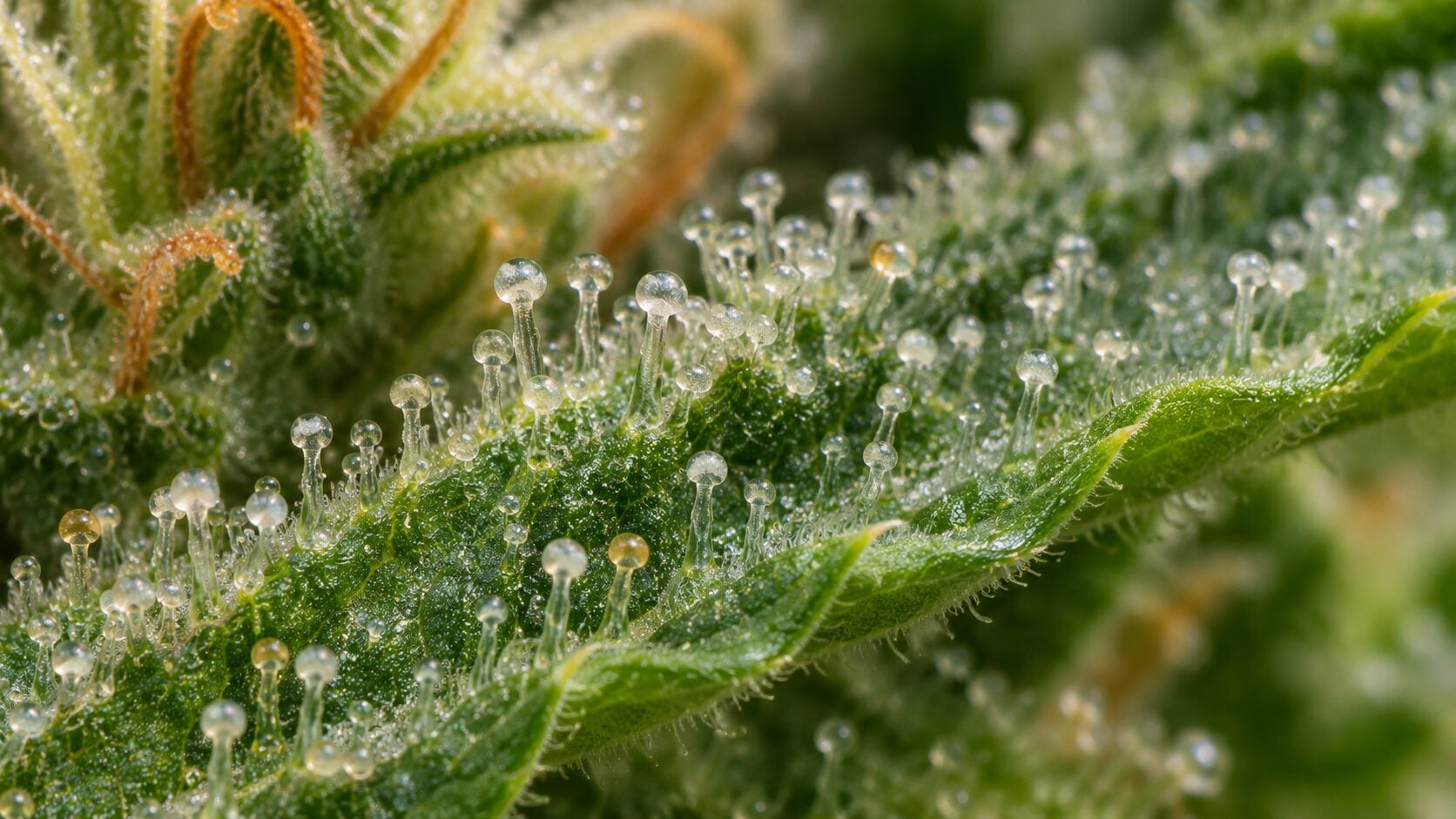
Every frosty speck on a cannabis flower is a tiny chemical plant. Those glittering glands, called trichomes, make almost everything people care about in the crop: THC, CBD, the fruity, piney or skunky aromas, and dozens of minor compounds most consumers have never heard of. Scientists have spent decades naming the individual machines inside that factory. What they did not have was a working blueprint of the whole floor. A new cannabis trichome terpenoid biosynthesis model tries to provide one, and the first time researchers switched it on, it pointed straight at a gap in the textbook: nobody knew which enzyme makes eucalyptol, a terpene with a cool, eucalyptus-like smell that shows up in many cultivars.
The work, published in November 2026 in Frontiers in Plant Science, comes from a team led by B. Markus Lange, a plant biochemist at Washington State University who has studied resin glands in mint, hops and cannabis for years. Four of the seven authors were employed by Dewey Scientific LLC, a cannabis genetics company, which the paper discloses as a potential conflict of interest. The team built a computer model they call CanSatGT_2025, used it to test competing ideas about how trichomes run their chemistry, and then went into the lab to confirm what the model suggested.
Key Takeaways
Researchers built a genome-scale metabolic model of cannabis glandular trichomes that links roughly 772 chemical and transport reactions to cannabis genes and to the measured chemistry of nine cultivars. The model favours one explanation for where the six-carbon “tail” of THC and CBD comes from: a thioesterase enzyme that cuts fatty-acid building blocks short, rather than the breakdown of fats or the incomplete burning of fatty acids. It also suggests that the carbon-fixing enzyme RubisCO does little useful work in these non-photosynthetic glands, because switching it off made the simulated factory about 18% more efficient. When the model failed to account for eucalyptol (1,8-cineole), the team tested a candidate enzyme previously described as making a different terpene and found that 45% of its output was eucalyptol. The findings are computational predictions plus one test-tube enzyme experiment, not field data, and the model cannot yet predict a strain’s terpene profile on its own.
How the Cannabis Trichome Terpenoid Biosynthesis Model Works
To see why this model matters, it helps to answer a basic question first: what are trichomes? On cannabis, the most important ones are glandular trichomes, tiny mushroom-shaped structures packed on the female flowers. Each has a stalk and a head of secretory cells that pump resin into a storage cavity. If you are wondering what trichomes do for the plant, the short answer is defence: sticky, smelly, bitter resin deters insects and grazing animals. For people, cannabis trichomes are where cannabinoids can exceed 25% of the flower’s dry weight and where terpenes often reach several percent. How much resin a plant lays down is itself an open research question, as recent work on a plant-derived biostimulant that raised trichome density and cannabinoid content shows.
A genome-scale metabolic model is a bookkeeping system for that chemistry. Picture a city map where every street is a chemical reaction and every car is an atom of carbon. The model knows which streets exist (from genes and published biochemistry), how many lanes each one has (from gene activity measurements), and what the city must deliver by the end of the day (the measured mix of cannabinoids, terpenes and other products). A method called flux balance analysis then calculates the traffic pattern that delivers everything with the least total driving. If a delivery is impossible, the map is missing a road.
The team started from two existing blueprints, a core model of the leaf of Arabidopsis, the lab weed of plant biology, and an earlier model of hop lupulin glands, which are close relatives of cannabis trichomes. They then added cannabis-specific pathways for cannabinoids, terpenes, flavonoids, stilbenoids and phenolic amides, matched reactions to genes in the ‘Pink Pepper’ cannabis reference genome, and plugged in gene-activity data for nine cultivars from the group’s 2019 study in Plant Physiology. Each cultivar got its own “delivery list” based on its real chemistry, with THCA reaching up to 263 mg per gram of dry flower and β-myrcene, the most abundant terpene, up to 43 mg per gram. A standard quality-check tool for such models gave it excellent scores for mass and charge balance.
A Resin Factory Without Solar Panels
Glandular trichomes look a bit like tiny leaves, and their cells even switch on some photosynthesis genes. But earlier microscopy and biochemistry, including a 2022 study in Current Biology, showed that the plastids in cannabis trichomes lack working photosystems. In plain terms, the glands have the wiring for solar panels but no panels. They must import sugar from the stalk cells below and burn it to power resin production.
That raised a question about RubisCO, the famous enzyme that captures carbon dioxide in green leaves. Some photosynthetic glands in other plants use it to recapture CO2 they would otherwise lose. When the researchers let RubisCO run in the cannabis model, it did recycle carbon, but at a steep energy price: the simulated cells had to run their mitochondria hard to pay for it. The gene data offered a clue. The small subunit of RubisCO is expressed in cannabis trichomes, but the helper proteins needed to assemble and activate the enzyme are barely present.
So the team tested a version of the model in which RubisCO carries no traffic. Averaged across the nine cultivars, total flux dropped by 18%, carbon dioxide lost per unit of product fell by 10%, and energy use, measured as ATP turnover, fell by 19%. The authors read this as support for the idea that functional RubisCO is negligible in these glands. They stress that it still needs direct experimental confirmation.
Where the Cannabinoid “Tail” Comes From
Every THC or CBD molecule carries a five-carbon chain on one side. It is built from a six-carbon starter molecule called hexanoyl-CoA, and despite years of work no one has proved where cannabis gets it. Three main ideas compete. A thioesterase enzyme could stop fatty-acid assembly early, like a factory worker snipping a chain after six links. Fats could be broken down through the oxylipin pathway, which releases short pieces. Or fatty acids could be only partly burned in the cell’s peroxisomes, leaving short leftovers.
The model tried each scenario in turn by “knocking out” the alternatives. With the thioesterase route available, the averaged sum of all fluxes was 48.6. Forcing the oxylipin route raised it to 81.2, and relying only on partial fatty-acid breakdown raised it to 84.0. The thioesterase, a cannabis relative of an Arabidopsis enzyme called ALT4 that is highly active in cannabis trichomes, was the clear winner on efficiency. The same enzyme, working with a less effective partner, could also supply the four-carbon starter that gives rise to THCV and other “varin” cannabinoids.
There is an important caveat. Flux balance analysis is designed to pick the most economical path, so it will tend to favour the shortest route whenever one exists. Efficiency is evidence, not proof. The authors propose confirming the result by switching off ALT4 in living cannabis plants, but they note that genetic engineering of cannabis remains slow, expensive and limited to certain genotypes, so they did not attempt it.
The Missing Link: Eucalyptol Terpene Synthase Hiding in Plain Sight
The model’s second test produced the headline result. When the researchers asked it to produce the full chemical profile of each cultivar, it returned no feasible solution. The reason was simple: several cultivars contain 1,8-cineole, better known as eucalyptol, but the network had no reaction that could make it. If you have smelled eucalyptus leaves, rosemary or bay, you know the eucalyptol terpene. In cannabis it is a common but usually minor aroma note, and the enzyme behind it had never been identified.
Terpenes are made by enzymes called terpene synthases, and cannabis has a large family of them, with more than thirty already characterized. The team compared the key active-site positions of known eucalyptol-making enzymes from other plants with those of cannabis enzymes. The best match was CsTPS13PK, an enzyme that a 2017 study and a later paper had described as making (Z)-β-ocimene, a sweet, herbal terpene.
To check, the researchers ordered a synthetic copy of the gene matching the public GenBank record KY014558, produced the protein in bacteria, purified it to more than 95% and fed it geranyl diphosphate, the standard raw material for terpenes of this size. Eucalyptol made up 45% of the products, alongside smaller amounts of α-pinene, β-pinene, sabinene, α-thujene, sabinene hydrates and α-terpineol. Three separate chromatography methods found no (Z)-β-ocimene at all. The enzyme’s kinetics were ordinary for a plant terpene synthase, with a Michaelis constant of 53 µM and a turnover number of 0.015 per second.
Structural modelling backed this up. A predicted 3D shape of CsTPS13PK closely resembled the crystal structure of the eucalyptol synthase from Greek sage, including an extended pocket at the bottom of the active site that appears to hold the water molecule needed to close the eucalyptol ring. Enzymes that make plain hydrocarbon terpenes lacked that pocket. The authors suggest the earlier characterization studied different sequences, since the protein sequence and gene sizes reported in those papers did not match the GenBank record.
Terpenes vs Cannabinoids: One Factory, Shared Raw Materials
The model also makes a point that is easy to miss when people talk about terpenes vs cannabinoids as if they were separate products. Inside the trichome they compete for the same supplies. Geranyl diphosphate, the raw material the eucalyptol enzyme uses, is also the building block that joins with olivetolic acid to form CBGA, the parent molecule of THCA, CBDA and CBCA. Malonyl-CoA feeds both cannabinoid cores and flavonoids. A breeder who pushes one branch of the network is, in effect, changing traffic on the others, which is one reason genome-wide studies of the genes behind cannabinoid production keep finding that what a plant looks like predicts its chemistry poorly.
The chemistry is also richer than the model can yet represent. Fresh analyses of three high-THC reference cultivars, ‘Caribbean Chocolate’, ‘Purple Mango’ and ‘Happy Trails’, found over 70 terpene peaks and close to 80 non-terpenoid volatiles such as esters and sulfur compounds. Some sesquiterpenes, including guaiol and selin-6-en-4α-ol, could not be added because their enzymes are still unknown. Terpene research has practical stakes beyond aroma: The Cannex has covered work on THC-free cannabis terpenes as a possible alternative to opioids for chronic pain, and knowing which enzyme makes which terpene is the first step towards producing those compounds reliably.
Frequently Asked Questions
Trichomes are small outgrowths on the surface of the plant. The ones that matter on cannabis are glandular trichomes, which are densest on the bracts of female flowers. Each mature gland has a stalk, a head of secretory cells and a cavity where the resin collects, which is why a ripe flower looks frosted. The resin in that cavity holds the cannabinoids, terpenes, flavonoids and other compounds the plant makes, and it is what the model described in this article tries to account for.
In the secretory cells of those glands, not in the flower tissue as a whole. Monoterpenes, the lighter aroma compounds such as myrcene, limonene and eucalyptol, are assembled in plastids from a building block called geranyl diphosphate. Sesquiterpenes, which are larger and include β-caryophyllene and α-humulene, are assembled in the cytosol from farnesyl diphosphate. Both are then released into the storage cavity, where they sit alongside the cannabinoids until the flower is harvested, dried and handled.
Terpenes are small, volatile molecules built from five-carbon units; they evaporate easily, which is why you can smell them. Cannabinoids such as THCA and CBDA are heavier and barely volatile, and they are hybrids: a core built by a polyketide pathway, joined to a piece that comes from the same terpene chemistry. That shared origin is the practical point of this research. Both classes draw on the same pool of raw material inside one gland, so they cannot be treated as independent traits.
It is legal but federally controlled, and the controls are in flux. Marijuana generally remains in Schedule I of the Controlled Substances Act. In April 2026 the Department of Justice moved two narrower categories, FDA-approved drug products containing marijuana and marijuana covered by a qualifying state medical licence, to Schedule III; a separate administrative hearing on whether to reschedule marijuana more broadly opened on 29 June 2026 and has not produced a final decision. Working with controlled plant material requires DEA registration, which is one reason much of the enzyme work in this study was done in bacteria carrying a single cannabis gene rather than in the plant itself. Hemp sits under a separate definition that Congress rewrote around total THC, with the changes phased in through late 2026.
Disclaimer
This article is published for information only and describes laboratory and computational research. It is not medical, legal or agronomic advice, and nothing in it should be read as a recommendation to grow, buy, use or produce any cannabis product. Cannabis and hemp laws differ by country and by state, and they change. Readers should consult the rules that apply where they live, and a qualified professional for any medical or legal question.