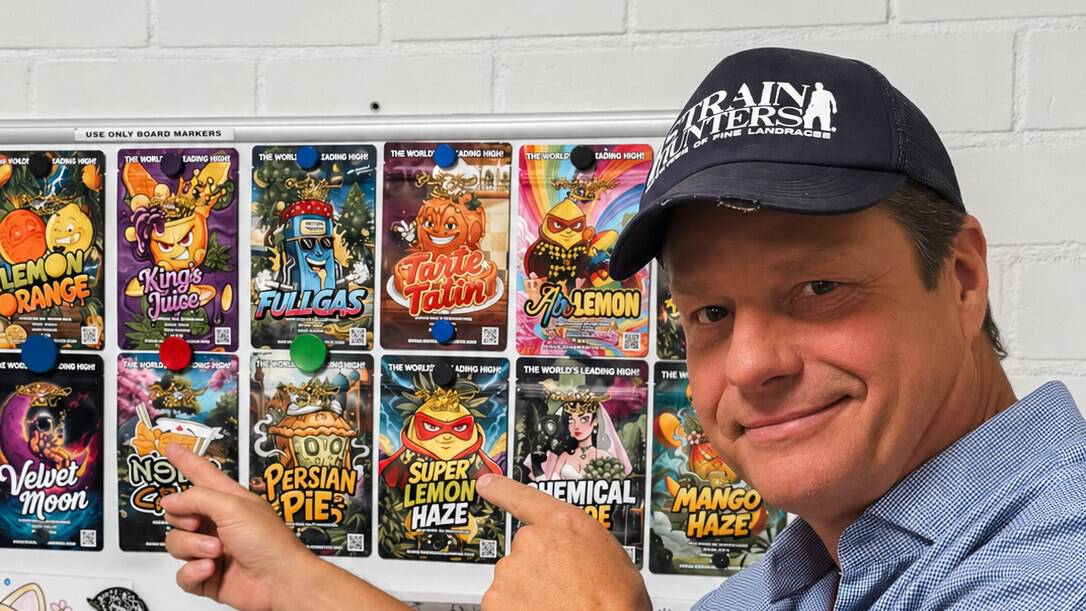
On brokers and borrowed names, real THC figures, landraces that don’t pay for themselves, Franco Loja, and why old genetics are like an open palm and new ones like a clenched fist.
The Cannex first met Arjan Roskam in Amsterdam. Catching him at the Dutch office isn’t easy these days: he spends roughly half the year in Thailand, where he is developing a separate project of his holding company. The trip has a personal meaning. In a 2018 interview with the grower Kushka, Arjan described how, as a teenager, he got seeds while travelling through Thailand. Decades later, he returned there with a team and a project of his own.
The Cannex didn’t come to retell his biography, but to check a few of his earlier statements and to talk about what matters to seed buyers today: how to tell a breeder’s work from a familiar name on a pack, what the THC percentage means, and why a landrace collection can’t develop according to the rules of a fashion catalogue.
Then Alan joined the conversation, a Russian-speaking member of the Green House Seed Co team working on projects in Thailand. With him, The Cannex talked about the Russian audience, the old school and his own path into the industry.
Thailand: Coming Full Circle
Your cannabis story began in Thailand when you were very young. Decades later you returned there with your own project. How does it feel now that you’ve come full circle?
Do you mean me at 17 or at 60? I’m truly happy there. Thailand is a beautiful country with a lot of opportunities. It might be my favourite place in the world: it’s good for eating, lying on the beach, going out in the evening, travelling, training. I train together with Alan. And the infrastructure there is very good.
But it’s also personal: where you like to live. When I started having problems in Holland, I moved to Spain. Now there are more problems in Europe as a whole, so I moved to Asia. In Europe everything is complicated.
How much of the year do you spend in Thailand?
Four or five months. I’m flying back again tomorrow.
Genetics will always be very important.
Arjan Roskam
“It’s the Champions League”
Russian-speaking growers know Green House Seed Co primarily as a seed bank. What is Green House Energrow: a farm, a breeding centre, a medical cannabis producer, or the beginning of an Asian headquarters?
Everything you listed. It’s something like our Asian headquarters. And it’s the first GMP-level facility (Good Manufacturing Practice) in Asia. Well, almost GMP.
There are medical farms in Germany, Malta, Israel, Canada, Colombia, South Africa, and now Thailand. Almost all of them work to the GACP standard (Good Agricultural and Collection Practice). If you compare it with hospitals, GACP is a small hospital, and GMP is a university clinic. You can do more.
Under GACP, every batch has to be sent to a third-party lab for testing: it’s an official medicine, everything gets checked. With GMP, I can send products almost directly to the pharmacy. The difference is like that between ordinary football and the Champions League. In Canada there are thousands of GACP facilities and only two GMP ones. That’s how difficult it is.
Arjan shows a report he was reading before the meeting: the sampling and testing procedures that have to be followed.
Do you know how many SOPs, that is, standard operating procedures, we have in Thailand? Three hundred. These are instructions for every action: how to clean the toilet, how to clean the equipment. You have to shower before entering the facility. Have you ever seen microchip factories in Taiwan, with Dutch ASML equipment? It’s something like that. Or a hospital. Very complicated.
Buds Since 1983
For decades Green House Seed Co sold genetics to people who grow their own. In Thailand you produce finished cannabis. Does that change the company itself?
The company has always produced buds. From 1983 to this day, I’ve been producing buds.
Do you know how many SOPs, that is, standard operating procedures, we have in Thailand? Three hundred.
Arjan Roskam
But growing for coffeeshops is prohibited in the Netherlands.
Yes. If the police catch you, you can go to prison. But after that, things work differently than, say, in Russia. The prosecutor asks for five years, and the judge says: “This has been going on for decades, the coffeeshops pay taxes and everything else. What, does marijuana fall from the sky?” And the judges are effectively telling the politicians: solve this problem yourselves.

That’s why such cases get dropped: we call it “9a”, case dismissed. No criminal record, everything is confiscated, the people are released if it’s proven that they work for a coffeeshop and the product is sold there. A six-week stock is allowed: if a coffeeshop sells ten kilos a week, you can have sixty. It sounds funny, but that’s Holland. For the judges, the coffeeshop is practically legal, but for the system it isn’t. The system is very old, and the judges now rightly say that politicians should have fixed it long ago.
Ten years from now, will seeds still be at the centre of your business?
Genetics will always be very important. That’s why we create new genetics and help other farms around the world grow our strains: that’s a new direction. There aren’t many people who know how to make truly good genetics. And tastes keep changing: one moment people want to smoke one thing, the next moment another.
You can compare it to wine. There’s the lower segment, the middle and the top. There are huge corporations that own nearly all of Australia. But there are also special places where great wines are made: Tuscany, Napa Valley, Bordeaux, old family châteaux. They will always survive: they have special land, special plants and very professional people. So genetics will always play an important role. But of course, the money is made on buds. So it’s a bit of both.
“Politics Can Change Very Quickly”
In 2018 you said that in 10–20 years cannabis could become legal even in Russia, China or India. Eight years have passed. Do you still think so?
Good question. When I started growing in 1983, I thought everything in Holland would become legal in 10–15 years. It didn’t happen. This country is still more illegal than many others, strange as that may sound. I always say things like that to push countries.
That’s what we make Strain Hunters for. After our trips to Colombia, Malawi, Saint Vincent and the Grenadines, South Africa and especially Congo, governments changed their policies. Watch the BBC interview with the head of Saint Vincent and the Grenadines after our visit. He said: we had Strain Hunters here, tourists come to us, and we put them in prison for one or two joints, even though it’s legal in America and Canada. That’s absurd. And now people there aren’t arrested for an ounce, 28 grams.
With our films around the equator we try to show that these laws are absurd. In Holland, 20,000 people die from tobacco every year, and 10,000 from alcohol. And how many die from alcohol in Russia? Why are alcohol and tobacco legal but cannabis isn’t? In my opinion, there’s only one reason: people might start thinking differently. Our opponents are the pharmaceutical, alcohol, tobacco and agricultural industries. I consider religion an industry too, and a very big one.
I never thought Thailand would legalise. In 2018 I myself talked a colleague out of going to a seminar at Bangkok University: why waste money, it will never be legal in Asia.
And a year ago a representative of a very large Asian country, which I can’t name, came to see us. He said: “We want to legalise marijuana.” They’re starting with research, in a tax-free zone.
In China and Russia it definitely won’t happen now. In other countries it’s possible. But politics sometimes changes very quickly: remember the Berlin Wall, Gorbachev. That was a huge surprise.
What could be the turning point?
The only thing on our side is science. Doctors say it’s a good product: for glaucoma, multiple sclerosis, cancer, for recovery after chemotherapy. Children with Dravet syndrome: they had two hundred seizures a day, now they have three or four, and milder ones.
The problem is that the plant contains hundreds of compounds. We know THC and CBD, but there are probably 70 to 120 cannabinoids; we measure about ten. We measure 20–30 terpenes, but there are around a hundred. Another 50–100 flavonoids. To research this properly you need billions of dollars. And the only one who can provide them is the industry that has its own medicines.
We have an endocannabinoid system in our bodies, and the plant has a cannabinoid system. It’s the only plant with such a system, and we’re the only animal with an endocannabinoid system. If you match the keys to each other, you can heal a lot from the inside.
And yet since the 1930s, when everything was banned, there has been progress: medical marijuana is now permitted in 51 countries. Governments don’t like coffeeshops and dispensaries: they bring too many problems. Their way out is pharmacies. It’s a kind of middle path. And that’s exactly the path we’re taking.
Dutch Brands and Spanish Seed Banks
In the Spanish cannabis scene you often hear harsh criticism: “Dutch seed banks are mostly brands. They don’t produce the seeds themselves; production moved to other countries long ago, often to Spain.” What makes a Dutch brand Dutch today: the genetics, the production or the logo?
There are too many seed banks in Spain now, and that’s what makes the market difficult. Many simply buy seeds, make packaging and resell them.
I was the first to go to Spain and help out there. They all know me, many of them are my friends. I was the first to bring clones there from Holland. In the early 2000s things got harder in Holland, and some seed banks moved to Spain. Me too: for a while I grew in the north, in the Basque Country, near San Sebastián and Bilbao. And also in Africa, Switzerland, Canada. Now in Thailand.
How do many Spanish seed banks work? A greenhouse, one male and twenty different females: all pollinated by one male. Very simple and cheap: one harvest gives twenty kilos, a million seeds. And many seeds sold in Spain aren’t Spanish at all anymore: they’re brought in from Colombia, and nobody talks about it. There you can buy any seeds by the kilo.
At our factory we have closed rooms, which is much more expensive. One male, and all the females are the same.
I was the first to go to Spain and help out there. They all know me, many of them are my friends. I was the first to bring clones there from Holland.
Arjan Roskam
Arjan shows a video on his phone.
Look, this is week seven. Here’s one room, and here’s another, in Thailand. See, the seeds are already setting. Same male, same female, everything indoors, so the seeds are of higher quality. I’m filming this for the first time; nobody has filmed this before.
Think logically. There are American, Spanish and Dutch seed banks. Which of them show their large-scale production on social media? It’s easy for Americans and Spaniards, they’re not in Russia, they’re allowed to film. But many have two black grow boxes with lamps in a basement. At trade shows they have huge queues, but their production is a drop in the ocean. That’s what we call window dressing. In America they say sugar coating. And every seed company badmouths the others: everyone does it.
He shows another video.
This is King’s Juice. I always ask the others: where’s your footage?
Overall, you have to ignore all this talk. Look at the forums: how many good reviews we have and how many complaints there are about some big companies. People always make fun of my films too. And I ask: where are your films? I haven’t seen a single one.
“95% of Seed Banks Are Brokers”
Thirty years ago a seed bank was associated with a specific breeder and recognisable genetics. Today the buyer may not know who bred the strain, who produced the seeds and who simply packaged them. Has the word “seed bank” lost its meaning?
I understand what you mean. 95% of seed banks are brokers: they buy seeds and sell seeds. Only a handful do real work. And I’m now joining forces with them.
Arjan shows a chat on his phone.

For example, Chris, who used to work at Compound Genetics, is a real breeder. We’re doing a collaboration with him. We’re also discussing working together with Seed Junkie. These are the people who do real work. There aren’t many of them.
Who else actually does breeding?
In Holland, Sensi Seeds, they do their own thing. Green House Seed Co. In America there are seed banks, but they’re small and make only a few strains. America’s problem is the industry itself: because of huge taxes in California and Canada, almost nobody makes money. You pay tax on every square foot. And you can’t move products from state to state: it’s illegal at the federal level. And now the US is changing the seed law again. Maybe as early as November it will no longer be allowed to sell seeds there.
“Everyone Lies”
In your 2018 interview with the grower Kushka, you explicitly named Ingemar as the creator of White Widow and Nevil as the author of Super Silver Haze. Do you think the industry has become less honest about authorship?
Definitely. Everyone lies. Everyone lies. There’s a huge number of names now.
It’s the brokers. They just change the names or call anything Super Lemonade or White Widow. Total mess. That’s why you can only trust companies like ours or those who have been working for 20–30 years. We know about these people: they have real genetics.
The problem is that they buy my seeds and make a copy. And there’s no way I can protect myself. I can’t protect the name, I can’t protect the intellectual property. And it’s like that every time we release new strains.
When your seeds are bought and multiplied, you get a fake, what we call a knockoff. It’s never as good as the original. But if you’re a grower in Russia, in Tokyo, in New York, anywhere, and you buy ten seeds and grow for the first time, you’re already happy to have ten plants. You don’t know you bought bad seeds from a bad company: you see buds, and you’re satisfied.
That’s why companies like yours and ours need to tell people about authenticity: what’s real and what isn’t.
“If It’s 39%, It’s One Hundred Percent Marketing”
The market is literally going crazy over THC right now. Ads feature strains with 39%. How much of that figure is genetics and how much is marketing?
If it’s 39%, it’s one hundred percent marketing. Because that doesn’t exist.
So what’s a realistic figure?
Arjan takes out his phone and shows lab reports on new strains. He asks us not to publish the names yet.
Look, here are real values: 32, 25, 26, 27, 28. This is an official report from an official university lab. I also work with medical cannabis, so I can give my strains to a medical lab, grow them and get real results. I’ll publish these results on my website. You can even see the lab’s ISO accreditation number here.
But in America you can go to a lab and say: you’re my friend, do the test for me, but put it a bit higher: it’s better for sales. American labs, Canadian ones: they all cheat. You can google how many labs in the US have been shut down because the state caught them falsifying results. In the last three months alone, two or three were closed.
After all, the point is independent verification: you can’t check yourself, so you send a sample to a third party. And then it turns out that this check is wrong too.
The Number on the Pack Is the Mother
When the packaging says, for example, 28% THC, what does that figure mean? One exceptional plant, one sample?
It’s the result of the mother plant we make the seeds from. Within the offspring there’s variation across phenotypes. There was a case: my plant tested at 28%, a friend took 20 seeds from me and found one among them with 30%.
So if I write 28, you’ll find plants from 25 to 30%: the result depends a little on the phenotype. That’s how it works. The figure I give is the original mother the seeds came from.
That’s very useful information for growers.
Good question, by the way. People have no idea about this.
“The Higher the THC, the Less I Like It”
Has the obsession with THC improved genetics or just made them easier to sell?
Also a very good question. Personally, the higher the THC, the less I like a strain.
I’m a cook at heart. I love cooking for my family, for friends. If I go to a restaurant, I want the food to be really delicious. I adore Michelin-starred restaurants. I don’t need a lot of food, I need excellent food. Better six small dishes than one big pointless plate.
It’s the same with THC. You go to Las Vegas: tourists, young people who’ve just turned 21, there for the first time, and they all want high THC, because everyone wants to get wrecked. I prefer strains with 22, 24, 25%. A bit weaker, but with flavour. More often than not, the less potent the weed, the richer its terpene profile, and that’s what gives the flavour.
It’s easy to compare. You know greenhouse tomatoes, hydroponic ones? And a tomato grown in your own garden, in real soil. You know the difference in taste. It’s roughly the same here. You can push a plant to very high THC, or you can grow it a bit weaker, in soil, and the flavour will be much better. In soil, THC is sometimes 2–3% lower than in hydroponics, but the product turns out much better.
In general there are four options. Best of all is growing in living soil, with worms and everything else. Then regular soil, then coco, then rockwool. Big medical facilities mostly work with rockwool and coco, because they run into difficulties with the rest.
“Only Industry Can Destroy a Landrace”
In 2018, when asked whether landraces were on the verge of extinction, you answered: “No. Not at all.” Is the answer the same today?
Yes, absolutely. But first you need to define what a landrace is. There’s already a big debate about that. I consider a landrace something that has been growing for at least 50–80 years in one specific area.
That’s why I recently went to Kyrgyzstan, and next I’m going to Kazakhstan, Peru, the Philippines. It’s the same in Thailand. There’s an area where they’ve grown the same strain for hundreds of years. Even if you bring my seeds there, the local strain is so strong that everything will cross, cross, cross, but after three or four generations the foreign genetics will dissolve. The local one is stronger.
Only large-scale industry can destroy a local landrace. Say, they find gold there or build a dam. Like in northern India, in Himachal Pradesh, where I shot a film. They started generating electricity from the river, built dams, all the infrastructure came, and so the farmers had to leave: they no longer had water.
So no, landraces won’t disappear. Unless people themselves destroy them through industrialisation.
During the conversation Arjan shows photos: Green House Seed Co seeds growing in the mountains of Morocco. According to him, about a hundred thousand seeds have been planted there. In October he’s going there for the harvest, and Alan will film the trip. For Alan it will be his second film with Arjan: he first appeared on camera during the expedition to Kyrgyzstan.

Landraces That Don’t Pay for Themselves
Which landrace in the Green House Seed Co collection is the most important for the future?
Probably Cloudwalker, Punto Rojo, the Colombian ones. They were very strong.
Why those in particular?
Just strong, beautiful plants. I like them. It’s personal. When we go to a restaurant together, everyone orders their own, and that argument will never end. I prefer the Chinese way: we put everything in the middle of the table, and everyone tries a little. Like in Spain, right? I don’t understand what “my plate” means. I want to try from yours.
And if we talk not about taste but about traits the industry will need?
The problem is that everyone wants high THC or a bright terpene profile. And with landraces that’s very hard to achieve through breeding: everything there is fairly low. There isn’t enough of a market for them. That’s why we make Lemon Orange, Full Gas, King’s Juice, purple strains. Young people look and say: “Oh, that looks great.” And they want something strong.
So it’s all complicated. We release landraces slowly. There’s, for example, a very beautiful Thai purple plant: it still needs a name. Yes, we’ll release landraces, but not many. They don’t sell.
If I have to dedicate a whole room to them, it’s very expensive: one cycle costs 10–20 thousand dollars. And then I sell a hundred packs at ten dollars and lose a pile of money. That’s the problem.
Franco
Franco Loja was the co-author of Strain Hunters and Arjan’s closest companion. He died in January 2017 of cerebral malaria, which he contracted in Congo.
I knew Franco personally, and I can’t help asking about him. Green House Seed Co with Franco and without Franco: what’s the difference?
He was my best friend and my best man in the mountains. What can I say? The difference is that I miss him on my travels. We didn’t make that many films together, but we travelled a lot.

And he was very well trained: he served four years in the Italian army, in the special forces. He had many skills. We were always together, and I taught him. He had never been to Africa before: I showed him how everything works there. He was a great soldier for me, my right hand. And a grower.
Now, in a sense, Dust has taken his place.
If Franco saw the company now, what would he argue with you about?
He would be very proud. He’s watching us from above.
The Market: Europe Is Shrinking, Trade Shows Are Alive
What’s happening with the European market right now?
It’s much smaller than before. In Germany you can now easily grow and buy cheaply: in a pharmacy, buds cost three to five euros. Before, people bought seeds and grew at home. Now it’s easier to go to a pharmacy and buy three grams for ten euros. Cheap, poor quality, but they don’t care. Last year 250 tonnes of medical marijuana went through German pharmacies, and before it was zero. The same is happening in England. And in Spain there are clubs: people are too lazy to grow themselves, they go to the club, buy and go home. All of this is putting pressure on the seed market in Europe.
What about South America? People say Chile, Argentina and Brazil are interesting markets.
There’s no money. I’ve been to Colombia, Brazil, Argentina and Chile many times, I have many friends there. Beautiful countries, but there’s a deep economic crisis. Brazil is a huge market, but it’s illegal there: hard to sell, hard to accept payments. Not as hard as in Russia, but similar.
Are trade shows still alive? Some companies complain that they spend more on taking part than they earn.
You always spend more: flights, hotel, dinners, taxis. But what you get is worth a great deal. For me it’s marketing. I go around with all the customers, take hundreds of photos and post them. And dinner for twenty people has to be paid for too.
We just got back from Düsseldorf: 20–25 thousand people. Mary Jane in Berlin is a huge show, something like 200 thousand visitors in four days. But some shows aren’t so interesting anymore. Vienna is dead, Prague has declined a lot, and we no longer go to Chile and Argentina: too far.
The two main shows were always in Barcelona and Düsseldorf. But Spannabis in Barcelona was closed. They tried Bilbao instead: we went to the first show, but it’s not the same: a beautiful city, but not for this. Now everyone from the Czech Republic and Austria goes to Berlin.
I also speak at medical conferences: ICBC in Berlin, Cannabis Europe in London. But that’s a different industry, not about seeds.
The last show was very mixed: medical cannabis next to recreational, social clubs next to pharmacies. I saw that for the first time. Usually separate shows are held for doctors and the medical industry.
I’ve been going to trade shows for twenty years, and it’s very tiring. In Düsseldorf I didn’t have time to eat. In Berlin on Friday I stood at the booth until ten in the evening: twelve hours, five thousand photos. But for the brand it’s necessary.
I understand. It’s a business with a human face.
“In 1985 There Were Three Seed Banks. Now There Are Three Thousand”
I talk a lot with people from the Russian grow community. The old school of growers knows you and other Dutch companies. But the new generation knows much less: it lacks information, and it has heard more about Fast Buds or Barney’s Farm. Why did that happen, and what is changing in your strategy for the Russian-speaking market?
That’s exactly why I’m now working with Alan, to conquer the Russian market. Alan is my gateway to this market: he has the biggest channel. That’s what I’m doing now.
And of course, when I started, in 1985, there were three seed banks. Now there are three thousand. That’s the difference.
That’s why I’m doing a collaboration with “ToroPykh”. And it’s not only about Russia: it’s all the Russian speakers in Canada, Thailand, Vietnam. Recently a guy from Kazakhstan came up to me at an airport: “Hey, I know you from Alan!” Now he comes to my shop in Thailand. Suddenly the whole Russian-speaking community started coming to me, because I’m with Alan. He’s a hero to them: “ToroPykh” has about 180 thousand subscribers on YouTube.
A colleague of Arjan’s from Green House Seed Co joins the conversation.
I can add what the main difference is. That’s exactly what we’re now adding to the strategy. Many young people don’t know that we’re one of the very few companies that grow their own genetics. As Arjan always says, the rest are mostly brokers.
Many companies live on hype. But hype passes, and original genetics never do. That’s our difference. And the new generation needs to be told again: we’re an OG brand: a brand with original genetics, with the very strains where it all began, and we create our own genetics. Most other companies don’t do that.
In the original: O.G. brand and O.G. strains. Here OG stands for original genetics.
Rapid-Fire: Strains and Beliefs
And now can we have a few of your personal recommendations? I’ll ask a short question, and you answer however you like. You can go into detail, or answer in one word.
One Green House Seed Co strain for a beginner?
Full Gas.
For an experienced grower?
Hawaiian Snow.
For a cold climate, say, outdoors somewhere in northern Russia?
Depends on what you consider a cold climate. You need indicas, strains with a short flowering time. King’s Juice.
The most underrated strain in the catalogue?
Good question. None of them are really underrated, lots of people grow them. Maybe Cloudwalker, Persian Pie: they’re very high-yielding and perform great outdoors.
A strain from another company that you really like?
I like MAC from Capulator Seeds. But half of it is my Super Lemon Haze. Many seed banks use our strains to create new ones. He’s a very nice person, a good company, and I like the strain.

But in general I really love sativas. And other companies hardly make sativas. Super Lemon Haze, Super Silver Haze, Hawaiian Snow, Ultra Haze. Other seed banks don’t create things like that: too difficult and too long a flowering time. I prefer an energetic, “uplifting” high, as we call it. There’s also Karel’s Haze, an old-school haze from a friend of mine. A very beautiful plant, I really like it.
How does your attitude to cannabis differ from the conventional one?
I don’t think you need to smoke every day. That’s how I differ from many people. I smoke maybe four days a week: that way the tolerance stays the same, and you don’t need to smoke more and more. And I change strains. I’m lucky: I can try something different every time.
The Question Nobody Asks
And finally: what question would you like to hear from journalists that for some reason nobody asks?
I don’t know, you’ve already asked in great detail… When will you make a film in Russia?
Good question.
Because I know: there are landraces in Russia. People have written to me, four or five of them: “I have a special landrace, I want to show it.”
Many Russian-speaking growers dream of getting into Green House Seed Co: growing for you, doing breeding.
Messages like that come every day, from all over the world: “I’m a big grower, I want to work for Green House.” And Alan is the one who did it.
Alan: “Everyone Involved with Cannabis Is a Little Alike”
Alan is a Russian-speaking member of the Green House Seed Co team and author of the Telegram channel “ToroPykh” (@toropkh). He lived in Toronto for 15 years and now lives in Thailand and works at the Green House Seed Co facility. Arjan calls him his main man and camera operator: Alan appeared in the Strain Hunters film about Kyrgyzstan.
Alan’s YouTube channel “ToroPykh”

“The Dots Connected Themselves”
How did you end up in the industry and at Green House Seed Co?
I guess I’m just a person who keeps digging deeper and deeper. An ordinary hobby gradually started turning into something much more serious. Then I got some education in Canada. Then I met a friend I work with now. That’s my supervisor, Kevin. We went to Bangkok, met Arjan there and came to his place. First Kevin started working here, then I joined.
To put it simply, I was just walking my own path, and the dots gradually connected themselves. The goal took shape, so to speak, along the way.
Seeds from Thailand
Many people now say that seeds produced in Thailand are worse than European ones. What do you think about that?
It seems to me what matters is who makes these seeds. In the end, they grow in the same substrate, under the same sun or light. It’s very important whose hand is involved and with what philosophy.
There are many new seed banks on the market now, and many guys go in a purely commercial direction, ignoring important things. And one of the most important contexts in the cannabis industry is probably fanaticism. Fanaticism, loyalty to history. If you do everything right in Thailand, Germany, the US or Canada, it will work out.
Of course, freedom of action is also very important. Somewhere in Russia or, for example, in Kyrgyzstan, doing this is extremely difficult. You know our story with the guys from Kyrgyzstan: they’re under investigation now. Although that story isn’t about cannabis in the usual sense at all: it’s connected with industrial hemp. But in Thailand the laws allow it, and a person has the opportunity to fully unlock their talents and skills. And as for Green House Seed Co, what we’re doing in Thailand is the foundation and the basis. A continuation of the whole story that Green House Seed Co has been carrying for decades.

American Genetics
Do you agree that American genetics are less stable than European ones?
More yes than no.
Why?
The very concept and philosophy of breeding. In the US, as we understand, it’s capitalism cubed. There, capital and the commercial side will always come first. Even when an idea appears, it will be polished in that direction.
It seems to me that in Europe there’s still a romantic element, and perhaps there always will be. The approach is much more quality-driven and philosophical. So more yes than no. But in the US there are definitely breeders who do very cool things too.
ToroPykh × Green House Seed Co
In the conversation with Arjan, we recalled that in 2012–2013 Green House Seed Co and Dutch Passion were at the top: everyone knew them. Now the situation is different. The new generation, which lives almost in an information vacuum, has other legends: those with more hype marketing. Arjan said that you are his path to the Russian-speaking audience. How do you plan to win back the trust and love of Russian-speaking growers?
To put it simply: by joining forces. Through joint efforts. I have a brand, a channel you know. And its main idea is 99% purely romantic. I have certain dreams and fantasies connected with cannabis and the Russian-speaking market.
Over time the channel became something like a metaphysical Russian-speaking industry. It’s as if it doesn’t exist, yet it’s as if it’s on the world map, because there’s the “ToroPykh” channel. I think next there will be a collaboration, a partnership with Green House Seed Co. I really respect this company, and when I got to know it better, I realised we’re on the same wavelength.
Plus we already have some interesting ideas. The first strain “ToroPykh” comes out with will be a collaboration with Green House Seed Co. Genetically it will be very, very close to King’s Juice, only it will be called a bit differently: Beaver’s Juice. Funny as that may sound.
Why this strain in particular?
Because it’s my favourite strain. I consider it one of the tastiest things I’ve ever tried.
The Fist and the Fingers
If you compare old genetics, the so-called old school, with the most fashionable American genetics, do you agree that everything new seems the same?
I agree. I can easily tell a certain set of new American genetics from old school even by the first puff. The difference will be significant. And Green House Seed Co has such a vivid palette in terms of organoleptics, that is, taste and aroma, that it stands out sharply against everything else, especially what’s on the market now.
It’s enough to try that same Lemon Orange: smoke it in a room, wake up in the morning and just smell the aroma in the room to understand that it’s something incredible. The same King’s Juice, the same White Widow. Personally, little else gives me comparable sensations. These are long-forgotten sensations.
Everything new is extremely potent, at least in the numbers, and the effect seems to be the same. But White Widow or Super Lemon Haze have their own colour. And Green House Seed Co carefully preserves these sensations. I don’t like advertising and I’m just telling it like it is: basically, I don’t smoke anything else.
That’s very accurate: you’ve explained to beginners what they lose when they chase only hype. Because you often hear: why do I need White Widow, it’s last century, when there’s so much new stuff around?
To put it simply, imagine a hand, and its fingers are different directions of emotion. Then all modern stone is a fist. Just stone. But in old genetics the sensations spread out in different directions. Somewhere it’s euphoria, somewhere something more energetic, and somewhere something more creative.
Super Lemon Haze is especially close to me. I love music, I make music, and for that I won’t smoke anything but Super Lemon Haze. Because nothing else gives me such lightness of thought, the right euphoric state and at the same time the ability to work. So yes, it’s carefully preserved genetics that has its own colour and is like nothing else.
Whichever way you look at it, different strains give different sensations. But in the modern world it all comes down to “are you high? are you wasted? are you smashed?” That gets old very quickly. Everything is getting simplified.
Like with information? Clip thinking?
Yes. New genetics are like 15-second reels, and the genetics of Green House Seed Co are like a good film, something by Kusturica, that leaves you impressed.
Yes, a great analogy. The same can be said about cars.
Absolutely. Now all cars are new and the same. But before, there was a whole palette in design. You sit in some old Cadillac, or even a Lada, you breathe and feel: this is it. You slam the door of an old Mustang and feel the weight of that door when the engine starts.
Feelings and emotions are very hard to put into words. Sometimes people are asked: what do you feel? And they say: “Well, I feel good.” It seems to me I can describe what I feel only with old-school genetics. Everything new is just “got high.” Or, as my partner used to say, “got wrecked.”