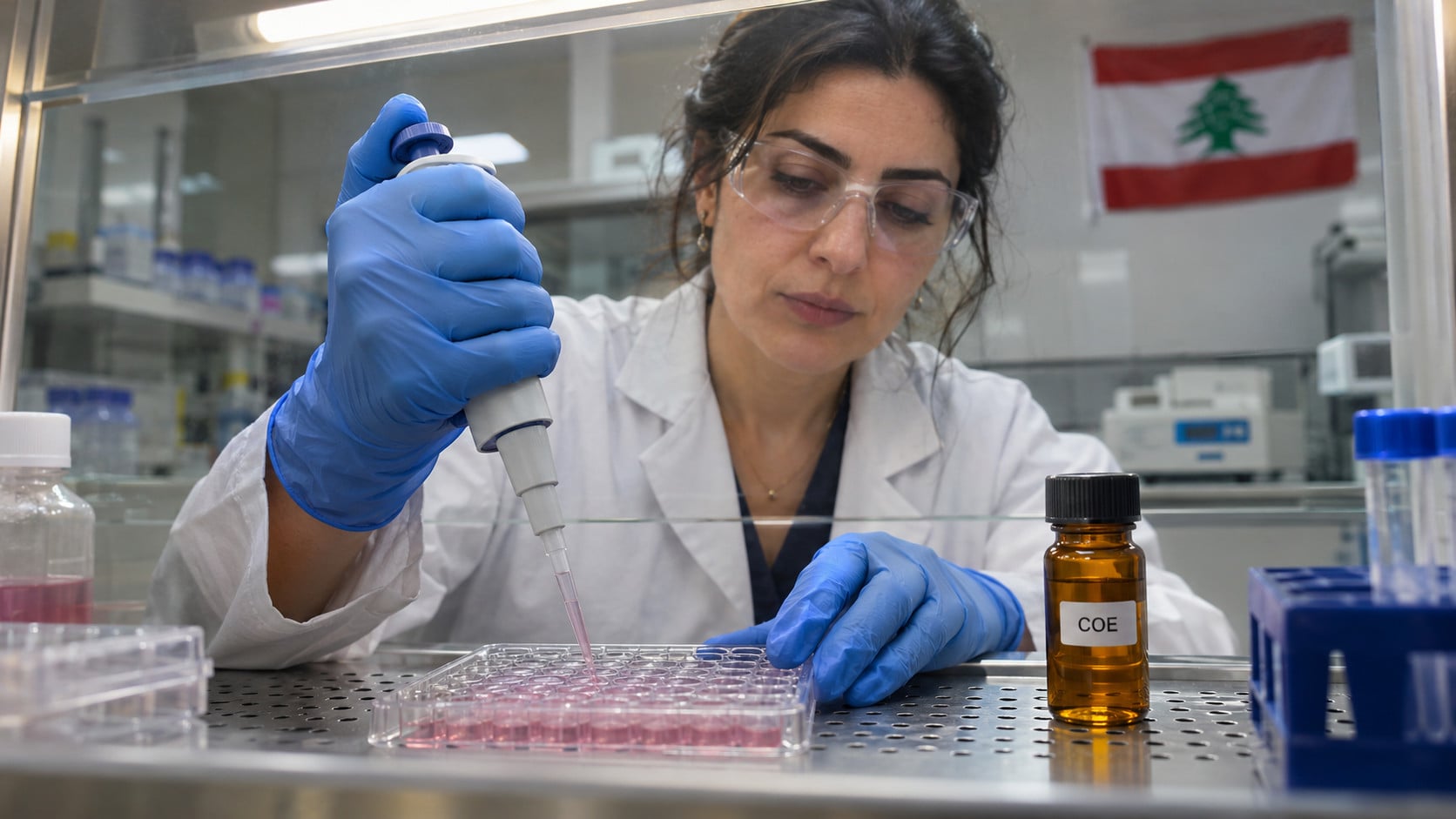
In Lebanon’s Bekaa Valley, a dark, sticky cannabis oil has been passed around for years as a home remedy for arthritis, diabetes, nerve problems and even cancer. Until 2020 it was entirely illegal, and nobody had checked what it actually does. A team at the Lebanese American University has now taken that oil into the lab and dripped it onto human lung and breast cancer cells. The Lebanese cannabis oil cancer cells study shows the extract can push tumour cells to self-destruct in a dish, but it is a very early step, and it tells us nothing yet about what the oil does inside a human body.
The paper, by Wassim Shebaby, Mohamad Mroueh and colleagues, was published online in November 2026 in Integrative Cancer Therapies and is free to read. It is a preclinical, in vitro study: everything happened in cell cultures, with no animals and no patients involved.
Key Takeaways
The researchers tested a whole cannabis oil extract, roughly 59% CBD and 20% THC, on two aggressive human cancer cell lines: A549 non-small-cell lung cancer and MDA-MB-231 triple-negative breast cancer. The oil reduced cancer cell survival in a dose-dependent way and was somewhat less toxic to rat stem cells used as a non-cancer comparison, though the authors themselves call this selectivity modest. Cells treated with the oil showed the molecular fingerprints of apoptosis, the cell’s built-in self-destruct program, and filled up with large bubbles in a pattern the authors describe as methuosis-like. At low doses the oil also slowed cancer cell migration, especially in lung cancer cells. Unexpectedly, the oil lowered rather than raised levels of reactive oxygen species. None of this shows that cannabis oil can treat cancer in people: the work used two cell lines in plastic dishes, compared them with rodent rather than human healthy cells, and did not test pure CBD or THC side by side.
How the Lebanese Cannabis Oil Study on Cancer Cells Was Done
The oil came from cannabis grown in Yammoune, a village in the Beqaa (Bekaa) Valley. It is the same batch the group prepared and chemically analysed for an earlier study on inflammation, published in the Journal of Ethnopharmacology in 2021. In that work, dried flowers were soaked in ethanol without further purification, deliberately mimicking the kind of crude extract sold informally in Lebanon.
That matters, because this is not a pharmaceutical-grade product. It is a full-spectrum oil, and its chemistry looks like this:
Cannabinoids made up 85.15% of the extract. Cannabidiol (CBD) dominated at 59.1%, followed by tetrahydrocannabinol (THC) at 20.20%, with smaller amounts of cannabinol (CBN, 3.63%) and cannabichromene (CBC, 2.22%). Terpenes, the aromatic compounds that give cannabis its smell, accounted for the rest of the identified fraction: monoterpenes at 4.12% and sesquiterpenes at 5.89%. Among them were β-myrcene (1.94%), β-caryophyllene (1.78%), α-bergamotene (1.74%) and α-pinene (1.01%).
The team chose two cancer cell lines that are standard workhorses in cannabis and lung or breast cancer research. A549 cells come from non-small-cell lung cancer, the type behind 80–85% of lung cancer cases. MDA-MB-231 cells come from triple-negative breast cancer, a form that lacks the three receptors targeted by many modern breast cancer drugs and is usually treated with conventional chemotherapy. As a stand-in for healthy tissue, the researchers used stem cells taken from the bone marrow of adult rats.
Does Cannabis Oil Kill Cancer Cells in a Dish?
The first test was simple: expose the cells to rising concentrations of the oil, from 5 to 80 micrograms per millilitre, for 72 hours and count how many survive.
Scientists summarise this kind of result with a number called IC50, the concentration that kills half the cells. Think of it as the dose at which the coin flips: lower means more potent. For the breast cancer cells the IC50 was 26.7 µg/mL, for the lung cancer cells 30.2 µg/mL, and for the rat stem cells 42.31 µg/mL.
So the oil needed a higher dose to harm the non-cancer cells. The authors calculated selectivity indices of 1.40 for the lung cells and 1.58 for the breast cells, and they describe this as “modest preferential cytotoxicity.” In plain terms, the margin between hurting cancer cells and hurting healthy ones was real but narrow.
For comparison, the team also ran etoposide, an established chemotherapy drug. Its IC50 was 35.84 µg/mL in the lung cancer cells and 10.87 µg/mL in the breast cancer cells. Comparing a crude plant mixture with a single purified drug by weight is not a fair race, though, and the numbers should not be read as “cannabis oil works as well as chemo.”
Inside the Cell: How the Cancer Cells Died
Killing cancer cells is easy; bleach does it too. The more interesting question is how they die. Here the study points to apoptosis, a tidy, programmed form of cell death that the body uses to remove damaged cells without causing inflammation.
Apoptosis is controlled by a set of proteins that work a bit like a car’s brake and accelerator. Bcl-2 is the brake, keeping the cell alive. BAX is the accelerator, pushing the cell’s power plants, the mitochondria, to leak a protein called cytochrome c. That leak switches on caspase-3, the “executioner” enzyme that dismantles the cell from within.
After treatment with the oil, the breast cancer cells showed the expected pattern: less Bcl-2, more BAX, more cytochrome c and more active caspase-3. At 40 µg/mL for 48 hours, BAX rose 7.05-fold. The lung cancer cells followed a similar pattern, although the rise in cytochrome c and caspase-3 was significant only at 24 hours.
A second method, flow cytometry, counted the dying cells directly. In breast cancer cells treated with 40 µg/mL for 24 hours, early and late apoptotic cells reached 14.74% and 50.46%, against 4.94% and 4.84% in untreated cells. In lung cancer cells, total apoptosis reached 42% and 46% at 20 and 40 µg/mL after 24 hours, and 33% and 55.5% after 48 hours. Together, these results suggest that at least part of the killing ran through what biologists call the intrinsic, or mitochondrial, apoptotic pathway.
Bubbles in the Cytoplasm: A Puzzling Second Signal
Under the microscope, something else stood out. The lung cancer cells treated with the oil filled up with fluid-filled bubbles, or vacuoles. Over 48 hours these merged into ever larger blisters until most cells were stuffed with them and died within 72 hours. The breast cancer cells showed the same effect, but less strongly.
This picture resembles methuosis, a rarer type of cell death in which a cell keeps gulping in fluid from outside and cannot process it, rather like a house whose drains are blocked while the taps keep running. The authors are careful here: they call the changes methuosis-like and stress that appearance alone does not prove the mechanism. Confirming it would require experiments that track how the cells take up and traffic that fluid.
Slower to Spread: Effects on Cancer Cell Migration
Cancer becomes deadly largely because cells break away and spread. To see whether the oil affects this, the researchers used a scratch test: they scraped a line through a layer of cells and watched how quickly the gap closed. They deliberately used low doses, a quarter and half of each IC50, so that any slowdown would not simply reflect dead cells.
The lung cancer cells reacted most clearly. After 24 hours, untreated cells had closed 52% of the gap, compared with 39% and 15% in the two treated groups. After 48 hours, the untreated gap was 95.6% closed, versus 51.6% and 19.6%. In breast cancer cells the effect was weaker: 79.4% closure in untreated cells at 24 hours against 62.3% and 57% with treatment, and 100% versus 92% and 74.8% at 48 hours.
Autophagy, ERK and ROS: Signals That Do Not Fit a Simple Story
The team also looked at autophagy, the cell’s recycling system, and found changes in its marker proteins. LC3B rose in both cell lines, and p62 rose in breast cancer cells but could not be detected in lung cancer cells at all. The authors acknowledge that these snapshots cannot show whether autophagy actually sped up or simply got stuck, so they speak of shifts in autophagy markers rather than proof of autophagic cell death.
A signalling switch called ERK was strongly activated, up to 10.79-fold in breast cancer cells and 14.40-fold in lung cancer cells. Again, the study does not show that ERK causes any of the effects seen; it only shows that it changed.
The biggest surprise involved reactive oxygen species (ROS), highly reactive molecules that in many earlier experiments helped cannabinoids kill tumour cells. Here the oil lowered ROS levels in both cancer cell lines. The authors suggest the difference may depend on cell type, cannabinoid mix, dose and timing, and they call for further work rather than drawing conclusions.
Whole Extract Versus Pure Molecules
A recurring idea in cannabis science is the “entourage effect”: the hypothesis that the plant’s compounds work better together than alone. Some earlier preclinical research supports it. A 2018 study in Biochemical Pharmacology found that a standardised cannabis preparation was more potent than pure THC in cell and animal models of several breast cancer subtypes, including triple-negative.
The Lebanese study leans on this idea, but it cannot test it, because it did not run pure CBD or pure THC alongside the oil. It also did not check the CB1 and CB2 cannabinoid receptors on the cells, which the authors themselves list as a gap. So whether this oil works because of its CBD, its THC, its terpenes or their combination remains an open question. Readers who want the basics of how CBD differs from THC can find them in our science-based CBD guide.
Why This Is Still Far From a Cancer Treatment
It is worth being blunt about the limits. This study used two cancer cell lines growing on plastic. The “healthy” comparison was rat bone marrow cells, not normal human lung or breast tissue. Every experiment was repeated three times, which is standard but small. There were no animal tests, no measurements of how the oil would be absorbed or broken down in the body, and concentrations in micrograms per millilitre of culture fluid cannot be translated into a dose for a person.
Crude ethanol extracts also vary from batch to batch and from plant to plant. The very feature that makes this study interesting, testing the oil people actually use, means another bottle bought in the Bekaa Valley may have a quite different chemical profile.
There is also a reason for caution that goes beyond missing data. In a separate lab study we covered, researchers at Harvard watched cannabinoids shield brain cancer cells from chemotherapy instead of helping it. Cannabis compounds act on many cellular systems at once, and how they interact with standard cancer treatment is still poorly understood. Results in other tumour types point in mixed directions too, as our coverage of a CBD and kidney cancer study and of research on CBD and cancer in dogs shows.
The U.S. National Cancer Institute states in its patient guide to cannabis and cannabinoids that the FDA has not approved cannabis or cannabinoids for treating cancer. Two cannabinoid-based drugs, dronabinol and nabilone, are approved only to manage chemotherapy-related nausea and vomiting.
Why Lebanese Cannabis Interests Researchers
Lebanon has long been one of the world’s major suppliers of cannabis resin, yet scientific studies of its plants are scarce. Cultivation, sale and use of cannabis were banned outright until April 2020, when a law opened the door to medical and industrial growing. The Lebanese American University group has since built a small body of work on the local oil: the 2021 inflammation study, a 2025 mouse study suggesting the extract protected kidney cells from damage caused by the chemotherapy drug cisplatin, and now this cancer cell paper.
That trajectory, from folk use to chemical analysis to cell studies, is how plant medicine research is supposed to start. The next logical steps would be animal experiments, comparisons with pure cannabinoids and, only much later, carefully controlled human trials.
Frequently Asked Questions
In laboratory dishes, yes: this study and many before it show that cannabis extracts can kill cancer cells at high enough concentrations. Here, the Lebanese oil killed half of the breast and lung cancer cells at 26.7 and 30.2 µg/mL. But killing cells in a dish is very different from shrinking a tumour in a person, and the same oil was also toxic to non-cancer rat cells at a moderately higher dose.
Preclinical studies have reported anti-cancer effects for both pure THC and pure CBD in many cell lines. This study did not test them separately, so it cannot say which compound was responsible. Some earlier work suggests a whole-plant preparation may be more potent than pure THC, while other experiments show cannabinoids can interfere with chemotherapy, so the overall picture is far from settled.
There is no evidence from human trials that cannabis cures lung cancer, breast cancer or any other cancer. Human research so far has focused on managing symptoms such as nausea, appetite loss and pain, not on treating the disease itself. Anyone considering cannabis during cancer treatment should discuss it with their oncologist, since cannabinoids may interact with other medicines.
It depends on the product and the state. Since April 28, 2026, marijuana covered by a state medical marijuana license and FDA-approved marijuana drugs have been in Schedule III of the federal Controlled Substances Act, while all other marijuana remains in Schedule I; a broader rescheduling is still pending a decision at the DEA. Whether a cancer diagnosis qualifies for a medical cannabis card is set by each state’s own program. An oil with around 20% THC, like the one in this study, does not qualify as hemp, which is limited to 0.3% THC, and the federal hemp definition is being tightened to count total THC from late 2026. The FDA has not approved any cannabis product to treat cancer.
Legal Disclaimer
This article is for informational and educational purposes only and does not constitute medical, legal or professional advice. The study described was conducted on cells in a laboratory and its results cannot be applied to people. Cannabis and cannabis products are not approved treatments for cancer. Do not use cannabis products to replace or alter any prescribed cancer treatment, and always consult a qualified healthcare professional before making decisions about your health. Laws governing cannabis vary by country and by state and change frequently; check the current rules that apply where you live.