
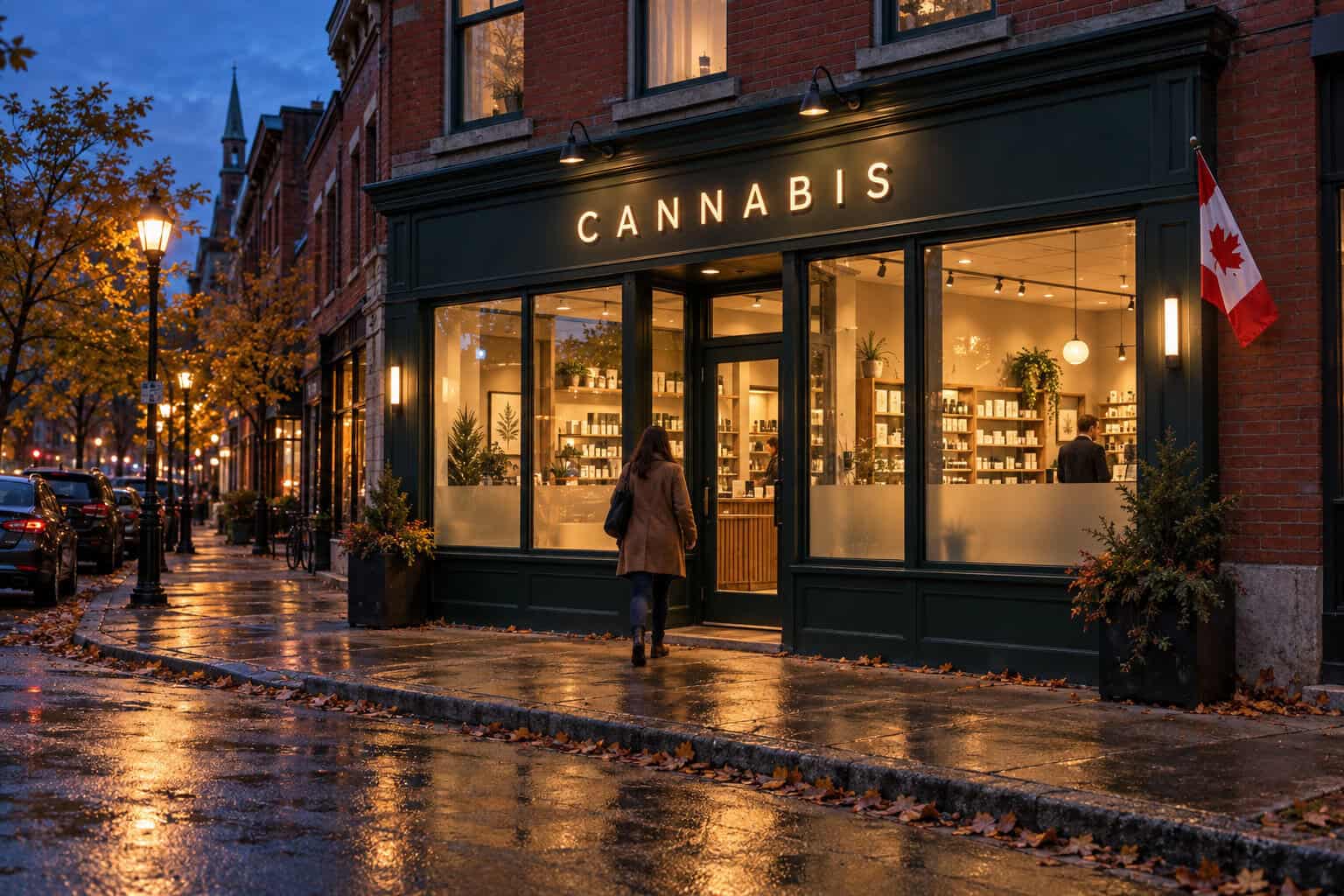
When a city council debates a new cannabis store, one fear comes up almost every time: the shop will bring crime to the block. A new study from Canada offers a reassuring answer to that fear. Around two legal cannabis stores, one in Toronto and one in Ottawa, crime did not measurably rise after they opened. The catch is written into the study’s own title. It looked at exactly two stores, and anyone quoting the result should know what two data points can and cannot prove.
The paper, “Crime levels near federally legal cannabis stores in two Canadian cities”, was written by Michael Armstrong, who teaches operations research at the Goodman School of Business at Brock University in Ontario and has studied Canada’s cannabis retail market for years. It appears in the International Journal of Drug Policy, surfaced in October 2026 and is assigned to the journal’s November 2026 issue (DOI: 10.1016/j.drugpo.2026.105529). It reached a wider audience through a summary published by NORML on October 15, 2026. The full text sits behind a paywall, so the details below rely on the published summary of the paper and the coverage so far.
Key Takeaways
The Canadian study compared crime within a radius of up to 3,000 meters around two legal cannabis stores, one in Toronto and one in Ottawa, in the months just before and just after each opened, and found no significant link between the openings and local crime levels. The swings that did appear were mostly explained by the weather: crime rose as days got warmer. The result fits much of the US research on cannabis dispensaries and crime, which usually finds no effect or a small one, although a few analyses have found more property crime next to new stores, especially in poorer neighborhoods. The Canadian finding holds only for these two sites. With no comparison neighborhoods, a very wide radius and a short time window, the study can neither rule out nor prove a small local effect. That makes it a useful data point in the debate, not a verdict.
What the Canada Study on Cannabis Stores and Crime Measured
Canada legalized adult-use cannabis in October 2018. Each province decides how cannabis is sold, and Ontario, where both Toronto and Ottawa sit, chose privately run stores licensed by the province. Those stores operate under fixed rules. A store cannot be located within 150 meters of a school, according to the Alcohol and Gaming Commission of Ontario, the provincial regulator.
Armstrong picked two of these stores and looked at crime inside circles of up to 3,000 meters around each one. He compared the months immediately before the opening with the months immediately after. The question was simple: does crime in the surrounding area change once a legal cannabis store opens its doors?
The answer was just as simple. According to the summary, the study found no significant associations between crime levels and the opening of legal cannabis stores in the two cities. “Significant” has a specific meaning in statistics: a difference large enough that chance is an unlikely explanation. No such difference turned up here.
Why Two Stores Prove Less Than the Headlines Suggest
This is the part that tends to get lost as the finding travels. “Two stores in two cities” quickly becomes “store openings in Toronto and Ottawa”, which sounds like a citywide comparison across many sites. In reality, the sample is as small as it can be if you want to compare two cities at all.
An analogy helps. Suppose you want to know whether a new coffee shop changes foot traffic on its street. You watch two coffee shops and see nothing. You now know something about those two streets. You know very little about every coffee shop in town, because location, customers and opening hours vary widely. Cannabis stores are no different. A shop in a busy mall and a shop on a highway strip next to a late-night bar start from very different places.
Three other features of the method deserve attention.
The first is the radius. A circle 3,000 meters wide in every direction covers about 28 square kilometers, roughly 11 square miles. That is whole neighborhoods. If a store affects crime at all, the effect is most likely concentrated in the first hundred or two hundred meters: the parking lot, the nearest corner, the doorway next door. An effect like that could easily vanish inside a large circle, the way a drop of ink disappears in a bathtub. The summary does not say whether smaller rings were analyzed separately.
The second is the lack of comparison areas. A before-and-after comparison shows whether something changed. It does not show whether it would have changed anyway. For that you need similar neighborhoods without a new store, observed over the same months. Researchers call this a difference-in-differences design: you compare not only before with after, but also the change here with the change there.
The third is the short time window. The study looked at the months right around each opening. Effects that build over years, for example if a block slowly changes as more customers walk through it, are outside the reach of this kind of analysis.
None of this is a criticism of the paper, which states its scope openly in the title. It does change what the paper can be cited for. Failing to find an effect is not the same as showing there is no effect.
The Weather Explanation: Why Crime Rises in Summer
The most useful part of the study may be a side finding. Armstrong attributes most of the variation in crime counts to the weather: as temperatures went up, so did crime. Criminologists have long known that crime tracks the seasons. On warm evenings more people are outside, more windows are open and there are more encounters and more opportunities.
That matters for any local argument about a store. Imagine a shop opens in March and a council compares January and February with May and June. What it measures may be mostly spring. A rise would look like the store’s doing when it was really the calendar’s. Statistics teachers make the same point with ice cream: sales and drownings both climb in summer, yet ice cream does not cause drownings. Anyone who does not account for seasonal patterns can blame a store for what the weather did, or miss a real effect hidden by a cold month.
What US Research Says About Cannabis Dispensaries and Crime
The Canadian paper does not stand alone. Researchers in the United States have studied cannabis dispensaries and crime for more than a decade, often with far more locations.
A widely cited analysis of Denver by two economists at the Federal Reserve Bank of Philadelphia reached a surprising conclusion (DOI: 10.1016/j.regsciurbeco.2019.103460). One additional dispensary in a neighborhood was associated with 17 fewer crimes per month per 10,000 residents, roughly 19 percent below the average for the period studied. Most of the drop came from nonviolent crime.
In Los Angeles, Tom Chang and Mireille Jacobson studied the opposite situation (DOI: 10.1016/j.jue.2017.04.001). In 2010 the city ordered hundreds of medical marijuana dispensaries to close. Around the shops that closed, crime rose compared with the ones allowed to stay open, mostly thefts and break-ins of cars. The authors point to “eyes on the street”: where customers come and go, there is less stealing. They found a similar pattern around restaurants temporarily closed for health code violations.
Washington state offered researchers a rare natural experiment, because it handed out retail licenses by lottery. That is a gift for research: chance decides where a store opens, not an owner who might deliberately seek out busy or cheap locations. Xiuming Dong and Justin Tyndall used the lottery (DOI: 10.1007/s00168-023-01246-x) and found no effect on crime in the average neighborhood. In the working paper version, however, they also report an increase in property crime right next to new dispensaries in low-income neighborhoods.
A study funded by the National Institute of Justice, the research arm of the US Department of Justice, points the same way. Its analysis of Seattle, Bellevue and Tacoma found modest but statistically significant increases in property crime in the small census areas where new retail stores opened.
So the overall picture is less clear-cut than single headlines suggest. Most studies find no effect or a favorable one. Some find small increases in property crime. Results depend heavily on how well-off a neighborhood is and how closely researchers look. The two-store Canadian study sides with the majority but cannot settle the dispute.
Public Opinion Has Not Caught Up With the Data
Americans remain wary. In a Pew Research Center survey of 5,140 adults conducted in January 2024, 34 percent said legalizing recreational marijuana makes communities less safe, 21 percent said it makes them safer and 44 percent said it makes no difference. In the same survey, 52 percent said legalization is good for local economies.
That gap between public worry and research findings shapes real decisions. Store siting, local opt-outs and even repeal campaigns often rest on the safety argument. In November, Massachusetts voters decide on a measure that would end licensed recreational sales, as we describe in our look at why lawmakers keep saying no despite broad public support. For where adult-use stores operate today, see our state-by-state guide to where weed is legal in the US.
Studies of individual stores cannot resolve those debates on their own. But they show what kind of evidence a city should ask for before claiming that a store made its streets less safe: comparison areas, the same months of earlier years and figures broken down by type of crime.
Canada Has Also Tested the School Question
Around the same time, another Canadian paper tested a related worry: that stores near schools push teenagers toward cannabis. A team led by Jamie Seabrook of Western University in Ontario analyzed data on more than 400,000 secondary school students from several provinces over five years (DOI: 10.1016/j.drugalcdep.2026.113368). Neither the number of stores nor how close they were was consistently linked to teen cannabis use.
That study works on a completely different scale from the two-store crime paper and is far more robust. It answers a different question, though, and the two should not be blended into one claim.
The author of the crime study is also no newcomer to the policy debate. In 2021 Armstrong published research suggesting that adding stores grew legal sales far more than it grew the number of users. In Brock University’s coverage of that work, he argued that municipal store bans, such as those in Mississauga in Ontario and Surrey in British Columbia, could end up hiding problems rather than solving them. Readers may weigh that context as they see fit. It does not change the data, and the new paper’s limits are visible on its face.
How Other Countries Handle Stores and Distance Rules
Canada and many US states regulate where stores can go rather than banning them outright. Germany, which partially legalized cannabis in April 2024, has no stores at all. Adults may grow at home or join non-profit cultivation associations, which must stay at least 200 meters from schools and playgrounds. Pilot projects with real shops have so far been rejected by the federal authority in charge. Even so, the first national surveys show no measurable rise in use, as our report on the German study of almost 36,000 people explains. Across Europe, from Dutch coffee shops to Swiss pilot sales points, the rules vary country by country, as our guide to cannabis laws in Europe shows.
Where legal stores do exist, they can take most of the market away from illicit sellers. The Missouri cannabis market study found that licensed stores captured about 93 percent of consumer spending. That matters for the crime question too, because one of the arguments for legal stores is that they shrink the illicit trade around them, an effect that studies of individual blocks over a few months are poorly placed to measure.
How Strong Is the Evidence?
Read honestly, the Canadian study is a small, clearly framed piece of evidence. Its result cuts against the fear that a cannabis store immediately makes its surroundings less safe, and it lines up with much of the US research. Anyone citing it against that fear is citing a thin piece of proof. The reverse holds too: anyone claiming stores attract crime has these two cases against them, and nothing more.
A stronger study would look different: many stores instead of two, comparison neighborhoods without a new store, small rings of 100, 250 and 500 meters instead of one large circle, several years of follow-up, separate results for theft, burglary and violence, and data on neighborhood income. Several of the US studies meet some of those conditions. As far as the public record shows, the Canadian paper does not. Its most lasting value may be the reminder that every local crime chart has its own weather.
FAQ
Most research so far finds no meaningful increase. The new Canadian study found no significant link around two stores in Toronto and Ottawa, and several US studies report similar or even favorable results. A few analyses from Washington state, however, found small increases in property crime next to new stores, mainly in low-income neighborhoods. The evidence does not support a single answer for every location.
Two: one legal cannabis store in Toronto and one in Ottawa. It compared crime within a radius of up to 3,000 meters in the months before and after each opening. Because of the tiny sample, the wide radius and the lack of comparison areas, the finding applies only to those two sites.
On warm days more people are outdoors, there are more encounters and more chances for crime, so many offense counts rise in spring and summer. Anyone comparing figures before and after an event without adjusting for these seasonal patterns can wrongly blame the event for a seasonal rise. The Canadian study attributes most of the variation it saw to the weather.
It depends on the state. Recreational stores operate only in states that have legalized adult use, and buyers there must generally be 21 or older and stay within state possession limits. In other states, retail sales are limited to medical patients or not allowed at all. Under federal law, recreational marijuana remains a Schedule I substance, so state legality does not remove every legal risk, and carrying cannabis across state lines is illegal.
Legal Disclaimer
This article is for informational purposes only and reports on published research and on cannabis laws in Canada, the United States and Europe. It does not constitute legal, medical or financial advice and is not a recommendation to buy, grow or use cannabis. Cannabis laws differ between countries, states and provinces and change frequently. Readers are responsible for knowing and following the rules where they live. For questions about your own legal or health situation, consult a qualified professional.


