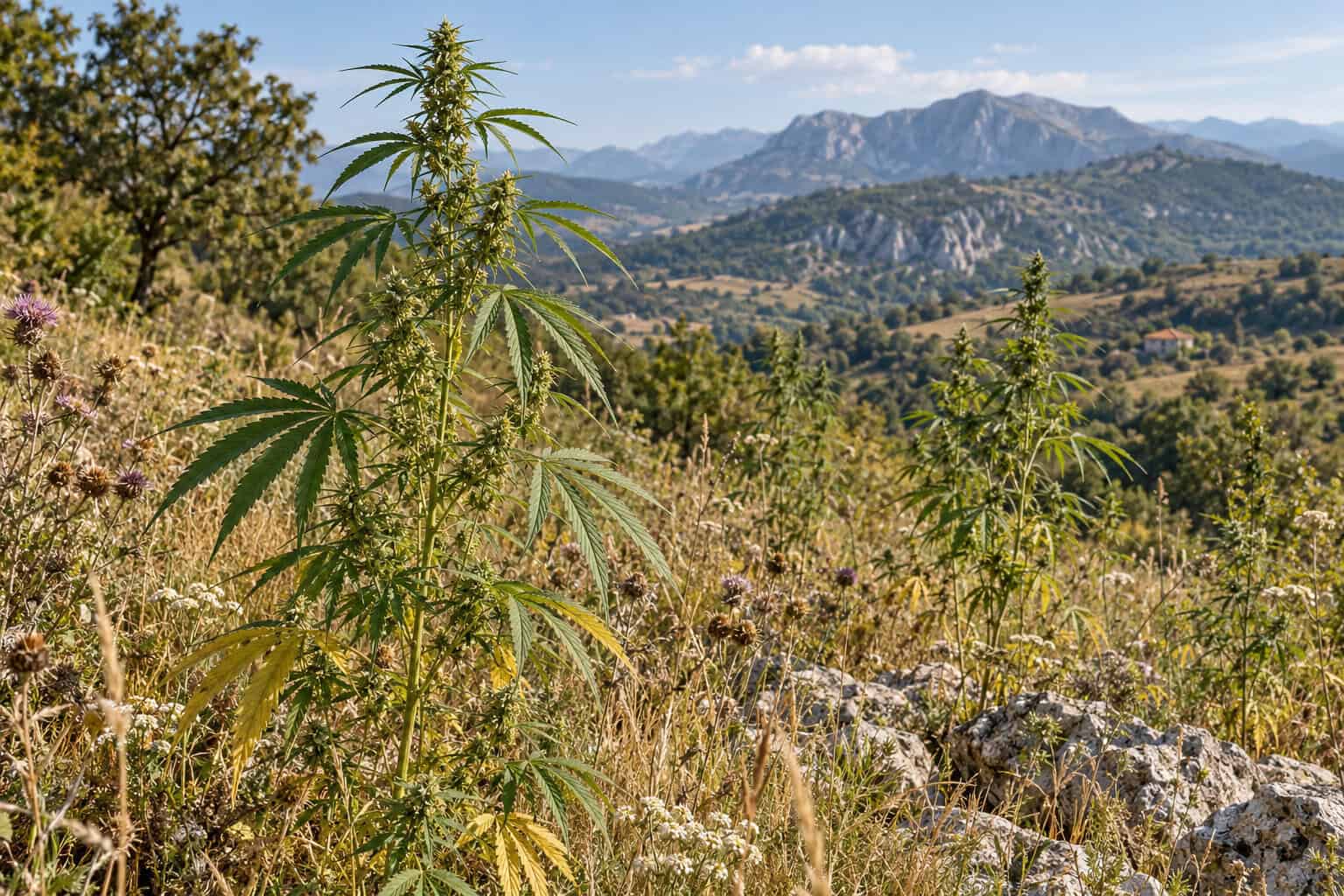
Somewhere between the roadside and the riverbank in North Macedonia, cannabis has been growing for years without anyone planting it on purpose. Seeds from old fields and abandoned gardens have produced plants that no breeding program ever selected. A research team from the Faculty of Pharmacy at Ss. Cyril and Methodius University in Skopje decided to ask a simple question: is this wild material worth anything to people who breed hemp?
Their answer, published in the journal Molecules in October 2026, is cautiously yes. The plants are distinct from the commercial cannabis strains they were compared with, they are rich in cannabidiol (CBD), and they contain very little of the compound that makes cannabis intoxicating. The authors call them “promising candidates” for hemp variety development, and they are careful to say that promising is not the same as ready. You can read the full study with its DOI, or the PubMed record, for the complete data.
Key Takeaways
Wild-origin cannabis from two regions of North Macedonia grew into plants that differed clearly from four commercial cultivars when grown outdoors under the same conditions. Their flowers were consistently CBD-dominant, with total CBD between about 5 and 7.6 percent, while total delta-9 THC stayed at or below 0.20 percent. Morphologically, the wild plants looked closest to Kompolti, a Hungarian hemp variety that has a long history in European registration. The strongest single result was a group from the Kočani region that produced ten female plants for every male, a ratio that could matter for flower production, though the authors say it still needs to be tested over more seasons. The study is a solid first look rather than a final verdict, because it covers one growing season and a small number of plant groups.
Plants That Grew Without a Breeder
Most of the hemp that Europe grows today comes from officially registered varieties. Those varieties have known origins, certified seed and documented traits, which makes them easy to compare across studies. Commercial cannabis is different. Many of the named strains sold in shops are hybrids whose parentage is poorly documented and whose names are not tied to any formal registration.
Wild-growing cannabis sits in a third category. In North Macedonia, such plants have been found in many places, but scientists do not yet agree on where they came from. The authors note there is not enough evidence to call them native, domesticated or leftovers from older hemp fields. They could be escapees from cultivation, descendants of historical hemp crops, or populations that have lived in the wild for a long time. Whatever their origin, they may carry traits built up over generations of local weather, soil and pests, including resilience and suitability for outdoor growing.
That is why the team set out to describe these plants systematically, using the same standards that plant-variety authorities use.
What the Researchers Measured
The team collected seeds from five groups of wild-origin plants. Three groups came from the Kočani region and two from the Strumica region, gathered in 2019 and 2020 from roadsides, village edges and a riverside bridge. Each seed lot came from a single parent plant, and the seeds were not pooled, so each group stayed separate.
The seeds were germinated in the laboratory, grown indoors for about a month, and then moved outdoors in 2021 at the facilities of a licensed cannabis company in North Macedonia. They grew alongside four commercial cultivars: Charlotte’s Angel, Bubba Kush × OG Kush, NYC Diesel and Great White Shark. Those four were chosen because they cover different chemical profiles, from CBD-rich to THC-rich.
Two kinds of data were collected. The first was morphology, scored against descriptors from UPOV, the International Union for the Protection of New Varieties of Plants. UPOV guidelines describe how a plant variety should be recorded, covering things like leaf shape, stem colour, height, sex expression and flower yield. The second was chemistry: the flowers were analysed by high-performance liquid chromatography to measure cannabidiol, THC and their acidic precursors. The authors also looked at terpenes, the aromatic compounds that give cannabis its smell and that are increasingly used to tell chemical types apart.
How the Wild Plants Looked Next to Commercial Cultivars
The clearest result was that the wild plants did not look like the commercial strains. A statistical model based on the UPOV traits separated the wild-origin plants from the commercial cultivars with strong explanatory power. The differences were not driven by one feature. Plant height, stem characteristics, leaf shape, seed traits and flower yield all contributed.
The wild plants were generally tall, with mean heights for most groups above 210 centimetres under outdoor conditions. The commercial cultivars were shorter on average, with NYC Diesel the smallest at around 123 centimetres. The wild plants also had yellow main stems and fewer leaflets per leaf than the commercial cultivars, and their central leaflets were much narrower than those of Charlotte’s Angel.
The wild-origin groups were not uniform, either. The plants partly grouped by where they were collected, with the Kočani and Strumica plants forming somewhat separate clusters. That is useful to breeders, because it suggests regional differences that a single collection point would miss.
Flower yield was respectable. Mean untrimmed flower yields for two Kočani groups, W1 and W2, were about 84 and 89 grams, within the range of the commercial cultivars.
The Hemp Connection: Kompolti and Registered Varieties
Perhaps the most interesting comparison involved registered varieties. The researchers combined their own UPOV data with published descriptions of registered varieties, including Estica and several varieties documented in Australia’s plant-variety system. In this expanded analysis, most of the wild-origin groups fell into the same broad phenotypic space as Kompolti, a Hungarian hemp variety first applied for in 1952.
Kompolti matters because it has been used as an example in UPOV’s own cannabis guidelines, and because it has been used as a comparator in Australian variety examinations. The Macedonian groups were not identical to it. They had fewer leaflets, grew taller, and had yellow rather than green main stems. The authors are explicit that the overlap is a morphological similarity, not a claim that the wild plants are Kompolti or any other registered variety.
Still, that similarity has a practical use. When a breeder or regulator later tests a new candidate for distinctness and uniformity, having a well-described reference variety that looks similar makes the comparison easier. The study points to Kompolti as a sensible starting comparator for that work.
Cannabinoids: CBD High, THC Low
The chemistry is the part most readers will focus on. All the wild-origin groups were classed as chemotype III, a category used for plants where CBD dominates over THC. Total CBD averaged between about 5.1 and 6.0 percent across most groups, with one plant reaching 7.61 percent. Total delta-9 THC stayed below 0.2 percent in every wild-origin group, with mean values between 0.14 and 0.17 percent for the four main groups.
The comparison with the commercial cultivars is revealing. Charlotte’s Angel contained more CBD than any wild group, averaging around 10.7 percent, but its THC content of about 0.6 percent went over the low-THC threshold that the study used for hemp. The two THC-dominant commercial strains, Bubba Kush × OG Kush and NYC Diesel, averaged close to 9 to 10 percent total THC, which is firmly in drug-type territory. Great White Shark sat in between, with a mix of both.
Put another way, the wild plants did not have the highest CBD in the set, but they combined a useful CBD level with a consistently low THC level. For a plain-language primer on what CBD is and how it is used, see our CBD complete guide. The authors place their CBD values within the upper part of the range reported for European hemp cultivars, and they point out that this combination is the real selling point.
The study also compared the wild plants with feral cannabis from other places. Populations in North America, Hungary and Serbia have been reported to show a range of chemical types, and the Macedonian material looked more uniform than many of them. That uniformity may be a result of the particular populations that were sampled, but it is an interesting observation for anyone thinking about breeding from wild stock.
Terpenes followed a similar picture. The wild-origin plants were dominated by myrcene and alpha-pinene, the same two compounds that lead several European hemp cultivars, including Kompolti and Tisza. The authors describe that as a broad pattern, not a precise match, since terpene profiles shift with growing conditions and sampling methods.
The Sex Ratio Question
One result stood out for growers. The Kočani group W1 produced ten female plants and one male. The researchers calculate that this is about 91 percent female. Dioecious cannabis, the type with separate male and female plants, usually shows a roughly balanced split, so this is unusual.
Why it matters: for flower production, growers want as many female plants as possible, because males produce pollen and little resin-rich flower. A reliably female-biased line could simplify production and reduce the cost of removing males.
The authors are careful, though. Sex in cannabis has a strong genetic basis, but it can also be shifted by environment, including day length, temperature, nutrition and stress. The ratio was seen in one growing season from one set of seeds. Other registered hemp varieties have also shown female-biased ratios, and one commercial cultivar reported 82.9 percent female plants. So the W1 result is promising, not proven.
What the Study Cannot Tell Us
The authors list their limitations clearly, and readers should take them seriously.
The experiment covered one outdoor growing season, in 2021. Environmental conditions change from year to year, and several of the study’s most attractive traits, including the sex ratio, are exactly the kind that need repeating across seasons.
The number of wild-origin groups is small: five, drawn from two regions. The chemical and morphological profile of Macedonian wild cannabis as a whole is still unknown. A sample of five groups cannot describe every population in the country.
The comparisons with registered varieties rely partly on published descriptions made in different environments, in different years, and possibly scored by different people. The authors call the expanded analysis exploratory, and they say directly that it does not assign the wild plants to any existing variety.
The study also does not include genetic analysis. Morphology and chemistry show that the plants differ from commercial cultivars, but they do not show how closely the wild groups are related to each other, to Kompolti, or to any other reference. The authors suggest that genetic work would be a natural next step.
Finally, the study is not a registration. It was not designed to produce a new variety, and nothing in it means the plants are ready to be sold as hemp seed. That step requires testing under formal rules.
Why It Matters for Breeding
Hemp breeding depends on material. Registered varieties give breeders a known starting point, but they also narrow the genetic base. Wild and feral populations can add diversity, and some of them may carry adaptations to local climates that cultivated lines lack. The Macedonian plants fit that idea. They grew outdoors without special treatment, produced substantial flower biomass, and kept THC low while CBD stayed high.
Regulation adds another layer, since the rules on hemp and CBD differ from one European country to the next. Our comparison of CBD regulation across Europe shows how much those rules vary. For a country that is still documenting its own wild cannabis, the study also does practical work. It shows that the plants can be described with the same tools used for registered varieties, which opens the door to future comparisons. The authors describe the material as a potential resource for agronomic evaluation, chemical selection and registration-oriented research. That is a long road, but the first map has now been drawn.
For readers, the main lesson is about how new cannabis material is evaluated. A plant can be interesting because it is chemically unusual, or because its traits suggest a stable and useful line. This study tries to do both, and it does so by measuring rather than making claims.
Frequently Asked Questions
UPOV is the International Union for the Protection of New Varieties of Plants, a treaty organisation that sets standards for describing and protecting plant varieties. Its guidelines list specific traits, such as leaf shape, plant height and sex expression, that breeders and examiners use to tell varieties apart. The Macedonian study used UPOV descriptors to make its wild plants comparable to registered varieties.
No. Across all wild-origin groups in the study, total delta-9 THC stayed at or below 0.20 percent, while total CBD ranged from about 5 to 7.6 percent. The plants are classed as CBD-dominant. They are not a source of intoxicating material.
In the United States, federal law defines hemp as cannabis containing no more than 0.3 percent total THC on a dry-weight basis. The study’s THC figures sit below that line, but that does not settle the question for any particular grow, because the THC level is measured on the crop itself, and state rules can add further requirements and licensing steps. The study itself does not address US law. This article does not provide legal advice, and anyone planning to grow cannabis should check current federal and state rules.
No. The authors say the comparison with Kompolti shows morphological similarity, not varietal identity. Registering a new variety requires formal testing for distinctness, uniformity and stability, and this study was not designed to do that. It is a first characterization that could inform such testing later.
Important Legal and Health Information
This article summarises a scientific study for general information. It does not provide medical, legal or agricultural advice, and it does not encourage anyone to grow, buy or use cannabis. Laws on cannabis differ widely between countries and states, and they change over time. Readers should consult qualified professionals and official sources before making decisions about cannabis.