
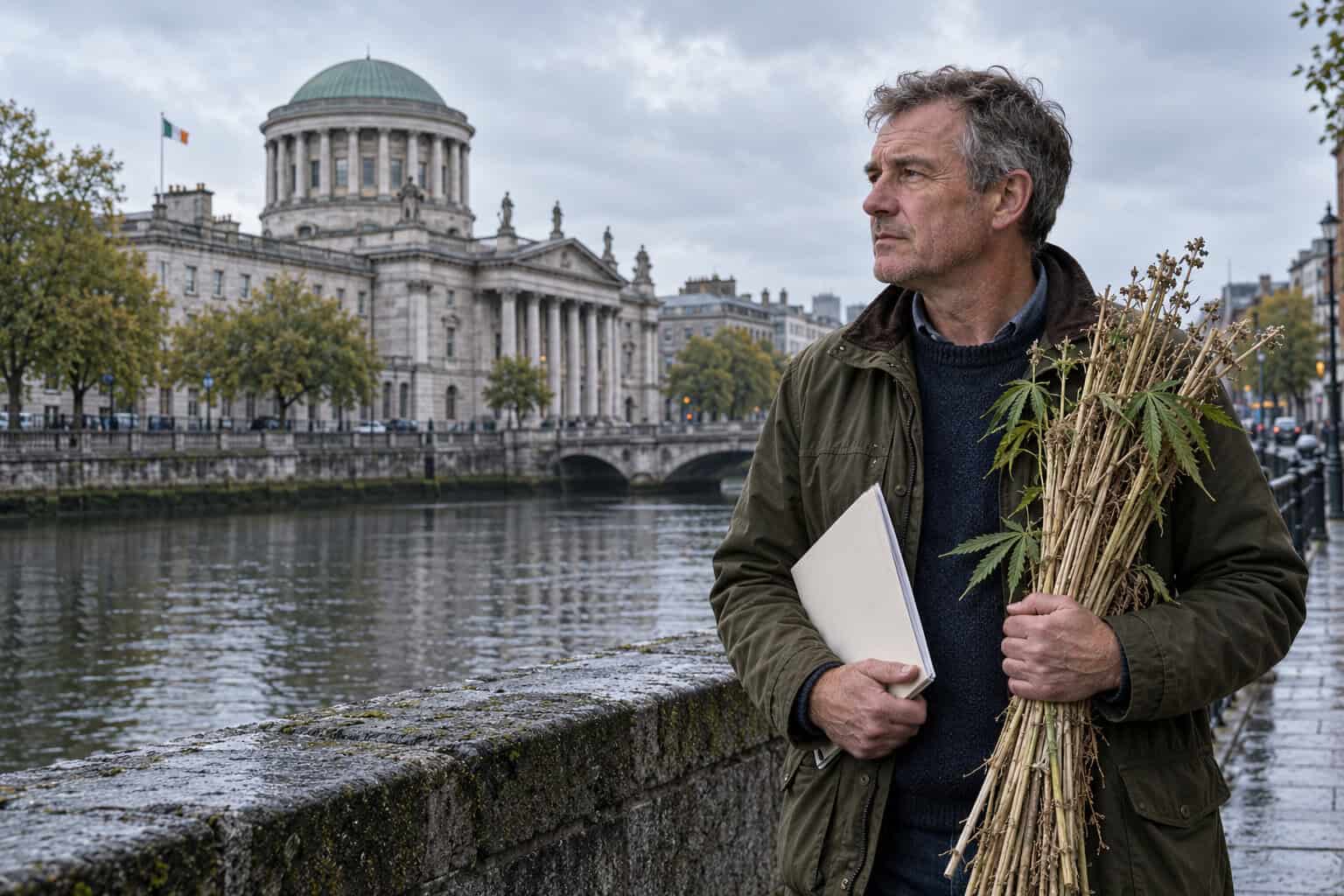
On 19 October 2026, Ireland’s agriculture minister chaired the meeting at which EU governments agreed that every part of the hemp plant, flowers included, should count as an ordinary farm product across the Union. A few hundred kilometres west, in County Clare, a 63-year-old former airline pilot is waiting for the Irish High Court to decide whether the same plant, grown under the same EU limit, can send him to prison for at least ten years. The Ireland hemp High Court EU case brought by Brendan O’Mara is the most direct challenge yet to the way Irish law classifies hemp, and it lands at the moment Brussels is moving the opposite way.
The case was laid out this week by Business of Cannabis in its analysis of Ireland’s hemp prosecutions, published on 20 October 2026, and the court record behind it was reported in September by TheJournal.ie from Ennis District Court. This article draws on both, on the Irish court judgments that came before, and on the EU documents that now frame the dispute.
Key Takeaways
Brendan O’Mara, a former Ryanair pilot and member of Hemp Federation Ireland, was charged after gardaí seized about 502 kilograms of plant material at his home in May 2025; he says it was low-THC hemp, and he denies the charge. In the High Court he is asking for declarations that listing hemp with 0.3% THC or less under Schedule 1 of the Misuse of Drugs Act 1977 is unlawful under EU law, that hemp is an agricultural good, and that the Act conflicts with EU legislation. His criminal case is adjourned to 9 December 2026 while the High Court decides. Irish courts have so far sided with the State, drawing a sharp line between the plant in the field, which may be grown at up to 0.3% THC under licence, and any product made from it, which must contain no THC at all. That approach has made Ireland an outlier in Europe, and the Irish hemp crop has shrunk from 314 hectares in 2019 to 11 hectares this year. At EU level, the Council’s new negotiating position keeps the whole plant inside farm law at 0.3% THC, but it also adds safeguards for national drug rules, so it does not automatically settle O’Mara’s case. The most likely decisive voice is the EU Court of Justice in Luxembourg, which is already handling an Italian referral on hemp flowers.
The Ireland Hemp High Court Case: What Brendan O’Mara Wants the Court to Declare
The facts, as reported from court, are simple. On 7 May 2025, gardaí searched O’Mara’s home at Meelick, County Clare, and seized plant material weighing roughly 502 kilograms. He was charged with possessing cannabis for sale or supply with a market value of €13,000 or more, the threshold for the more serious offence under Section 15A of the Misuse of Drugs Act. Prosecutors put the value at about €10 million. When charged, he replied that he was not guilty.
He spent almost three months on remand before the Court of Appeal overturned a refusal of bail at the end of July 2025. The conditions were heavy: an independent surety of €150,000, his own bond of €70,000 with €35,000 lodged, surrender of his passport and pilot’s licences, and an undertaking not to attend any airfield.
His defence is not that the material was something other than cannabis. It is that cannabis below the EU hemp limit is, in law, a farm crop. His solicitor told Ennis District Court that the substance was low-THC hemp that would be treated as agricultural goods elsewhere in Europe, and that two cases pending at the EU Court of Justice could bear on the outcome. The High Court challenge asks for three declarations: that including hemp of 0.3% THC or less in Schedule 1 of the 1977 Act is invalid under EU law, that hemp is an agricultural good, and that the Act is at odds with EU legislation. On 9 September 2026, Judge Adrian Harris adjourned the criminal case to 9 December pending that ruling.
Two points of caution belong here. O’Mara’s account of what was seized has not been tested in court, and the THC content of the material has not, as far as public reporting shows, been put in evidence. And a declaration that a law is incompatible with EU law is a high bar; Irish judges have so far refused every version of this argument.
Is Hemp Legal in Ireland? A Crop in the Field, a Drug in the Bottle
Botanically, hemp and marijuana are the same species, Cannabis sativa. The difference is legal, and it turns on THC, the compound that produces a high. Across the EU, hemp varieties may be grown with CAP farm support if the plants contain no more than 0.3% THC, under the Common Agricultural Policy rules in Regulation (EU) 2021/2115.
Ireland accepts that much, but only for the field. Cannabis, including hemp, sits in Schedule 1 of the Misuse of Drugs regulations, the strictest tier. A farmer needs a licence from the Minister for Health, processed by the Health Products Regulatory Authority. In a Dáil answer in June 2026, the Health Minister confirmed that the flowering tops and leaves of licensed hemp must not be processed further, and that every applicant signs an undertaking to that effect. Those are the parts that contain CBD, which is the main reason anyone grows hemp for the consumer market.
Imagine a country that lets farmers grow barley with EU subsidies but treats every bottle of beer brewed from it as contraband if it holds a trace of alcohol. That is roughly the position hemp businesses describe. The field crop can be up to 0.3% THC. The oil in the bottle must contain none.
Ireland’s medical cannabis access programme and its penalties for recreational possession are covered in our country-by-country guide to cannabis laws in Europe. The hemp question is separate: it is about whether a product the EU treats as agricultural can be prosecuted as a drug at all.
How Irish Courts Have Ruled So Far
The anchor of the industry’s argument is the Kanavape judgment of the EU Court of Justice of 19 November 2020. The court held that CBD is not a narcotic under the UN Single Convention, and that a member state may block CBD lawfully produced in another member state from the whole plant only if the ban genuinely protects public health and goes no further than necessary.
Irish courts have read that ruling narrowly. In 2022 the High Court rejected the first test case, brought over a litre of CBD oil, in what became known as the Bogusas case. In 2024 it ruled against Denise Lynch, a shop owner from Cavan whose seized CBD oils contained no more than 0.20% THC. On 3 November 2025 the Court of Appeal dismissed her appeal. Mr Justice Anthony Collins found that Kanavape was about the THC content of the plant, not of the finished product, and that Lynch had produced no evidence of the THC level of the plants her oils came from. The court declined to refer the question to Luxembourg. Lynch is now seeking leave to go to the Supreme Court.
There has been one significant crack. In May 2022, Ms Justice Emily Egan granted a Tipperary hemp retailer, Mark Jenkins, a stay on a criminal prosecution while he challenged the import ban. She noted that independent testing put the seized material below 0.2% THC and that neither the State nor the prosecution had offered any evidence, scientific or otherwise, that the ban was needed to protect health. The stay covered only the first of his three prosecutions, because the necessary test results had not been put before the court for the other two.
The pattern matters for O’Mara. The cases the State has won turned partly on missing evidence about the plants. A case built around a large quantity of raw plant material, if its THC content is documented, would test the legal question more squarely. Other retailers’ challenges, including those of Little Collins in Galway and Puff n Stuff in Youghal, both raided in April 2019, are still waiting to be heard. JP O’Brien of Little Collins, who has traded since 2018, summed up the mood to Business of Cannabis: “You have to be half mad to still be doing this at this stage.”
The €10 Million Figure and the Price That Quietly Changed
The headline value in O’Mara’s charge rests on a number the State has since changed. Until August 2026, Garda and Revenue press releases valued herbal cannabis at €20,000 a kilo, which is how 502 kilograms becomes €10 million. An analysis of 449 Garda and Revenue seizure figures published by the Irish site cannabidiol.ie found that releases on individual seizures switched to €14,000 a kilo between 10 and 26 August 2026, with no public announcement. The Irish Times reported that Garda research put the wholesale price at €3,500 to €4,000 a kilo.
This is not a technicality. Section 15A, with its 10-year presumptive minimum sentence, applies once the market value of the drugs reaches €13,000, and the courts use street value as the test. At €20,000 a kilo, that line was crossed at 650 grams. At €14,000, it is about 929 grams. Applied to the same 502 kilograms, the new rate gives roughly €7 million instead of €10 million. That is simple arithmetic, not a claim about how the figure will be argued in court, where market value is a matter of evidence. It also does not touch the underlying question of whether low-THC hemp should be valued as a drug in the first place.
From 314 Hectares to 11: What Happened to Irish Hemp Farming
Ireland had its CBD boom around 2017 and 2018, like much of Europe. Shops, processors and growers appeared across the country. The cultivation figures tell what happened next. According to Department of Agriculture data, the hemp area peaked at 314 hectares in 2019, up from 17 hectares in 2015. By 2021 it had fallen to 153 hectares. This year, according to evidence heard by the Oireachtas Joint Committee on Agriculture and Food on 1 July 2026, as reported by Business of Cannabis, just 11 hectares were registered.
The committee heard that the controlled-drugs framework drove the collapse as much as the lack of processing plants did. That is consistent with the economics: a farmer who must destroy the flowers and leaves is left with stalks and seeds, and the Department of Agriculture’s own consultation concluded that growing hemp for fibre alone is not currently viable in Ireland.
The industry also disputes how the current licensing regime came about. It says that in 2021 the Health Minister moved hemp licensing from an agricultural footing to a criminal-law one without consultation, and without notifying the European Commission as required for technical rules under Directive (EU) 2015/1535. Under EU case law, a national technical rule that should have been notified but was not can be unenforceable against individuals. A judicial review by Hemp Federation Ireland members makes that argument. It has not yet been decided, and the State’s answer to it is not on the public record.
Brussels Moves the Other Way, With Ireland Holding the Pen
The EU half of the story moved fast this month. In July 2025 the European Commission proposed amending the rules on the common organisation of agricultural markets so that hemp flowers, leaves and other plant parts would be recognised as agricultural products, with a 0.3% THC cap and certified seed. In May 2026, a European Parliament committee backed using CAP funds for the hemp sector on the basis of cultivated area.
On 19 October 2026, the Council of the EU agreed its own partial negotiating position. According to the Council’s press release, governments kept the Commission’s plan to harmonise hemp production and marketing, so the sector would cover all parts of the plant, with strict seed certification and a 0.3% limit for delta-9 THC. The meeting was chaired by Ireland, which holds the rotating presidency, and the minister presenting the deal was Martin Heydon, the same Irish agriculture minister who told the Dáil in February 2025 that hemp cannot be grown in Ireland without a Department of Health licence. The Brussels outlet Rapporteur had reported a week earlier that hemp was the last obstacle to the Council’s agreement.
There is an important qualifier that the industry’s framing tends to skip. The Council also added safeguards to ensure the new hemp rules do not interfere with national rules on public security, drugs or health. In plain terms, member states wrote themselves a reservation. If that wording survives negotiations with Parliament, it could be read as preserving exactly the kind of national drug-law discretion Ireland relies on. The full text of the Council’s negotiating mandate will matter more than the headline, and the final law depends on talks with the Parliament that have only just begun.
The Luxembourg Route: Italy’s Referral and What It Could Mean for Ireland
The question Irish courts have declined to send abroad is already in Luxembourg by another door. In November 2025, Italy’s Council of State referred the Italian ban on hemp flowers to the EU Court of Justice, asking whether EU law, which draws no distinction between plant parts, allows a country to prohibit the leaves and flowers of approved low-THC varieties. Business of Cannabis reports a parallel reference from the Netherlands and does not expect a ruling before the end of 2026.
A CJEU answer would bind courts in all 27 member states, including Ireland’s. That is why O’Mara’s legal team has pointed to pending European cases. The comparison with other countries is instructive: our review of CBD regulation across nine European countries shows how differently governments classify the same products, and Greece has just adopted a zero-THC retail rule with a similar logic to Ireland’s, which we examined in our piece on Greece’s full-spectrum CBD ban.
What This Case Can and Cannot Settle
It helps to separate what is known from what is argued. Known: the charge, the bail conditions, the declarations sought, the 9 December date, the Irish judgments to date, and the Council’s new position. Argued, and not yet tested: that the seized material was compliant hemp, that the 2021 licensing change should have been notified to Brussels, and that EU farm law overrides Ireland’s drug schedules.
The State’s case also has a real foundation. EU law gives member states room to protect health, and the quality of hemp products is uneven: a European laboratory study found that about half of CBD oils did not contain what their labels claimed. That is an argument for testing finished products, though, rather than for treating every trace of THC as a controlled drug. Kanavape requires the State to show a genuine risk, and in the Jenkins case the State offered no evidence at all.
Even a win for O’Mara would not legalise recreational cannabis or high-THC products in Ireland. It would decide whether plant material within the EU hemp limit can be prosecuted under the 1977 Act. That alone would reshape a sector that, by its own account, has been waiting seven years for Irish law to decide whether a low-THC plant is a crop or a drug.
FAQ
They are the same plant species. The distinction is legal and rests on THC, the intoxicating compound. In the EU, varieties grown as hemp must stay at or below 0.3% THC in the field and be listed in the EU’s catalogue of approved varieties. Plants above that level are treated as drug cannabis. Hemp is mainly grown for fibre, seeds and, in many countries, CBD.
Growers need a Department of Health licence and must not process the flowers and leaves, which are the most valuable parts for CBD. Without those, and without processing plants for fibre, the crop rarely pays. The registered area fell from 314 hectares in 2019 to 11 hectares in 2026, according to evidence given to an Oireachtas committee.
There is no fixed date for the High Court judgment. The criminal prosecution in Ennis District Court is adjourned to 9 December 2026 pending that ruling. A separate answer could come earlier or later from the EU Court of Justice in the Italian hemp referral, which would apply across the EU.
A product being legal under US federal hemp rules does not make it legal in Ireland. Irish law treats any product containing THC as a controlled drug, whatever the concentration, unless a specific exemption applies, and Irish courts have upheld that position. Many full-spectrum CBD oils and hemp flower products sold in the US contain measurable THC, so carrying or posting them into Ireland can expose the sender or recipient to prosecution. EU free-movement arguments, which are at the heart of the O’Mara case, generally concern goods lawfully produced or imported within the EU, not goods arriving from the US.
Legal Disclaimer
This article is journalism about court proceedings, legislation and published reporting. It is not legal advice and does not recommend growing, buying, selling, carrying or using any cannabis, hemp or CBD product. Brendan O’Mara has been charged but not convicted, has denied the charge, and is presumed innocent; the accounts of the seized material given here are his and his lawyers’ and have not been tested in court. Irish, EU and US rules on hemp and cannabinoids differ and change frequently, and the EU legislation described here is still under negotiation. Anyone affected by these rules should take advice from a qualified lawyer in the relevant jurisdiction.

