
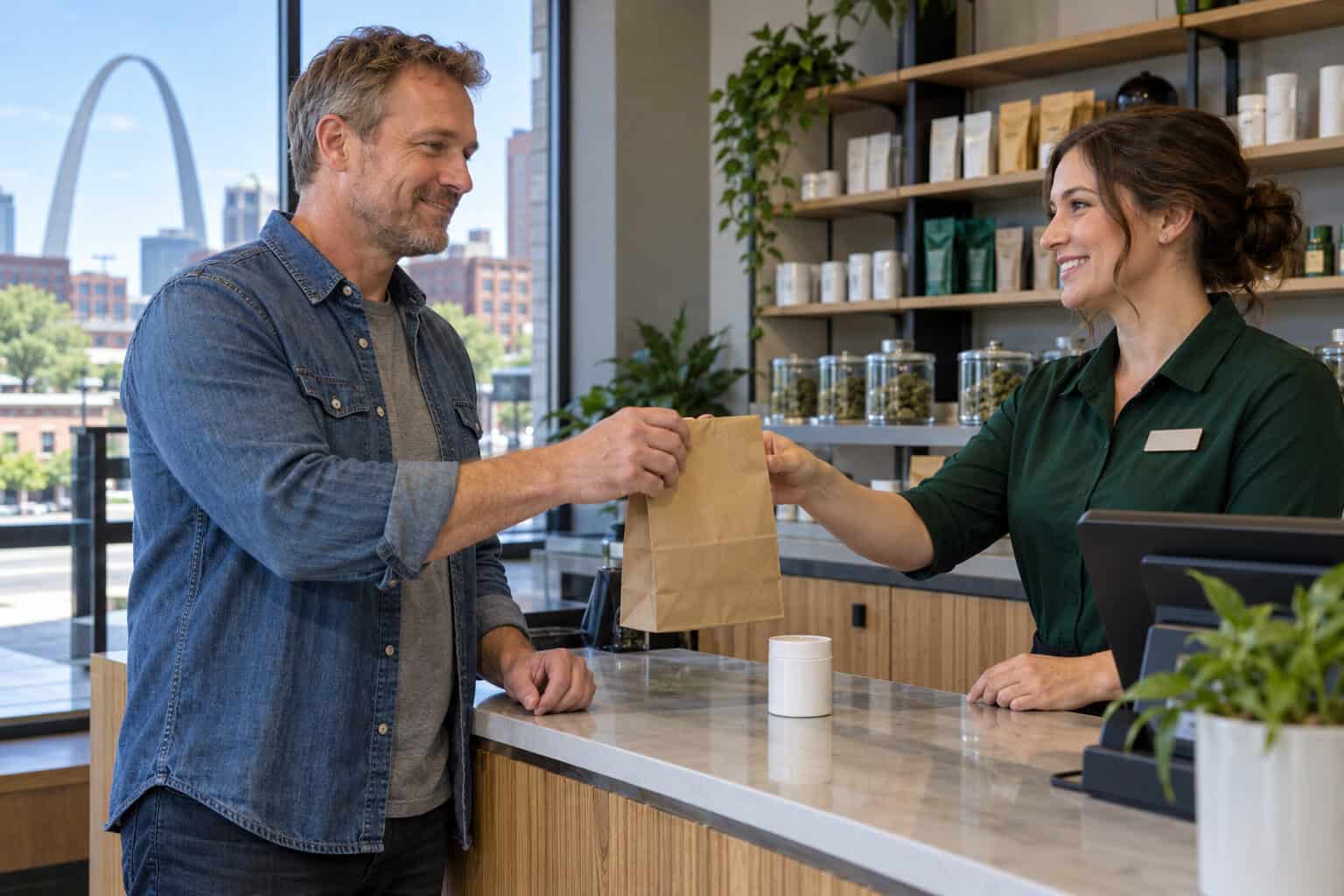
Ask a cannabis buyer in Missouri why they shop at a licensed store, and “because it’s legal” is rarely the first answer. The first state-commissioned Missouri cannabis regulated market study now puts numbers on that hunch: licensed dispensaries capture about 93% of what consumers spend on cannabis, yet only 17% of buyers say legality influences what they buy. Price and THC potency do the heavy lifting.
The report, Missouri Cannabis Market Study: Phase 1 Report, was released in mid-October 2026 by the Missouri Department of Health and Senior Services and its Division of Cannabis Regulation (DCR). It was carried out by Cannabis Public Policy Consulting (CPPC), with Gideon Cunningham as principal investigator and Mackenzie Slade, Summer Fox and Mimosa Khatun as co-authors. The department’s own announcement describes it as the first market study published for Missouri since the state built its legal cannabis industry, and as Phase 1 of a two-part project; a separate economic impact report is due later this year.
Key Takeaways
Missouri’s licensed dispensaries and delivery services account for roughly 93% of reported monthly cannabis spending, and that share stays above 90% in every one of the state’s eight congressional districts. The figure describes money, not people: many consumers still pick up some cannabis from friends, family or dealers, even if those purchases are small. When asked what shapes their buying decisions, 66% of consumers named price and 58% named THC potency, while only 17% named whether the product was obtained legally. Among people who had bought from an illicit seller in the past month, 62% said it was cheaper, and not one respondent blamed a lack of adult-use stores nearby. Flower still takes about half of all spending, but vapes and pre-rolls are growing fastest. Hemp-derived THCA has quietly reached 15% past-month use among Missouri cannabis consumers. The consultants conclude the market is competitive, not overcrowded, and see no need to issue more licenses right now. The evidence comes from a self-reported survey checked against state sales records, which makes it stronger than a typical poll but still a snapshot of one spring.
Inside the Missouri Regulated Market Study: Who Was Asked and How
The study rests on two pillars. The first is a survey of 1,200 Missouri adults who had used cannabis in the previous 30 days, collected between March 16 and April 3, 2026. Most respondents (93.7%) were recruited by text message from voter files and commercial records, and the rest through an online panel that verifies its members. The stated margin of sampling error is plus or minus 2.8 percentage points. After quality checks removed speeders, duplicates and statistical outliers, 1,033 respondents remained in the cleaned sample, 208 of them registered medical cannabis patients.
The second pillar is hard data: 35 months of Missouri’s track-and-trace records, the system that logs every licensed plant, transfer and sale in the state. This is what makes the study more than an opinion poll. The researchers took the survey’s estimate of how much people spend at dispensaries, scaled it up to the state’s cannabis-consuming population, and compared it with the actual sales recorded for the same month. The real figure fell inside the survey’s confidence range.
Think of it like checking a pre-election poll against the actual vote count. If the poll nails the result for the candidate whose votes you can count, you have more reason to trust what it says about the candidates you can’t count directly. Here, the countable candidate is legal sales, and the uncountable ones are dealers, friends and home grows.
93% of Spending, Not 93% of People
Several headlines have reported that 93% of Missouri consumers use the legal market. That is not quite what the report says. The 93% is a share of dollars.
On average, a past-month cannabis consumer in Missouri spent $161.81 a month. Of that, $149.95 went to licensed stores and delivery services. Dealers took $5.26, purchases from friends or family $4.79, and home growing, caregivers, gifts and other sources together accounted for less than two dollars.
Counting products instead of dollars gives a slightly different picture. The share of past-month units bought through licensed channels was 93% for pre-rolls, 88% for vapes, 86% for edibles, 85% for flower and 82% for concentrates. Beverages were the clear outlier at only 55%, which the authors link to hemp-derived THC drinks being sold outside dispensaries. So the legal market dominates, but the “leakage” is uneven and sits mostly in a few product types.
Price and Potency Beat the Law
The most striking result is about motivation. Consumers were asked which characteristics influence their cannabis purchases, and could pick as many as they liked. Price came first at 66%, THC potency second at 58%, then convenience at 40% and strain at 36%. Safety and testing for contaminants mattered to 26%. Whether the product was obtained legally mattered to just 17%.
When forced to name the single most important factor, 30% chose price and 26% chose THC potency. Legal status was the top factor for only 4%. In fact, legality was more likely to be listed as the least important consideration than the most important one.
The authors read this as a sign that Missouri’s licensed stores are winning on the attributes customers actually care about, rather than on the moral pull of the law. They also note that safety beat legality, which suggests that messages about tested, labelled products may persuade consumers more than reminders about compliance.
Why Some Missourians Still Buy From Dealers
Respondents who had bought from an illicit seller in the past month were asked why. The answers were mostly economic: 62% said it was cheaper, 35% said it was more convenient, 23% said they prefer to support community or small businesses, and 19% said they get products they like more. Distrust also played a part, with 18% saying they don’t trust government regulation and 11% saying they trust illicit products more than regulated ones.
Access barely registered. Only 6% cited the absence of medical dispensaries or caregivers in their area, and 0% said there were no adult-use stores near them. Asked for the single most important reason, 46% said price. No other reason passed 12%.
For regulators, this reshapes the question. In many young legal markets, the fix for the illicit trade is more stores. In Missouri, the study suggests the remaining illicit market is a pricing problem, not a geography problem.
The Grey Zone: Friends, Family and Legally Bought Cannabis
The report spends real time on informal sharing, and the findings are subtle. Among consumers who received or bought cannabis from friends or family, about 56% said it originally came from a regulated dispensary or its delivery service. Around 23% said it was homegrown, 22% weren’t sure, and only about 5% traced it to an illicit seller.
In other words, much of what looks like the “illicit” share is legal cannabis changing hands after the sale. Sharing is common: more than six in ten respondents said they had shared a product with someone at least sometimes. Direct selling is rare, with just 4% reporting that they had ever sold cannabis. The report notes that selling cannabis to friends or family counts as illicit even when the product was bought legally, and recommends more research on this secondary market. The same pattern of legal supply seeping into informal channels shows up at a global scale in the UN’s latest drug report.
Home growing, often feared as a rival to licensed stores, turns out to be small. Only 3% of respondents were growing at the time of the survey, 16% had grown in the past, and 81% never had. Current growers kept an average of 4.77 plants, with a median of four.
Medical Patients Spend More, Across the Board
Missouri’s 208 surveyed medical patients spent more than adult-use consumers in every major product category. Patients spent an average of $96.00 a month on flower, against $76.70 among adult-use consumers. The gap was widest for edibles, where patients spent $45.61 compared with $20.19, more than double. Patients also used dispensary delivery much more, for example $7.07 on delivered flower versus $1.58.
This tracks with Missouri’s tax design. Medical purchases carry a 4% state tax, while adult-use purchases pay 6%, plus up to 3% in local tax where voters approve it. But the authors warn against reading too much into the patient numbers: their weighting could not correct for patient demographics, so the 208 patients may not represent all of Missouri’s medical program.
THCA and Hemp: The Market Next Door
The survey also asked about cannabinoids sold outside the licensed system. CBD was the most familiar, with 22% past-month use and another 41% who had used it before. Among intoxicating hemp-derived products, THCA stood out: 15% of respondents had used it in the past month. Delta-8 THC reached 6% past-month use, and hemp-derived delta-9 THC 5%.
The consultants judge that these products remain a supplement rather than a substitute for the licensed market, and they advise monitoring rather than new regulation for now. Two caveats matter. First, the authors admit consumers often can’t tell which hemp-derived cannabinoid they consumed, so these answers are less reliable. Second, the DCR has reported that unregulated shops selling hemp-derived cannabinoids have become common across the state, and survey respondents may not always know whether they bought from a licensed dispensary or from one of those shops.
This part of the market is about to change for reasons outside Missouri’s control. A federal law passed in November 2025 redefines hemp by total THC, including THCA, and caps finished hemp products at 0.4 milligrams of total THC per container. Congress has since pushed the effective date back to December 11, 2026. Earlier research has shown that intoxicating hemp products thrive where cannabis stays illegal; Missouri will offer a test of what happens to that demand in a state where licensed stores are already everywhere.
A Market That Grew Without Getting Crowded
The second half of the report uses track-and-trace data to check whether a few players dominate the market. Annual dispensary sales rose about 16%, from $1.30 billion in 2023 to $1.51 billion in 2025, while the number of active dispensary licenses grew from 201 to 220. Average sales per store held steady at roughly $6.5 million to $6.9 million a year, meaning new stores didn’t simply slice the same pie thinner. Monthly statewide sales generally ran between $115 million and $130 million.
Under the surface, tastes are shifting. Monthly flower sales slipped from peaks above $60 million in early 2023 to about $51 million to $57 million by late 2025. Vape sales roughly doubled over the same period, from about $18 million a month to more than $35 million, and pre-rolls climbed from $8 million to $9 million a month to $17 million to $18 million.
To measure concentration, the consultants used the Herfindahl-Hirschman Index, a standard antitrust yardstick that rises as sales pile up in fewer hands. Dispensary, cultivation and manufacturing sales all stayed well below the thresholds for a highly concentrated market, statewide and in every district. One important limit: the index was calculated per license, not per owner, because usable ownership data wasn’t available. A company holding several licenses would look like several independent competitors.
Missouri’s arrival also reshaped its neighbours. Our Illinois cannabis sales breakdown shows that out-of-state buyers’ share of Illinois adult-use dollars started falling in 2023, the year Missouri opened adult-use stores. For how a single state’s numbers fit into global estimates, see our explainer on how big the cannabis market really is.
Not Every District Looks the Same
Average monthly spending ranged from $240.50 in District 6 to $108.30 in District 5, a difference the researchers found statistically significant. District 6, a large and largely non-metropolitan area, also had the highest licensed dispensary spending at $218.30, while District 5, which includes the Kansas City area, had the lowest at $99.43.
District 7 had the lowest regulated share and the heaviest reliance on purchases from friends and family. It was also where price mattered most: 81% of consumers there named it as a purchasing factor, compared with 52% in District 1. The importance of convenience swung from 18% in District 8 to 50% in Districts 2 and 3. The authors stress caution here, because the survey could not be weighted at the district level.
How Much Weight Can These Numbers Bear?
On the strength side, the survey used probability-based recruitment, a respectable sample, and, crucially, a reality check against official sales data. That is better than most consumer surveys in the cannabis space.
On the weakness side, the report lists its own limits plainly. Everything about illicit and informal purchases is self-reported, so recall errors and the urge to give socially acceptable answers can creep in. It is a single snapshot from spring 2026, so it shows associations, not causes. Rare behaviours such as home growing, caregiver use and some hemp cannabinoids rest on small numbers. And the survey gave respondents examples of each source rather than strict definitions, which leaves room for confusion between licensed and unlicensed shops.
There is also context worth stating. CPPC designed the survey instrument it used, and its chief executive, Mackenzie Slade, is both a co-investigator on the report and the person who publicly praised the result: in a statement she called capturing more than 90% of spending within three years a significant accomplishment. That does not make the findings wrong, and the track-and-trace check is an independent anchor. But readers should know who is grading the exam.
What Comes Next for Missouri
Missouri legalized medical cannabis by constitutional amendment in 2018 and adult use in 2022, with adult-use sales starting in February 2023; our state-by-state guide to US cannabis laws shows where it sits nationally. Adults 21 and over may possess up to three ounces and, with a state-issued personal cultivation card, grow up to six mature plants.
The consultants’ main recommendation is to hold steady. Missouri allocates dispensary licenses by congressional district, with at least 24 per district written into the constitution. CPPC suggests that, in the long run, demand rather than district lines should guide where new stores open, but acknowledges that changing the constitution is unlikely soon. In the meantime, it lists options from keeping the current structure to adding licenses only in more concentrated districts. It also recommends collecting de-identified ownership data so future studies can see who really controls the market, more research on informal redistribution, and incentives such as grants or tax breaks for cannabis businesses in underserved areas.
The state has its own changes underway. Missouri plans a final round of at least 77 microbusiness licenses in late 2026, and the Phase 2 economic impact report is expected to follow. The DCR has said it will take a fresh look at the market in the years ahead and add ownership data to future studies.
FAQ
According to state track-and-trace data cited in the report, Missouri dispensaries sold $1.51 billion worth of cannabis in 2025, up from $1.30 billion in 2023. Monthly sales usually fall between $115 million and $130 million, spread across about 220 active dispensary licenses.
Mostly because of price. Among consumers who bought from an illicit seller in the past month, 62% said it was cheaper and 46% named price as their single most important reason. Convenience came second. Almost nobody cited a lack of nearby stores.
Flower, which accounts for roughly half of all reported spending at an average of $80.88 a month per consumer. Vapes ($28.40) and edibles ($25.69) follow. In sales data, vapes and pre-rolls are the fastest-growing categories, while flower’s monthly sales have edged down since 2023.
No. Missouri’s constitution allows adults 21 and over to buy cannabis from licensed dispensaries, possess up to three ounces, and, with a state personal cultivation card, grow up to six mature plants for personal use. Selling cannabis outside the licensed system, including to friends or family, is treated as an illicit sale even if the product was originally bought from a dispensary. Cannabis also remains restricted under US federal law, so state legality does not remove every legal risk.
Legal Disclaimer
This article is for informational and educational purposes only. It summarizes a government-commissioned market study and does not constitute legal, medical, financial or investment advice. Cannabis laws differ between US states and between state and federal levels, and they change frequently. Readers should consult official state sources or a qualified attorney before making decisions related to buying, possessing, growing or selling cannabis. The Cannex does not encourage illegal activity or cannabis use by anyone under the legal age.


