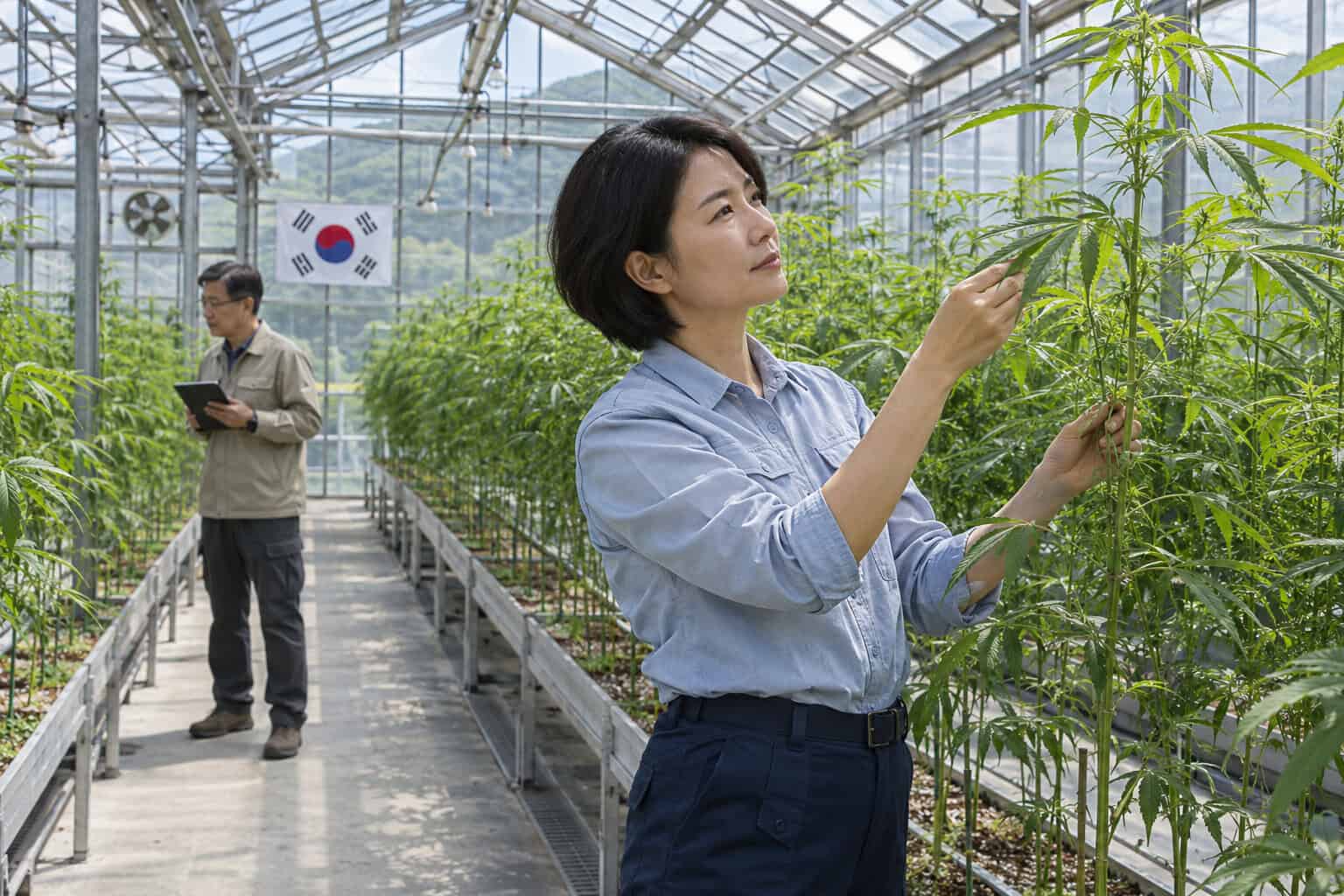
Headlines about South Korea CBG, CBN and CBC legalization have been circulating since early November, and they make it sound as if one of the strictest cannabis regimes in Asia is about to open the door to three more cannabis compounds. The reality is narrower and, for anyone following the global CBD market, more interesting. From 2027, a single fenced-off test zone in the city of Andong will be allowed to produce and study cannabigerol (CBG), cannabinol (CBN) and cannabichromene (CBC) as raw materials for medicines. Nobody in South Korea will be able to buy a CBN gummy or a CBG oil as a result.
The story reached international readers through a report by the French cannabis outlet Newsweed published on November 4, 2026, which in turn relied on Korean news agency Newsis. The underlying decision is older and comes from the government itself: on June 29, 2026, South Korea’s Ministry of SMEs and Startups and the Office for Government Policy Coordination designated seven new regulatory-free zones, one of which extends Andong’s existing hemp pilot from CBD alone to what Korean officials call “trace cannabinoids.” The fresh element is the money and the timetable, which Andong city confirmed after Minister of SMEs and Startups Lee So-young visited the zone on October 30, 2026.
Key Takeaways
South Korea has not legalized CBG, CBN or CBC; it has widened a regulatory sandbox in Andong, North Gyeongsang Province, so that licensed companies can extract and handle these compounds as pharmaceutical raw materials under strict state monitoring. The new pilot runs from 2027 to 2030 with a total budget of 29.5 billion won, of which 14.7 billion comes from the national government, 12.5 billion from local governments and 2.3 billion from private companies. Everything outside the zone stays the same: the Supreme Court ruled in May 2025 that CBD, THC and CBN are “cannabis” under Korean law no matter which part of the plant they come from, and food regulators are actively testing imported products for CBN and CBG. For the global market the signal is about supply rather than demand, because Korea is building toward EU-standard factories that could one day export pharmaceutical-grade minor cannabinoids, while neighbouring Japan has just banned CBN outright. The science on all three compounds is still mostly preclinical, so the commercial bet is running well ahead of the clinical evidence.
What the South Korea CBG, CBN and CBC legalization headlines actually describe
A “regulatory-free zone” is South Korea’s version of a regulatory sandbox. Think of it as a walled garden where a handful of approved companies are temporarily excused from specific rules so the government can watch what happens before deciding whether to change the law for everyone. The ministry describes the system as a way to suspend regulations in a defined area for a set period. With the June round, the country now operates 56 such zones that have granted 149 regulatory exemptions in total, according to The Herald Business.
The Andong expansion is officially called the “Gyeongbuk Industrial Cannabis Regulatory-Free Zone (Additional).” According to the Maeil Shinmun’s report on the designation, it covers about 217,920.6 square metres across the Pungsan, Imha and Pungcheon areas of Andong. Korean regional papers reporting on the October visit, including Daegu Shinmun, describe two goals for the new phase: building a production platform for CBG, CBC and CBN, and creating a “full life-cycle” safety system for controlled pharmaceutical raw materials, from the field to the finished ingredient. The province also plans to pilot a dedicated management centre for narcotic raw materials.
In plain terms, the 2027 change lets a small number of firms do inside one zone what was previously forbidden everywhere in Korea: grow hemp for these compounds, extract them, store and move them, and turn them into active pharmaceutical ingredients. It does not create a retail market, it does not change criminal law, and it does not apply outside Andong.
How Andong became Korea’s only legal cannabis test site
Andong first received sandbox status for industrial hemp in 2020. The original pilot was strictly limited to cannabidiol, and the Herald Business notes that Korea still bans industrial use of cannabis outright, which is why patients with conditions such as severe childhood epilepsy depend on imported medicines. Between 2021 and 2024 the province put about 46.8 billion won into hemp cultivation, pharmaceutical-ingredient manufacturing and safety monitoring, according to Pressian. When the original pilot exemption ended in November 2024, it was converted into a temporary permit that runs until the end of 2027, as Gukje News reported.
The main private player is NeoCannBio, a spin-off of the Korea Institute of Science and Technology. Its chief executive, Ham Jeong-yeop, gave a candid explanation of why the expansion matters in a June 2026 interview: because the original rules allowed only CBD, the zone threw away the other three compounds. He also pointed to the price gap that drives Korea’s interest in local production, noting that a 100 ml bottle of the CBD epilepsy medicine sold by GW Pharmaceuticals costs 1.5 million won in Korea.
The province is now trying to turn six years of trials into an industry. On October 12, 2026, Gyeongbuk province, Andong, NeoCannBio and a regional investment body signed an agreement for a hemp-based pharmaceutical hub worth about 175 billion won. Pressian reports that the ingredient plant is meant to meet EU-GMP, the European Union’s manufacturing quality standard, and that a contract development and manufacturing line will make finished medicines for other drug companies. Construction is scheduled to start in 2027.
Why CBG, CBN and CBC, and what the science shows
All three are so-called minor cannabinoids, compounds the plant makes in much smaller amounts than THC or CBD. CBG is often described as the “mother” cannabinoid because the plant builds THC, CBD and CBC from its acidic precursor. CBN is not made directly by the plant at all: it forms when THC slowly breaks down with heat, light and age. CBC is a close chemical relative of CBD and THC that does not appear to cause a high. Our explainer on why research is shifting from THC to minor cannabinoids covers the chemistry in more detail.
Korean coverage of the expansion has pitched CBG for inflammation and glaucoma, CBN as a natural sleep aid and CBC for pain. Those claims run ahead of the data. Most of the evidence for all three comes from cell cultures and animal experiments, and the human trials that exist are small and short. A recent study comparing CBG with a full-spectrum cannabis extract in inflammatory pain is a good illustration of where the field stands: promising signals, modest scale, many open questions. Even Newsweed’s own report cautioned that laboratory and animal findings should not be confused with proven benefits for patients.
That gap is exactly why a sandbox matters for a country like Korea. Before anyone can run serious clinical trials, researchers need a steady supply of standardised, pharmaceutical-grade material. Rare compounds that exist in tiny quantities are hard to source consistently, and a controlled domestic supply chain solves that problem first. Korea also has a research base to build on: Korean scientists, including a team that worked with the Ministry of Food and Drug Safety, have already reported rare cannabis compounds that inhibited neuroblastoma cells in the lab.
What stays illegal in South Korea
For consumers and travellers, nothing changes. Korea’s Narcotics Control Act treats cannabis as a narcotic, and its definition has been read broadly. On May 29, 2025, the Supreme Court held that major cannabinoids such as CBN, THC and CBD extracted even from the legally “excluded” parts of the plant, such as seeds, roots and mature stalks, are themselves cannabis. The Ministry of Food and Drug Safety followed up by warning that possessing, consuming, importing, manufacturing or selling CBD products is generally prohibited and can lead to imprisonment or fines, as The Asia Business Daily reported. The only route to cannabis-based medicine remains the medical exception under the same law, which lets patients obtain approved imported products such as Epidiolex through official channels.
Enforcement is active. In May and June 2026, the ministry ran a targeted inspection of foods bought from overseas online shops in countries where cannabis is legal, testing gummies, drinks and similar products for 55 controlled substances, including CBD, THC, CBN and CBG. The message to foreign brands is clear: Korea is making room for minor cannabinoids as medicine ingredients, not as wellness products.
The Asian contrast: Korea studies CBN as Japan bans it
The Andong decision looks even more striking next to Japan. From June 2026, Japan’s health ministry classified CBN as a designated drug under its pharmaceutical law, banning its production, sale, possession and use, with penalties of up to five years in prison. The ministry acted after at least four people fell ill or were hospitalised after eating CBN products and an animal study found a high risk of hallucinations; a narrow exception remains for treating disease when no alternative exists.
So within a few months, two neighbouring countries have taken opposite paths with the same molecule. Japan reacted to a consumer market that grew without rules and caused harm. Korea never allowed that market in the first place and is now trying to build the pharmaceutical version under tight control. For regulators elsewhere, the two cases are a useful pair: one shows what happens when a minor cannabinoid spreads as an unregulated sleep aid, the other tests whether the same compound can be channelled into a supervised medicine pipeline.
What it means for the global CBD and minor-cannabinoid market
The first implication is that the market is splitting in two. On one side are consumer products sold as supplements or wellness goods; on the other are pharmaceutical ingredients made to drug-manufacturing standards. Korea is committing public money only to the second category. If Andong’s plant reaches EU-GMP certification, Korean companies could eventually become suppliers of high-purity CBG, CBN and CBC to drug developers in Europe and elsewhere. That would make Korea a competitor to established European and North American producers, not a new market for them.
The second implication concerns the United States, the largest market for hemp-derived cannabinoids. A new federal definition of hemp enacted in November 2025 is scheduled to take effect on November 12, 2026. It measures total THC rather than delta-9 THC alone and excludes certain categories of products, including cannabinoids synthesized or manufactured outside the plant. Much of the CBN sold in the US is produced by converting other cannabinoids, so its status is likely to face closer scrutiny. Taken together, the American, Japanese and Korean moves point in the same direction: governments are tightening the consumer side of minor cannabinoids while leaving a door open for regulated medical development.
The third implication is about CBD itself. Korea’s sandbox began with cannabidiol, the one cannabinoid with an approved medicine behind it, and our science-based CBD guide explains why that evidence base is so much stronger than for any minor compound. Expanding to CBG, CBN and CBC suggests that Korean planners see CBD supply as a solved problem and are looking for the next higher-value ingredients. NeoCannBio’s Ham Jeong-yeop has said the compounds the zone used to discard sell for several times the price of CBD, which helps explain the economics.
What to watch between now and 2030
The biggest unknown is the law. Companies at the October meeting asked for help amending the Narcotics Control Act, timely national funding and financing for the period after the sandbox ends, according to Daegu Shinmun. Lawmaker Kim Hyung-dong of the People Power Party, who represents Andong, has sponsored an amendment aimed at domestic production of CBD-based medicines for rare conditions such as severe childhood epilepsy, but it has not passed. Without a change to the statute, everything produced in Andong stays inside the sandbox.
The second marker is the factory. The 175-billion-won hub still needs special-purpose companies, land contracts and financing before construction starts in 2027, and EU-GMP certification is a demanding process. The third marker is clinical work: production capacity only matters if it feeds trials that show CBG, CBN or CBC actually help patients. Until those results exist, “legalization” is the wrong word. A more accurate one is “pilot.”
FAQ
No. From 2027 to 2030, licensed companies in a single regulatory-free zone in Andong will be allowed to produce and study these compounds as pharmaceutical raw materials under government supervision. Possession, sale and import of products containing them remain prohibited under Korean narcotics law outside that framework.
CBG is the precursor the plant uses to build other cannabinoids, so mature plants usually contain only small amounts. CBN forms when THC breaks down over time with heat and light. CBC is a non-intoxicating relative of CBD and THC. All three are classed as minor cannabinoids, and human research on each is still at an early stage.
CBN is widely marketed as a sleep aid, but the human evidence is limited to small, short studies with mixed results. It is generally considered far weaker than THC, yet Japan’s health ministry cited an animal study suggesting a high risk of hallucinations when it banned CBN in 2026, which shows how uncertain its safety profile still is.
Hemp-derived cannabinoid products have been widely sold under the 2018 Farm Bill, but a revised federal definition of hemp is scheduled to take effect on November 12, 2026, introducing a total-THC standard and excluding some categories of products, including cannabinoids synthesized outside the plant. How individual CBG or CBN products are treated will depend on their composition, how they are made and state law.
Legal Disclaimer
This article is for informational and educational purposes only and does not constitute legal or medical advice. Cannabis and cannabinoid laws differ between countries and US states and change frequently. In South Korea, cannabis and products containing cannabinoids such as CBD, CBN and THC are controlled under narcotics law, and violations can lead to criminal penalties. Nothing in this article recommends buying, importing, possessing or using any cannabis product. Consult a qualified lawyer or healthcare professional about your specific situation.