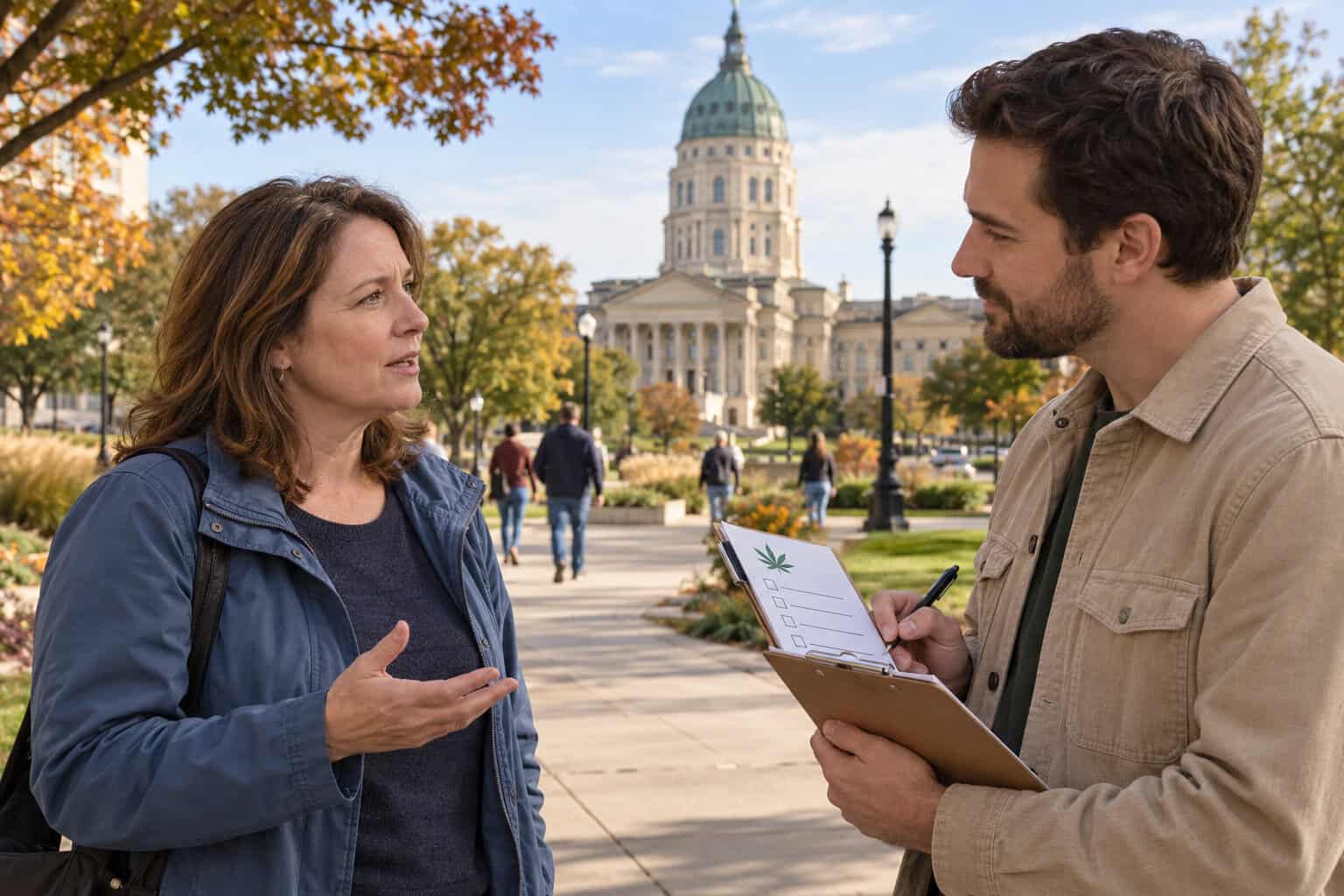
A Kansan can cross the state line into Missouri or Colorado and buy cannabis legally at a store counter. Driving it home is a crime. That gap between what the neighbors allow and what Kansas allows is the backdrop for the newest Kansas cannabis legalization poll, published in October 2026, which once again finds that most adults in the state want the law to change, and that the people who could change it have not.
The numbers come from the Kansas Speaks Fall 2026 report by the Docking Institute of Public Affairs at Fort Hays State University, an annual statewide opinion survey the institute has run every year since 2009. Fieldwork ran from September 23 to October 16, 2026, and the report was released less than two weeks before the November 3 general election. Cannabis Business Times broke the results down by party and connected them to the governor’s race.
Key Takeaways
Two out of three Kansas adults in the survey, 65%, support legalizing medical marijuana, and only 15.3% oppose it. Support for recreational marijuana is lower but still a clear majority at 58.3%, with 21.3% opposed, and it rises to 60.9% when the question is framed as legalizing adult use so the state can tax it. Majorities of Republicans, Democrats and independents back both medical and adult-use legalization, according to Cannabis Business Times’ reading of the crosstabs. Support for medical cannabis has slipped from the 70% recorded in both 2024 and 2025, a dip worth noting but not a reversal. The survey is an online panel of 603 adults, weighted to look like the state, and it does not publish a margin of error, so small year-to-year changes should be read with caution. The main reason public opinion has not turned into law is structural: Kansas has no citizen ballot initiative, so every change has to pass a Legislature where the Senate leadership has blocked medical cannabis bills since 2022.
What the Kansas cannabis legalization poll actually measured
The Kansas Speaks survey is not a cannabis poll. It is a broad public-affairs questionnaire that covers the economy, Medicaid, abortion, immigration, guns, data centers and more. Marijuana takes up three questions in Section 7 and one more tucked into a section on “sin taxes.” That matters, because people answering a long general survey are not being primed by a string of cannabis-specific prompts.
The four cannabis results for 2026 are these. Asked how much they support legalizing medical marijuana “in general,” 65% of respondents said they strongly or somewhat support it, against 15.3% who oppose. On recreational marijuana in general, 58.3% support and 21.3% oppose. When legal adult use for people 21 and older is offered as a way to raise state revenue without raising traditional taxes, support reaches 60.9%, with 20.9% opposed. And 59.3% said they were highly or somewhat likely to vote for a state legislative candidate who supports medical marijuana, while 17.2% said they were unlikely to.
The gap between the plain recreational question and the tax version is small, about two and a half points, but it points in the expected direction. Framing legalization as money for the state nudges a few hesitant people toward yes. Whether a legal market would actually deliver that money is a separate debate; at the federal level, analysts have tried to price out what a national marijuana tax could raise, and the answer depends heavily on how prices fall once the market opens.
Support is broad, but it slipped this year
The long view is the most striking part of the Kansas marijuana legalization story. When the Docking Institute first asked about recreational use in 2017, fewer than half of respondents, 49%, supported it, according to High Plains Public Radio. By 2023, two in three backed it. In the 2025 Kansas Speaks report, based on a panel of 526 adults, about 70% supported medical marijuana and about 59% supported recreational use.
This year’s figures are a little softer. Medical support fell from 70% to 65%, and recreational support stayed roughly level at 58.3%. Report co-author Jian Sun, quoted by Cannabis Business Times, said backing remained strong even as several measures dipped modestly, and that the issue was still politically salient.
It is tempting to read a five-point drop as a trend. It may not be one. The survey changes slightly from year to year, the people in the online panel are different each time, and the wider mood in Kansas was gloomier in 2026: 48.6% of respondents said the state economy was getting worse, up from 36.1% a year earlier. A sour mood can shave a few points off support for almost any change. One year of data cannot separate those effects, so the honest summary is that support for medical cannabis in Kansas has sat in the mid-60s to around 70% for several years, with this year at the lower end of that range.
Republicans, Democrats and independents: where the majorities sit
The party breakdown is what makes the Kansas numbers politically awkward. According to Cannabis Business Times, medical marijuana is backed by 72.4% of Democrats, 58.7% of Republicans and 68.8% of independents. For adult use, the figures are 63.3% of Democrats, 54.2% of Republicans and 60.3% of independents.
So even among Republicans, the party that holds a supermajority in the Legislature, a majority favors both forms of legalization. That is not unusual nationally. A similar pattern runs through national polling on marijuana legalization, where broad public support across party lines has repeatedly failed to move lawmakers. Kansas is a sharp, single-state example of the same mismatch.
The same survey hints at how voters feel about the institutions in the middle of that mismatch. Only 27.4% of respondents said they were satisfied with the Kansas Legislature, and 34.6% were dissatisfied. Term-limited Democratic Gov. Laura Kelly, who has pushed for medical cannabis, drew the highest satisfaction of any official listed, at 46.9%.
How much weight can 603 online respondents carry?
Every poll is an estimate, and this one comes with specific limits that are worth stating plainly.
First, it is an online panel, not a random sample. The Docking Institute switched from random-digit telephone dialing to an online panel in 2020 and has contracted with Qualtrics for data collection since then. Panel members sign up to take surveys, and the institute sets quotas by gender, age and metro versus rural county so the group roughly matches the state. Think of it as building a model of Kansas out of volunteers rather than drawing names out of a hat. It can work well, but the usual statistical margin of error does not strictly apply, and the report does not publish one.
Second, the raw panel did not match Kansas perfectly. Men and Johnson County residents, the state’s largest suburban county, were underrepresented. To correct for that, the institute weighted responses by age, gender, education and party registration, which turned 603 completed surveys into an effective weighted count of 585. Weighting is standard practice, but it means some respondents count for more than one person and others for less.
Third, the institute itself flags where self-reports go wrong. The survey asked who people planned to vote for as governor, but the researchers chose not to publish the answer: 92.3% of registered voters said they planned to vote, far above the roughly mid-40s turnout typical of Kansas governor’s races since 2002, and the survey had no way to filter out unlikely voters. That kind of caution is a good sign. It also reminds readers that the 59.3% who say they are likely to vote for a pro-medical-marijuana candidate are describing an intention, not a ballot.
None of this undermines the main finding. A clear majority for medical cannabis has appeared in Kansas Speaks year after year, through a change of survey method and different panels. What the limits do undermine is over-reading small shifts, such as the drop from 70% to 65%.
Why majority support has not become law in Kansas
If most Kansans want medical marijuana, why is it still illegal? The short answer is that Kansas voters cannot put the question on the ballot themselves.
Kansas is one of 24 states without citizen-initiated ballot measures, so cannabis policy depends entirely on the Legislature. Every state that borders Kansas, Missouri, Nebraska, Colorado and Oklahoma, does have the petition initiative, and voters in all four used it to approve some form of cannabis access. Missouri’s regulated market, created that way, now captures the bulk of cannabis spending in the state, as a study of Missouri’s cannabis market found, and it sits within easy driving distance of Kansas City, Kansas.
The 2026 survey tested this directly. Asked whether Kansas should adopt the petition initiative, 51.3% agreed and 12.2% disagreed. When respondents were first told that all four neighboring states already have it, support rose to 58.4% and opposition fell to 7.7%. It is a neat small experiment: a single sentence of context moved opinion by seven points.
Inside the Legislature, medical cannabis has repeatedly died in the Senate. In 2021, the Kansas House passed a medical cannabis bill 79-42. It carried over into 2022, when the Senate let it die; Senate President Ty Masterson never brought it to a vote and has called medical cannabis reform a “nonstarter,” as Cannabis Business Times reported. An interim committee on medical cannabis met in late 2024, and in October of that year it rejected a motion by Sen. Cindy Holscher to recommend legalization heading into the 2025 session. In the current 2025–2026 session, SB 294, a bill to create a Kansas medical cannabis act covering cultivation, processing, sale and use, is listed as dead.
The result is that Kansas remains one of eight states with no medical cannabis program at all, alongside Idaho, Indiana, North Carolina, South Carolina, Tennessee, Wisconsin and Wyoming. The other 42 states have licensed programs for patients with qualifying conditions.
The Kansas governor race puts both sides on the ballot
The two people at the center of that legislative history are now running against each other. Masterson, the Republican Senate president, faces Holscher, the Democratic senator from Overland Park, in the November 3 election to replace Gov. Kelly. Cannabis Business Times reports that the Cook Political Report moved the race from “Lean Republican” to “Toss Up” on October 27.
Their positions are not subtle. Ahead of the August primary, KWCH reported that every Democratic candidate supported at least medical cannabis and that Holscher backed both medical and recreational legalization, while all but one of the Republicans who answered opposed legalization. Masterson’s reply to the station was brief: “In Topeka there isn’t support for it.”
A governor alone cannot legalize cannabis in Kansas; the Legislature writes the law, and Republicans hold a supermajority there. But the governor shapes the agenda, signs or vetoes bills, and appoints the officials who would build any program. Will Kansas legalize weed in 2026? Not this year: the Legislature is not in session before the election. What the result can change is the odds for the 2027 session.
What Kansas weed laws say right now
For anyone asking whether weed is legal in Kansas, the answer today is no, for both medical and recreational use. Under K.S.A. 21-5706, possessing any amount of marijuana is a class B misdemeanor on a first conviction, punishable by up to six months in jail and a $1,000 fine. A second conviction is a class A misdemeanor, and a third or later conviction becomes a drug severity level 5 felony. Buying legally in Missouri or Colorado does not protect you once you cross back into Kansas.
Kansas CBD laws are the one narrow exception. Since 2018, CBD products with no THC have been legal. In 2019 the state added Claire and Lola’s Law, which gives patients, or parents of sick children, an affirmative defense in court for possessing CBD oil with up to 5% THC if they carry a qualifying doctor’s letter. As KCUR explained at the time, an affirmative defense is not immunity: a person can still be arrested and charged, and the letter only becomes useful at trial. Nothing in that law lets anyone grow, make or sell THC products in Kansas.
To see how Kansas compares with the rest of the country, our state-by-state guide to where weed is legal in the US lays out each state’s current status.
What to watch after November
Three things will decide whether this year’s Kansas cannabis legalization poll is another data point or a turning point. The first is the governor’s race and whether the winner makes medical cannabis a first-year priority. The second is the makeup of the Kansas Senate leadership in 2027, since that chamber has been the bottleneck. The third is whether the petition-initiative idea, which a majority of respondents now support, gains any traction, because it would take the question out of the Legislature’s hands entirely. That would require a constitutional amendment, which in turn would need two-thirds of both chambers before going to voters, so it is a long road.
Until then, the Kansas Speaks numbers tell a consistent story: most Kansans, across parties, want at least medical marijuana, and the state’s political structure has so far been able to say no.
Frequently Asked Questions
No. The Kansas Legislature does not meet again until its 2027 session, and medical and recreational marijuana both remain illegal through the end of 2026. The November 3, 2026 election for governor and the makeup of the Senate leadership will shape whether a medical cannabis bill gets a real chance in 2027.
Public opinion is well past the threshold: 65% of adults in the Kansas Speaks Fall 2026 survey support medical marijuana. Legislatively, Kansas has come close once, when the House passed a bill 79-42 in 2021, but the Senate never voted on it. The most recent medical cannabis bill in the 2025–2026 session died without passing either chamber.
Mainly because of how Kansas makes laws. Voters cannot put a measure on the ballot by petition, so any change has to pass the Legislature, where Senate leaders have blocked medical cannabis since 2022. Neighboring states that legalized did so largely through ballot initiatives that Kansas does not have.
Possession of any amount of marijuana is a crime in Kansas. A first conviction is a class B misdemeanor with up to six months in jail and a fine of up to $1,000; a second is a class A misdemeanor; a third or later conviction is a felony. Cannabis bought legally in Missouri or Colorado is still illegal in Kansas. CBD with no THC is legal, and patients with a qualifying doctor’s letter have a limited court defense for CBD oil with up to 5% THC, but that does not prevent arrest or charges.
Legal Disclaimer
This article is for general information and journalism purposes only and does not constitute legal advice. Cannabis laws in Kansas, in neighboring states and at the federal level change frequently and may differ from what is described here by the time you read it. Marijuana remains illegal under US federal law. Nothing in this article encourages buying, possessing, transporting or using cannabis. For advice about your own situation, consult a licensed attorney in Kansas.