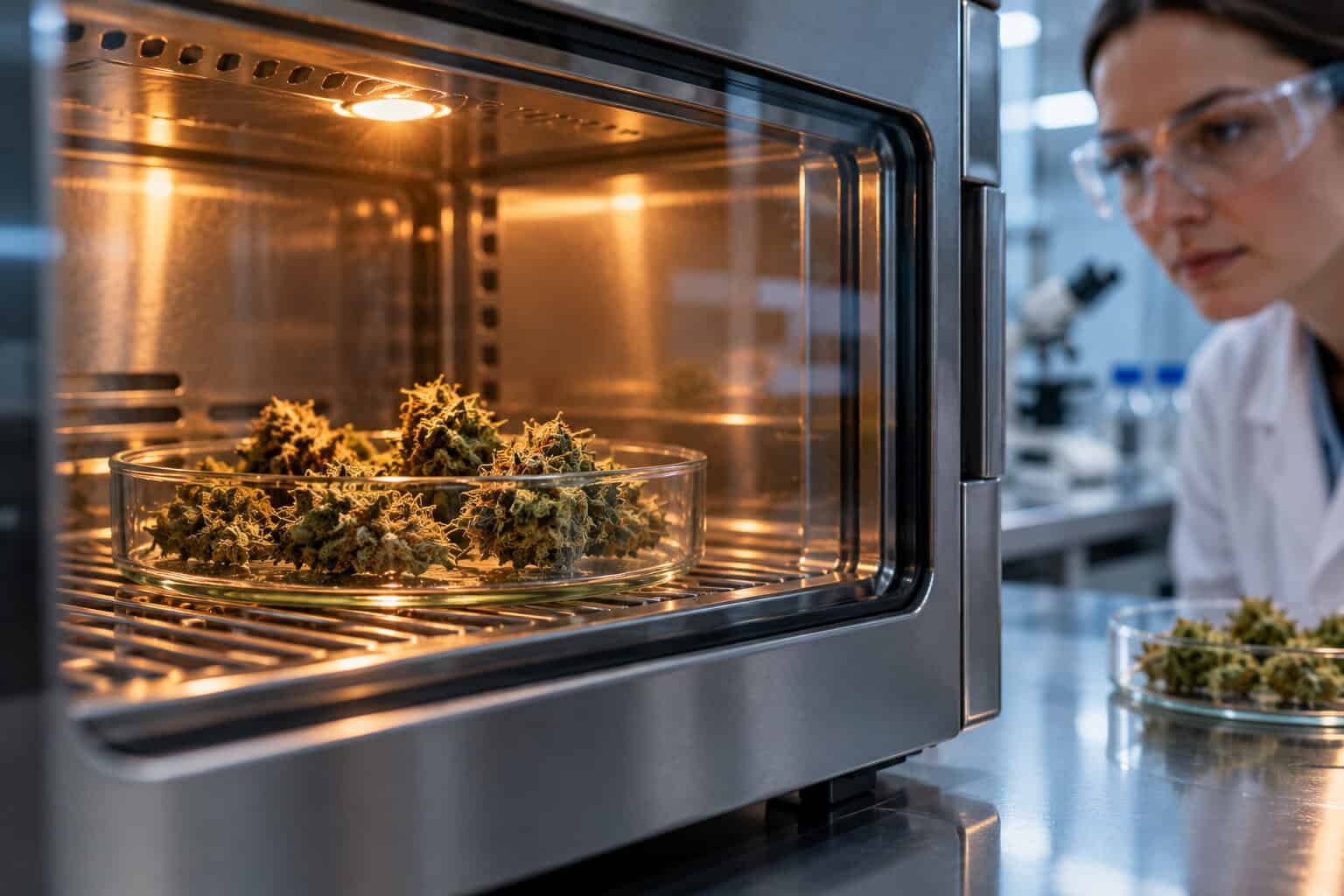
Almost nothing in a freshly dried hemp bud is “CBD” or “THC” in the form people talk about. The plant stores its cannabinoids as acids, and it takes heat to knock a small piece off each molecule and turn it into the active compound. How fast that happens, and what else the heat destroys along the way, is the subject of decarboxylation kinetics. For THC in hemp flower, the question is not just academic: in the United States, whether a batch counts as legal hemp depends on how much THC it contains or could contain.
A new study, published in ACS Omega in October 2026 by researchers at the Swiss hemp breeder Puregene AG and two external consultants, measured this process across the full range of temperatures used in drying, extraction and vaporization, from 60 °C up to 230 °C. The full text is open access on PubMed Central. Its two headline findings pull in different directions for producers: CBD’s acid precursor converts almost instantly at vaporizer temperatures, but more than half of the resulting CBD can be lost to heat, and there was no sign that heating hemp flower makes THC accumulate.
Key Takeaways
The researchers heated a finely milled CBD-rich hemp flower and tracked how its cannabidiolic acid (CBDA) turned into CBD. At 60 °C, only about 2.5% had converted after two hours, while at 230 °C, 99.96% had converted within a single minute. The faster the conversion, the higher the price: total CBD fell by 31.3% after two hours at 150 °C and by about 58% after 12 minutes at 230 °C, with losses roughly doubling for every 20 °C step between 180 °C and 230 °C. In a second experiment, five hemp varieties with very different THC-to-CBD ratios, plus pure CBD and THC, were heated to 230 °C in sealed vials, and none showed a meaningful net rise in delta-9-THC. Instead, THC broke down into cannabinol (CBN). The authors stress that they measured only the end point, so brief, short-lived THC formation cannot be ruled out, and the study was funded by a company that sells hemp flower.
Decarboxylation Kinetics of THC and CBD in Hemp Flower: The Basics
Cannabis plants make tetrahydrocannabinolic acid (THCA) and cannabidiolic acid (CBDA). These acids carry an extra carboxyl group, a cluster of one carbon and two oxygen atoms. Heat breaks that group off as carbon dioxide, leaving THC and CBD. This is decarboxylation. The acids themselves are not inert, and research on them is growing, as we covered in our piece on acidic cannabinoids such as THCA, CBDA and CBGA, but most products are judged by their neutral cannabinoid content.
Because the carboxyl group has weight, the conversion also loses mass. Labs account for that with a fixed factor: one gram of THCA or CBDA can yield at most 0.877 grams of THC or CBD. That is why “total THC” is calculated as delta-9-THC plus THCA multiplied by 0.877, and the new study uses exactly this formula.
“Kinetics” simply means how fast a reaction runs. Decarboxylation generally follows what chemists call first-order kinetics: the rate depends on how much acid is left. Picture a stadium emptying after a match. When the stands are full, thousands leave each minute; as the crowd thins, the flow slows, even though the exit gates have not changed. The “rate constant” is the size of the gates, and temperature is what widens them.
How the Experiment Was Built
The kinetics series used one variety, called PG1, containing 9.7% total CBD and 0.4% total THC by weight. The flower was ground into a fine powder, and roughly 100 mg portions were spread thinly in small aluminum foil bags so heat could reach every particle quickly. Samples spent up to 120 minutes in a static oven at 60, 90, 120 or 150 °C, or up to 12 minutes at 180, 190, 200, 210, 220 or 230 °C, the window typical of dry-herb vaporizers. After heating, each sample went straight onto dry ice to freeze the reaction at that moment.
For the THC question, the team switched to sealed headspace vials to limit evaporation and heated five other varieties (PG2 to PG6) for 12 minutes at 230 °C. Their THC-to-CBD ratios ranged from almost pure THC (PG2, 19.9% total THC) to almost pure CBD (PG6, 15.6% total CBD and 0.6% total THC). CBD and THC isolates went through the same treatment. Every sample was then measured with two different lab methods, liquid chromatography (UHPLC-DAD) and gas chromatography (GC-FID), so that a quirk of one method could not explain the result.
What Temperature Decarboxylates CBDA, and How Fast
The lower range shows how stable the acids are at moderate heat. At 60 °C, conversion after two hours was about 2.5%. At 90 °C, nearly half of the CBDA had converted within 120 minutes, and the authors’ rate estimate implies near-complete conversion would take between 460 and 540 minutes. At 120 °C, about 40% had converted by 12 minutes and the reaction was close to finished by 60 minutes. At 150 °C, more than 97% had converted by 12 minutes and 99.9% by 60 minutes.
In the vaporization range, the process became almost instantaneous. At 180 °C, 70% of the CBDA was gone within one minute and it dropped below the detection limit by three minutes. At 230 °C, 99.96% had converted in the first minute.
The calculated rate constants rose from 1.07 × 10⁻⁴ per second at 90 °C to 1.23 × 10⁻³ at 120 °C and 6.64 × 10⁻³ at 150 °C. At 120 °C, the new value is about twice those reported earlier by Moreno and colleagues in 2020 (4.89 × 10⁻⁴) and by Fućak and colleagues in 2023 (5.38 × 10⁻⁴). The authors attribute the gap to sample handling rather than chemistry: 100 mg of fine powder heats far more evenly than 10 g in a beaker or 500 mg in a Petri dish. Moreno’s group had already shown that quadrupling the depth of the plant bed slowed decarboxylation by roughly 38% at 140 °C.
The Hidden Cost: Potency Lost to Heat
Converting acid into CBD is only half the story, because heat also removes the CBD it creates. At 60 °C and 90 °C the losses were small, with relative drops in total CBD of 8.3% and 5.9% after two hours. At 120 °C, the loss reached 18.3%, and at 150 °C, 31.3%.
The high range was harsher. After 12 minutes, total CBD fell by 11.2% at 180 °C, 21.9% at 200 °C, 28.9% at 210 °C and about 58% at 230 °C. In plain terms, CBD held up reasonably well to around 200 °C and then started to disappear quickly. Even the CBD isolate, heated alone in a sealed vial, lost more than 30% at 230 °C.
The study cannot say how much of this loss is evaporation and how much is chemical breakdown, because both show up only as missing mass. For a buyer or a regulator, the practical meaning is the same: a label based on raw-flower testing will overstate what survives intense heat.
What This Means for Extract Producers and Raw-Material Drying
For manufacturers, the most useful number in the paper may be the factor of two. The same flower, at the same temperature, decarboxylated twice as fast in this lab as in earlier studies simply because the material was finer and spread thinner. Published time-and-temperature tables therefore do not transfer cleanly from one plant to another. A producer who decarboxylates biomass in deep trays, or oil in large vessels, will see different rates than a lab heating 100 mg in foil, and needs to validate the process on its own equipment and batch sizes.
The data also frame a basic trade-off. Higher temperatures finish the job in minutes, but every step above about 120 °C costs a visible share of the cannabinoids, and above 200 °C the losses accelerate. Lower temperatures preserve more, but the reaction stretches into hours. The study did not test commercial drying, so it cannot tell growers what happens in a drying room. What it does show is that at 60 °C the acids remained largely intact after two hours, which suggests that gentle, low-temperature drying is unlikely to convert much THCA or CBDA on its own. Anyone running hotter or longer drying cycles would need their own measurements to know where they stand.
For anyone who sells CBD flower in a market where lab results matter, the loss data are a reminder of how far real products can drift from their certificates. Our report on 186 European CBD oils tested against their labels showed how common such gaps already are before heat enters the picture.
Does CBD Turn Into THC When Heated?
This is the question the study was really designed to test. In a test tube, chemists have known since 1966 how to turn pure CBD into THC, usually with acid. Some later work found conversion under harsher conditions, including a 2021 study in Scientific Reports that described CBD as a precursor of THC in e-cigarettes, where heating coils create very high local temperatures.
In whole hemp flower at 230 °C, the picture was different. More than 30% of the CBD isolate decomposed, yet no delta-9-THC was detected in it; the breakdown produced 0.2% CBN and under 0.1% each of cannabichromene and delta-8-THC. Across the five varieties, total THC did not rise. In the CBD-dominant PG6 sample, delta-9-THC went from 0.036 mg to 0.498 mg, but that came from decarboxylating the THCA already present, and total THC actually fell from 0.676 mg to 0.507 mg. In the THC-rich PG2, total THC dropped from 19.932 mg to 11.862 mg, while CBN climbed above 3%. The THC isolate lost about 13% to CBN.
The pattern suggests THC is more fragile than CBD under strong heat and tends to degrade into CBN rather than build up. The authors are careful about the limits of that conclusion: they measured only before and after, not minute by minute, so THC that forms and then quickly breaks down would be invisible. Their oven also had no airflow, unlike a vaporizer, which pulls vapor away from the heat within seconds. And THC itself is psychoactive in a way CBD is not, a difference explored in our piece on CBD versus THC for anxiety, so even small conversion would matter to consumers.
Why Total THC Matters for US Hemp Law
The US is in the middle of changing how it defines legal hemp. Section 781 of the FY2026 agriculture appropriations law (P.L. 119-37) replaces the old limit of 0.3% delta-9-THC with a limit of 0.3% total THC on a dry-weight basis, explicitly counting THCA, and caps final hemp-derived cannabinoid products at 0.4 mg of total THC per container. According to the Congressional Research Service, those changes were set to take effect on November 12, 2026. H.R. 6500, signed on September 2, 2026, moved the total THC standard and the per-container cap to December 11, 2026, while the exclusion of synthetic cannabinoids from the hemp definition still starts on November 12.
A total THC test already assumes that every molecule of THCA will become THC. The new data suggest heating does not push the number higher than that assumption: in every flower sample, total THC after heating was lower than before. If the finding holds up, a total THC result is a conservative ceiling for heated hemp flower rather than an underestimate. State rules differ, though, and our state-by-state guide to US cannabis laws tracks where hemp and marijuana stand locally.
How Strong Is the Evidence?
The study has real strengths. It covers the whole temperature range from gentle drying to vaporization, uses two independent analytical methods that agreed with each other, and checked the lab’s accuracy through an interlaboratory proficiency scheme. The comparison across six chemotypes and two isolates is broader than most earlier work.
The limits are just as clear. The kinetics come from a single variety, and each sample weighed about 100 mg, measured in triplicate. One data point, at 230 °C and 8 minutes, was compromised and could not be repeated. The conversion experiment measured only end points, and the static, airless oven is a simplified model of a vaporizer. No humans were involved, so the study says nothing directly about what people inhale. Finally, the work was funded by Puregene AG, a subsidiary of Pure Holding AG, which sells hemp flowers, and three of the five authors are Puregene employees. The authors declare this openly. It does not invalidate the chemistry, but independent replication would carry more weight, especially on the regulatory claim. For a broader view of what is and is not established about cannabidiol, see our science-based CBD guide.
FAQ
Decarboxylation is the heat-driven reaction that turns the plant’s natural acids, THCA and CBDA, into THC and CBD by releasing carbon dioxide. It matters because most effects and most legal limits are tied to the neutral forms. Raw flower contains mostly acids, so its effects and its THC level change once it is heated.
There is no single cut-off; speed rises steeply with heat. In this study, CBDA in finely milled hemp flower converted by about 2.5% in two hours at 60 °C, about half in two hours at 90 °C, more than 97% in 12 minutes at 150 °C and 99.96% in one minute at 230 °C. Sample size and particle size changed the rate by roughly a factor of two compared with earlier studies, so published figures are approximate.
In this experiment, no meaningful net increase in delta-9-THC was found after 12 minutes at 230 °C in five hemp varieties and in pure CBD. The authors note that brief THC formation followed by rapid breakdown into CBN cannot be excluded, and other studies have reported conversion under acidic conditions or in high-power e-cigarettes.
Under the revised federal definition, hemp is measured by total THC, which already counts THCA as if it had fully converted to THC. That standard and the 0.4 mg per-container cap for final products take effect on December 11, 2026, after a delay signed in September 2026, while the exclusion of synthetic cannabinoids starts on November 12, 2026. State laws can be stricter, and Congress may change the dates again.
Legal Disclaimer
This article is for informational and educational purposes only and does not constitute medical, legal or regulatory advice. It summarizes laboratory research and does not recommend any product, method of use or processing technique. Cannabis and hemp laws differ between countries and between US states and change frequently. Consult a qualified attorney or the relevant regulatory authority before making compliance decisions, and a licensed healthcare professional before using any cannabinoid product.