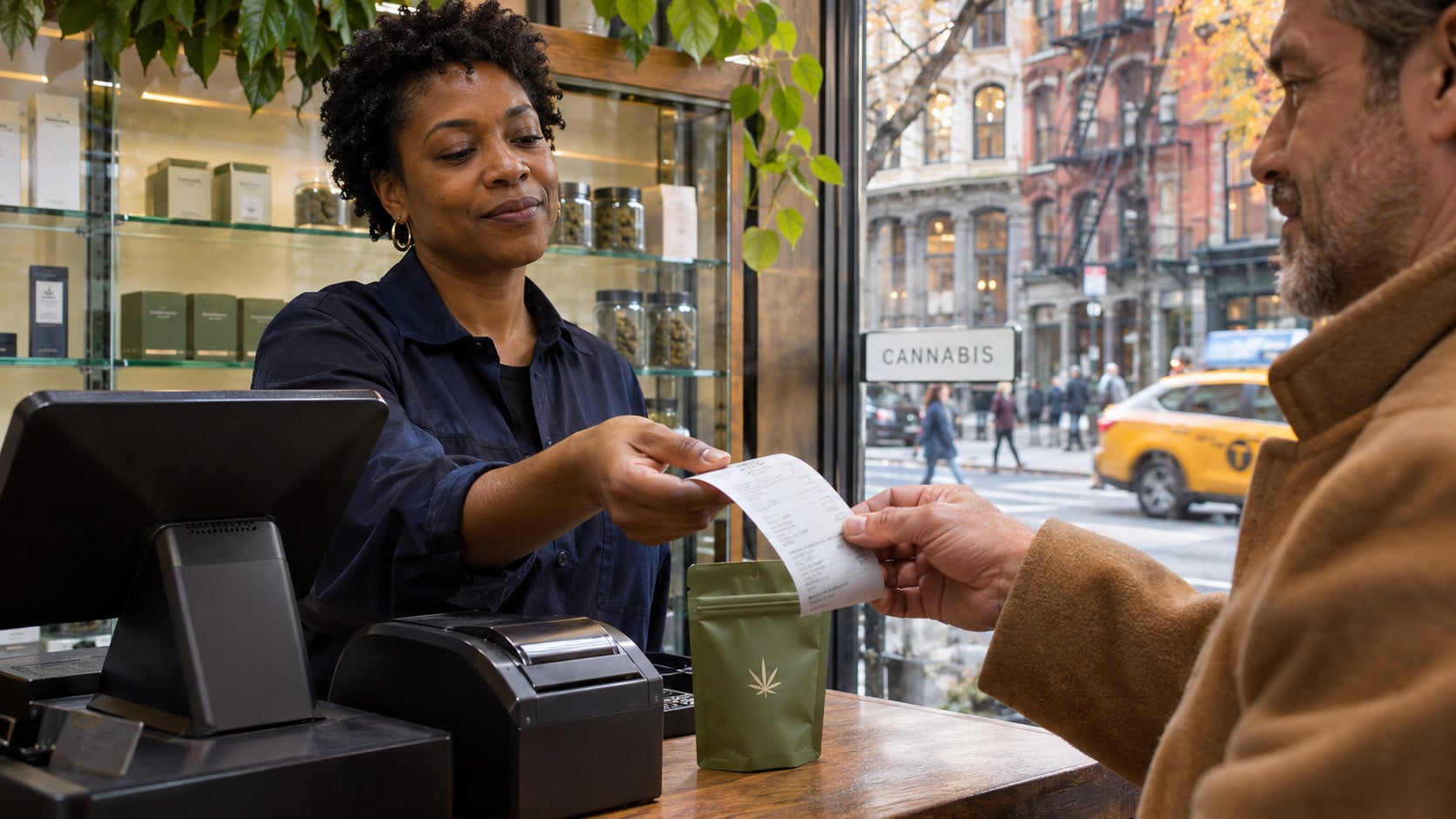
New York cannabis tax revenue has finally started to look like the numbers politicians promised when the state legalized adult use in 2021. After a slow and litigation-heavy start, the legal market spent 2025 opening stores at a pace no other East Coast state has matched, and the tax money followed. The interesting part is that there is no single figure for how much the state took in. Depending on who is counting, and what they count, the answer is either about $173 million or about $241 million for the same calendar year.
The lower number comes from the Marijuana Policy Project’s state-by-state report on adult-use cannabis tax revenue, a fresh annual analysis published in June 2026, which puts New York’s 2025 total at $173,363,400. The higher number comes from the state itself: the New York State Department of Taxation and Finance reports adult-use cannabis tax collections of $241 million in 2025, up from $124 million in 2024. Both are real. They simply measure different slices of the same pie, and understanding why tells you a lot about how cannabis taxes actually work.
Key Takeaways
New York’s legal cannabis market generated between roughly $173 million and $241 million in adult-use tax revenue in 2025, depending on the source. The Marijuana Policy Project’s figure of $173,363,400 deliberately leaves out local taxes and uses estimates for the most recent months, while the state tax department’s $241 million reflects what New York actually recorded in cannabis tax collections. Either way, revenue nearly doubled compared with 2024, driven mostly by the number of licensed dispensaries roughly doubling, from 261 at the end of 2024 to more than 500 by late 2025. New York ranked eighth among legal states in the MPP data, behind California, Illinois, Michigan, Washington, Massachusetts, Arizona and Colorado, and just short of the group of seven states that each collected more than $200 million. By the state’s own reckoning, quarterly cannabis tax collections overtook taxes on liquor in mid-2025. Under state law, 40% of the state’s cannabis tax money is earmarked for schools, 40% for community reinvestment and 20% for drug treatment and public education, after administrative costs are covered.
Where New York Cannabis Tax Revenue Stands Now
Think of New York cannabis tax revenue as a river fed by three streams. The first is a 9% tax paid by distributors when they sell products to stores. The second is a 9% state tax charged at the register. The third is a 4% local tax, also charged at the register, that flows to counties and New York City. Add the two retail pieces together and shoppers see a 13% cannabis tax on their receipt.
The Department of Taxation and Finance’s guidance for adult-use cannabis businesses confirms the current setup: retailers collect retail taxes totaling 13%, distributors pay 9% on what they charge stores, and these rates have applied since June 1, 2024. Before that date New York used an unusual tax based on how much THC a product contained, calculated per milligram. Accounting firm Anchin explained at the time that the potency tax ignored falling prices, which is why the industry lobbied for the flat 9% replacement. There is one more detail that surprises many buyers: cannabis products are exempt from ordinary New York sales tax, so the 13% is not stacked on top of the regular sales tax.
With that structure in mind, the state’s quarterly numbers tell a clear story. According to the tax department, cannabis collections rose in every quarter of 2025: $48.5 million in the period reported for March, $55.0 million for June, $66.3 million for September and $71.6 million for December. In 2024 the same quarters started at $18.0 million and ended at $44.5 million.
Why the Two Totals Don’t Match
The gap between $173 million and $241 million is not a scandal or an accounting error. It is a methods question.
The Marijuana Policy Project set out to compare states fairly, so it counts cannabis excise taxes and any regular sales tax applied to cannabis, but it excludes medical cannabis taxes, licensing and application fees, income taxes paid by industry workers, federal taxes and municipal cannabis taxes. For New York, that means the 4% local share is outside the frame. The report also notes that its figures for New York’s later periods are estimates, because full official data were not yet available when it was compiled.
The tax department’s figure, by contrast, is a running record of cannabis tax collections as reported to the state. It is the closer of the two to “money that actually came in,” while MPP’s number is better for apples-to-apples comparisons with other states. A third yardstick adds to the confusion: New York’s budget runs on a fiscal year from April 1 to March 31, so official budget documents report yet another set of totals that straddle two calendar years.
That fiscal-year view comes from the Office of Cannabis Management’s 2025 annual report, released at the end of December 2025. It shows cannabis taxes of $50.8 million in fiscal year 2023–24 and $158.4 million in fiscal year 2024–25, with $131.4 million collected in the first eight months of fiscal year 2025–26, through November 30, 2025. Including fees and fines, the regulator counts $379,602,866 in total since the market launched.
The practical lesson for readers: when you see a headline figure for any state’s cannabis tax revenue, check whether it is calendar or fiscal year, whether local taxes are included, and whether fees are mixed in. Those three choices can move a number by tens of millions of dollars.
How New York Compares With Other States
On the national stage, MPP counts $4,570,126,266 in adult-use cannabis tax revenue across legal states in 2025, the highest single-year total since recreational sales began in 2014, and more than $28.4 billion cumulatively. Here is how the leaders stack up, using MPP’s figures so that the comparison stays consistent:
| State | Adult-use cannabis tax revenue, 2025 (MPP) |
|---|---|
| California | $1,049,136,426 |
| Illinois | $552,644,272 |
| Michigan | $507,275,129 |
| Washington | $495,814,160 |
| Massachusetts | $290,599,658 |
| Arizona | $246,722,756 |
| Colorado | $220,884,560 |
| New York | $173,363,400 |
| Nevada | $157,913,273 |
| Oregon | $143,680,856 |
Seen this way, New York, the fourth most populous state, still trails markets that opened years earlier. Illinois, which began sales in January 2020, collected more than three times as much by MPP’s count. Massachusetts, open since late 2018, sits well ahead too. But New York’s first legal sale took place at a single store on December 29, 2022, and MPP’s cumulative tally for the state is $329,863,400 across 2023 to 2025. Most of that arrived in the last of those three years, which is why many analysts view New York as a market still climbing toward its ceiling rather than one that has already peaked.
The state’s own $241 million figure, if dropped into the same table, would lift New York to seventh place, ahead of Colorado. That is not a fair comparison, because the other states’ numbers exclude local taxes too, but it shows how close New York is to the top tier.
Neighboring New Jersey offers an instructive contrast. It launched legal sales in April 2022, eight months before New York, yet MPP records $78,475,863 in 2025 revenue there. The difference is largely about tax design: New Jersey relies mainly on its standard 6.625% sales tax plus a modest per-ounce fee, while New York stacks a wholesale tax and a dedicated 13% retail tax. Higher rates raise more per sale, but they also widen the price gap with the unlicensed market, which is a trade-off every legal state wrestles with.
For a broader view of what these state totals add up to, our analysis of how big the cannabis market really is explains why national and global estimates vary so widely. The federal government’s own tracking points the same way: the U.S. Census Bureau reported in September 2026 that 30 states and the District of Columbia collected an estimated $3.55 billion in cannabis excise taxes between July 2025 and June 2026. The Census total is lower than MPP’s because it covers excise taxes specifically and uses a different reporting period.
What Drove the Jump in 2025
The single biggest factor was storefronts. The Office of Cannabis Management counted 261 open adult-use dispensaries at the end of 2024 and 519 by November 30, 2025, with its year-end announcement putting the figure at 556 by December 30. New York City alone had 214 stores by November, more than any other region. Each new store means more legal sales, and each legal sale means more tax.
Sales followed the store count. The regulator’s report shows adult-use sales of $155.3 million in 2023, $882.1 million in 2024 and $1,482.3 million in 2025 through the end of November. That growth happened even as prices fell. The average retail price per item peaked near $39 in early 2024 and dropped about 15%, to roughly $32, by the third quarter of 2025, although New York prices remain well above the national median. Because New York’s taxes are a percentage of price, cheaper products mean slightly less tax per item, so the revenue gain came from volume, not from pricier purchases.
Enforcement against unlicensed shops likely played a supporting role. The regulator reports 2,017 enforcement actions in 2025 and more than $20 million worth of illicit cannabis seized. Isolating the tax effect of those raids is impossible from the available data, so it is best treated as one plausible contributor rather than a measured cause.
The state also gained an unexpected talking point. In the tax department’s quarterly series, cannabis collections of $55.0 million in the June 2025 report edged past the $52.5 million collected from liquor taxes, and the gap widened later in the year. That does not mean New Yorkers buy more cannabis than spirits. Liquor tax in New York is charged per liter rather than as a share of the price, while cannabis carries a steep percentage tax. It does show how significant the new revenue line has become in only three years.
Where the Money Goes
Under the Marihuana Regulation and Taxation Act, the state’s share of cannabis tax revenue goes into a dedicated fund. After state agencies cover regulatory and administrative costs, 40% goes to the State Lottery Fund for school districts, 40% to the Community Grants Reinvestment Fund, and 20% to the Drug Treatment and Public Education Fund.
The reinvestment piece was the political heart of legalization, designed to steer money toward neighborhoods hit hardest by decades of cannabis arrests. Its first round finally paid out in October 2025: 50 organizations received $100,000 each, $5 million in total, mostly youth groups working on mental health, workforce training and housing. Critics have pointed out that this is a small slice of the hundreds of millions collected, and the regulator says a second round opens in 2026.
The 4% local tax follows a separate path. The Office of the State Comptroller pays counties and New York City directly, and counties then pass a share to the cities, towns and villages that host a dispensary. For New York City, the budget impact is now visible: Mayor Zohran Mamdani’s preliminary budget expects $24 million in city cannabis tax revenue for the current fiscal year, rising to $33 million in fiscal 2027 and $43 million by fiscal 2030.
What Comes Next
State budget writers expect the climb to continue. When Governor Kathy Hochul released her budget in January 2025, it projected $248 million in cannabis revenue for the fiscal year ending March 31, 2026, with forecasts of $339 million in fiscal 2027 and $374 million by 2029. Projections like these have missed before: New York’s first-year cannabis forecasts fell well short, mainly because licensed stores opened far more slowly than planned. With the store count now above 500, the forecasts rest on a firmer base, but falling prices and saturation in some neighborhoods could slow growth.
It is also worth keeping New York’s situation in perspective against states that have not legalized. Public support for legal cannabis is high nationwide, as our look at why most Americans back legalization while many lawmakers still resist shows, and some of the largest states still have no adult-use market at all. Texas is the obvious example, and our guide to whether weed is legal in Texas explains how a state of that size handles cannabis without collecting any adult-use tax. Shifting consumer habits matter for future revenue too: nationally, pre-rolls have overtaken flower as the top-selling category, and product mix affects average prices and therefore tax per sale.
A final caveat on the evidence. MPP is an advocacy organization that supports legalization, and while its figures are drawn from state sources, its framing naturally highlights revenue. Its New York number partly relies on estimates. The state’s own data are more complete but use a different scope. Neither source tells us what share of cannabis New Yorkers buy still comes from the unlicensed market, which is the number that would ultimately determine how much more revenue the state could collect.
FAQ
Shoppers in licensed New York dispensaries pay a 13% retail cannabis tax: 9% goes to the state and 4% to the local government where the store is located. Before products reach the shelf, distributors also pay a 9% tax on their sales to stores, which is usually built into the price. Cannabis products are exempt from regular sales tax, though accessories such as lighters and rolling papers are not.
After administrative and regulatory costs, the state’s share is split three ways: 40% to schools through the State Lottery Fund, 40% to the Community Grants Reinvestment Fund for communities harmed by past cannabis enforcement, and 20% to drug treatment and public education. The 4% local tax goes to counties and New York City, and counties share part of it with municipalities that host dispensaries.
California, by a wide margin. The Marijuana Policy Project counts more than $1 billion in adult-use cannabis tax revenue for California in 2025, followed by Illinois, Michigan and Washington, each with roughly $500 million. New York ranked eighth on that list.
Yes, for adults 21 and older under the state’s Marihuana Regulation and Taxation Act of 2021. Adults may possess up to 3 ounces of cannabis and up to 24 grams of concentrated cannabis, and legal purchases are limited to state-licensed dispensaries. Consuming cannabis is restricted in many public places, driving while impaired is illegal, and federal law still does not permit recreational cannabis, which matters on federal property and when crossing state lines.
Legal Disclaimer
This article is provided for general informational and educational purposes only. It does not constitute legal, tax, financial or medical advice, and it should not be relied upon as a substitute for advice from a qualified professional. Cannabis laws and tax rules differ between jurisdictions and change frequently; the figures cited reflect the sources available at the time of writing and may later be revised. Cannabis remains subject to restrictions under United States federal law. Readers are responsible for knowing and complying with the laws that apply where they live.