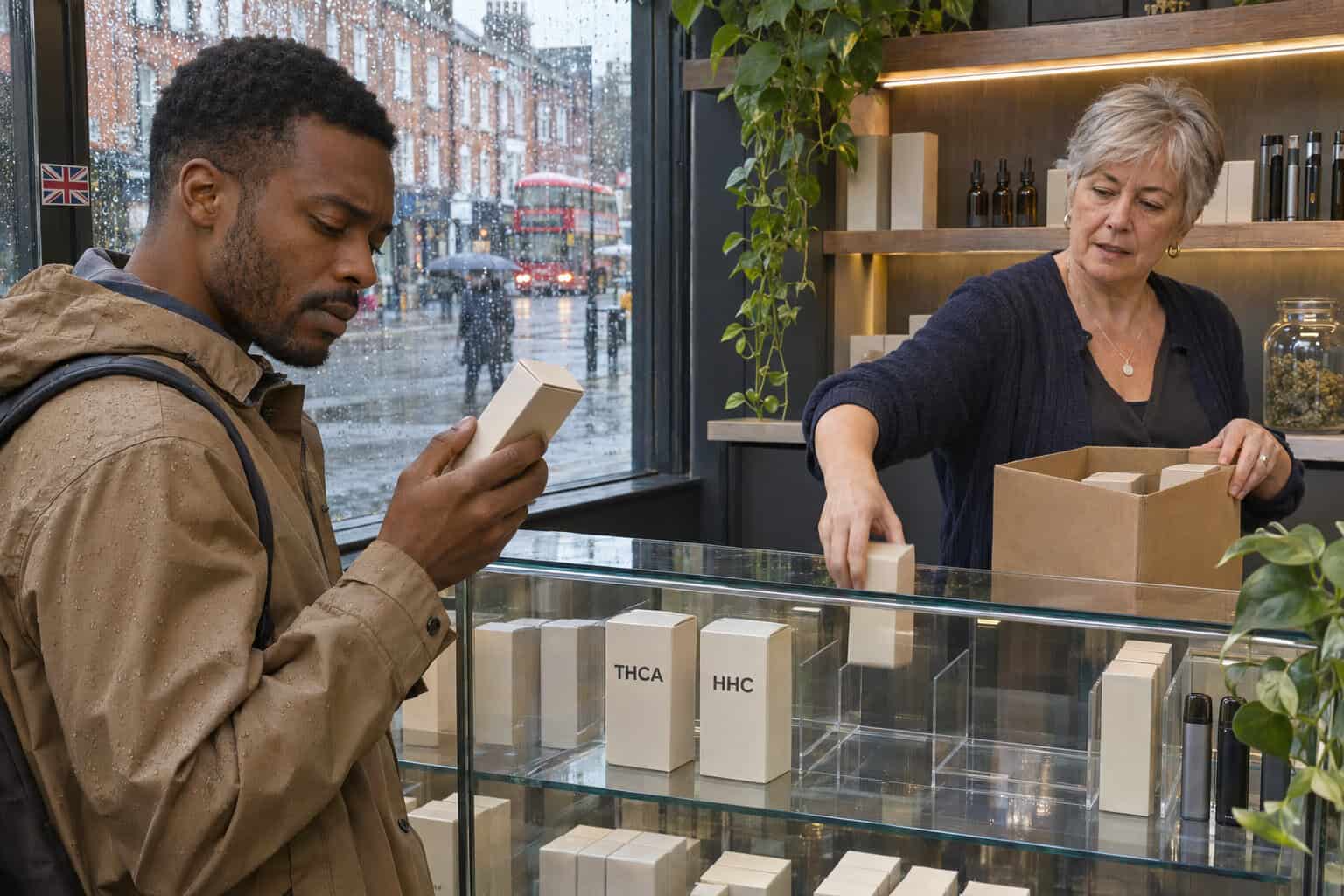
For a few years, British high streets and websites have sold a strange category of products: vapes, gummies and glittering “diamonds” built around cannabinoids that the law did not name. The two biggest were HHC, a lab-made cousin of THC, and THCA, the raw acid form of THC that the cannabis plant produces before it is heated. The UK ban on THCA and HHC products is now close: the government has put a draft law before Parliament that would make both Class B drugs, the same category as cannabis itself.
The legal instrument is the draft Misuse of Drugs Act 1971 (Amendment) Order 2026, published on legislation.gov.uk in a revised version on 27 October 2026. It replaces an earlier draft of the same Order that appeared on 14 September 2026 and was withdrawn on 21 October. Both versions rest on a May 2025 review by the Advisory Council on the Misuse of Drugs (ACMD), the expert body that advises the Home Office on drug control. This article explains what the Order covers, what it does not, how the timing works, and what it means for people who buy cannabinoid products in Britain.
Key Takeaways
The draft Order would add twelve substances to Class B of the Misuse of Drugs Act 1971: nine hexahydro compounds led by HHC, one THC metabolite called 11-OH-THC, and two forms of THCA. It is not law yet, because both Houses of Parliament must approve it first, and it would then come into force 28 days after it is formally made. Once in force, possessing these substances could carry up to five years in prison and supplying them up to fourteen, the same as cannabis. The Order targets isolated compounds, crystals and analogue products, not cannabis plant material, which is already a Class B drug in its own right, so “THCA flower” was never a legal loophole. Consumer CBD products can still be lawful if they meet the Home Office’s exempt product rules, but the industry body representing CBD sellers has asked for clarity on trace THCA, and the government has not yet given a detailed answer. The evidence of harm behind the ban is real but limited: the ACMD counted 108 UK detections of HHC and six of THCA, and described serious toxicity from HHC as uncommon.
What the UK ban on THCA and HHC products actually covers
The Order works by inserting a new list into Part 2 of Schedule 2 of the Misuse of Drugs Act, the part that defines Class B drugs. The September draft names the twelve substances in full:
The hexahydro group: hexahydrocannabinol (HHC), hexahydrocannabiphorol (HHCP), hexahydrocannabihexol (HHCH), 9-OH-HHC, 10-OH-HHC, 11-OH-HHC, 10-OH-HHCP, HHC-C8 and HHC-C9. One THC derivative: 11-hydroxy-THC (11-OH-THC), which is also the compound your liver turns THC into after you eat an edible. Two THC precursors: tetrahydrocannabinolic acid A and tetrahydrocannabinolic acid B (THCA-A and THCA-B).
The explanatory note attached to the revised October draft describes the same package: ten semi-synthetic cannabinoids plus two precursor acids of THC brought under Class B control. The same Order also tightens the rules on new synthetic opioids, synthetic cathinones and a handful of Class C substances, so cannabinoids are one part of a broader clean-up rather than a standalone cannabis law.
There is a second, quieter change. The Order rewrites the legal definition of “cannabinol derivatives”, the catch-all wording that already controls many THC-like molecules. The new text covers tetrahydro and hexahydro derivatives of cannabinol, including their 11-hydroxy versions and longer-chain homologues. In plain terms, this is designed to stop chemists from making a slightly tweaked version of HHC next year and selling it as “not on the list”.
The new entry applies to these compounds “save where they are contained in cannabis or cannabis resin”. That phrase is easy to misread. It does not mean that THCA in cannabis is legal. It means the new entry is not needed there, because cannabis and cannabis resin are already Class B drugs under their own entries. The Order is aimed at things the plant does not hand you ready-made: isolates, crystals, distillates and lab-made analogues.
Why THCA is on the list, even though it does not get you high
THCA is the odd one out. HHC is semi-synthetic: it is usually made by chemically adding hydrogen to cannabinoids extracted from hemp. THCA, by contrast, is natural. Fresh cannabis contains very little THC; most of what will become THC sits in the plant as THCA. On its own, THCA does not produce a high. Heat changes that. When THCA is smoked, vaped or baked, it loses part of its structure and turns into ordinary delta-9-THC, a process chemists call decarboxylation. The ACMD report puts the temperature range at roughly 105–120 °C, which a lighter or a vape coil reaches easily.
A useful analogy is a firework with the fuse not yet lit. Legally, the UK has treated the unlit firework as harmless. The Home Office’s own drug licensing factsheet on cannabis, CBD and other cannabinoids states that pure, isolated THCA is not controlled under the 1971 Act, while noting that it readily turns into THC. That gap is what sellers used. Some products were marketed as “not for human consumption” or for uses that supposedly avoid heating, even though the obvious way to use a THCA crystal is to smoke or vape it.
The ACMD’s covering letter to ministers explains the shift in thinking. Control of THCA used to look unnecessary because it was locked inside a plant that was already illegal. Once THCA started appearing as pure crystals for smoking and in vape liquids, the council concluded that control had become necessary.
How much harm are we talking about?
This is where honest framing matters. The ACMD’s full report lists every UK detection of these compounds reported by stakeholders. HHC was by far the most common, with 108 detections, first seen in 2023. Delta-9-THCP followed with 10, then delta-8-THC-O-acetate with 10, delta-8-THCP with 5, THCA with 6, and HHCO and HHCP with one each. For THCA, the lab company Eurofins reported five cases in 2024 and one in 2023, mostly crystals totalling 550 grams, including one cannabis cigarette rolled in THCA crystals.
Those are small numbers, and the council itself warns they probably underestimate how widespread these products are, because routine drug testing does not always look for them. On harm, the ACMD describes HHC as behaving much like THC in the body. Reported effects include drowsiness, heart and stomach symptoms, psychiatric effects and withdrawal. Rarer cases involved seizures, and a few people needed hospital treatment. But the council is clear that serious toxicity appears uncommon, that much of the evidence is preliminary, and that some reported effects may come from other substances taken at the same time.
So the case for the ban is not “these products are uniquely dangerous”. It is closer to “these products do roughly what cannabis does, they are sold with little quality control, and the law should treat them the same way.”
When does the ban start?
Not yet, and not automatically. The Order uses the affirmative procedure, which means a draft must be approved by a vote in both the House of Commons and the House of Lords before it can be made. After that, it is formally made as an Order in Council, and the controls take effect on the 28th day after that date.
The timetable has already slipped once. The September draft was withdrawn on 21 October and replaced six days later. The Home Office has not publicly explained why; the only official note on legislation.gov.uk is that the new draft supersedes the earlier one. That history is a reminder not to treat any date in a shop’s marketing email as final.
The road here has been long. The ACMD published its review in May 2025. The then-policing minister, Dame Diana Johnson, accepted the recommendations on 20 August 2025, promising to act “when parliamentary time allows” but to consult first on THCA because it had been uncontrolled for so long. Her successor, Sarah Jones, then confirmed on 11 May 2026 that THCA-A and THCA-B would be controlled. That consultation drew only three substantive responses on THCA: two about scientific research and one warning about knock-on effects for CBD products.
What happens to HHC products right now?
HHC is not in a legal vacuum today. As the ACMD notes, psychoactive HHC already falls under the Psychoactive Substances Act 2016, the “legal highs” law. That Act makes it an offence to produce, supply, import or export a psychoactive substance for human consumption, but it does not make simple personal possession an offence outside prisons and similar institutions.
Moving HHC into Class B changes the picture for buyers as well as sellers. Under the Misuse of Drugs Act, Class B penalties reach up to five years in prison, an unlimited fine or both for possession, and up to fourteen years for supply and production. Cannabis has long been treated this way, and our explainer on what UK police guidance says about medical cannabis patients shows how enforcement plays out in practice for a Class B drug.
What it means for CBD products and the hemp industry
This is the part of the ban that worries legitimate businesses. Almost every CBD oil made from hemp carries traces of other cannabinoids, including THC and THCA, because separating CBD perfectly is extremely difficult. The Home Office factsheet acknowledges this directly.
UK law handles those traces through the “exempt product” definition. To qualify, a product must meet three conditions: it is not designed to deliver the controlled drug to people or animals, the controlled drug cannot easily be recovered from it, and no single component part contains more than one milligram of the controlled drug. The Home Office says the “component part” is generally the container, such as a whole bottle of oil, not a single dose. That is an absolute amount, not a percentage, so a large bottle can fail where a small bottle of the same oil passes.
Today, pure THCA does not count toward that limit. After the Order, THCA would become a named controlled drug, so its traces would arguably need to fit inside the same one-milligram budget. The Government Chemist’s guidance on analytical limits already notes uncertainty about whether that milligram applies to each controlled cannabinoid separately or to all of them combined, and adding THCA makes that question sharper.
The Cannabis Trades Association, which represents CBD sellers, has pointed out the difference between a concentrated THCA isolate and a CBD oil with a natural trace of it. In comments reported by the UK cannabis outlet Leafie, its chief executive Marika Graham-Woods urged the government to be careful not to create unintended consequences for the hemp and CBD sector. The May 2026 ministerial letter simply points back to existing guidance without addressing that concern in detail. Businesses that handle bulk hemp extract may also need Home Office licences during extraction and manufacturing, even when the finished bottle qualifies as exempt.
Alternatives: what stays legal after the ban
For consumers, the honest answer is that there is no new legal substitute waiting in the wings, and that is exactly what the rewritten “cannabinol derivatives” definition is designed to achieve. What remains is the existing legal landscape.
CBD products remain lawful when they meet the exempt product rules, and CBD sold as food in Great Britain also has to sit within the Food Standards Agency’s novel food process. Our science-based guide to CBD covers what the research does and does not show about it. Hemp seed foods and oils, which come from parts of the plant that are not controlled, are unaffected.
For people using cannabis for a medical condition, the lawful route is a prescription for a cannabis-based medicine from a specialist doctor, a market that has grown fast through private clinics. Our analysis of UK medical cannabis prescription data shows how that market has developed and who pays for it.
How the UK compares
Britain is late rather than early. The ACMD report notes that HHC is already controlled in many countries, and the Republic of Ireland listed HHC as a Schedule 1 controlled drug in 2025, criminalising its import, sale, supply and possession. Our country-by-country guide to cannabis laws in Europe sets the British approach against its neighbours, where cannabis itself ranges from fully criminalised to partly legal.
What makes the UK Order stand out is THCA. Most European HHC bans focus on lab-made molecules. Naming a natural plant acid alongside them is a more unusual step, and it mirrors a debate in the United States, where federal hemp rules have been rewritten to count THCA toward a product’s total THC. The politics around that American change, including an unexpected alliance with the alcohol industry, are covered in our report on the fight over hemp THC drinks.