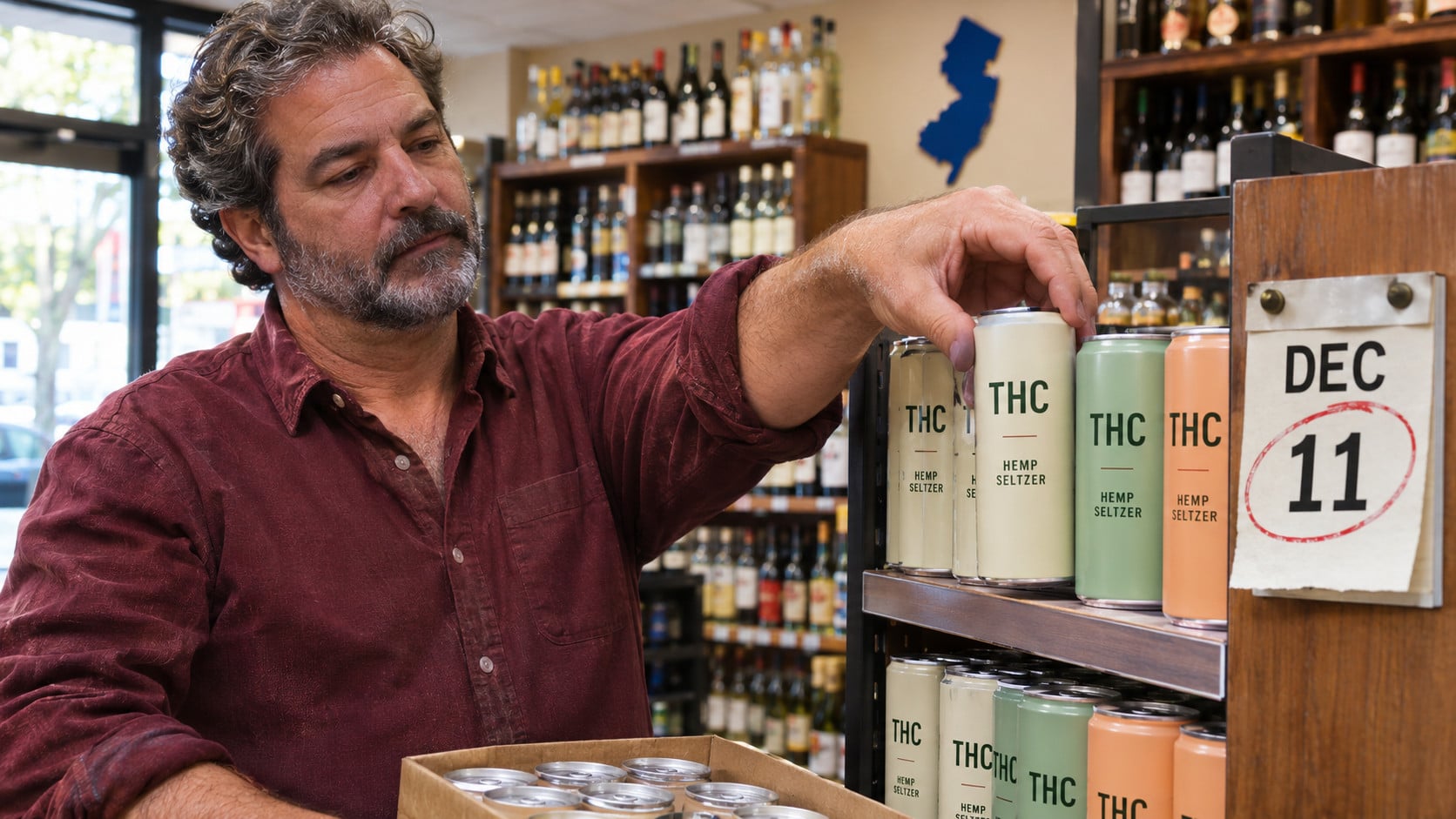
For a few hours this week, it looked like THC drinks in New Jersey were about to vanish from liquor store coolers overnight. The state’s cutoff for selling hemp-derived THC seltzers outside cannabis dispensaries was set for Friday, November 13, and a bill to delay it was still sitting unsigned on the governor’s desk. Then, on Thursday, November 12, the bill was signed. Liquor stores can now keep selling these drinks until December 11 at the earliest.
The countdown was laid out by New Jersey 101.5, which reported on November 12 that unless Gov. Mikie Sherrill signed bill S4635, liquor stores would have to stop selling intoxicating hemp drinks the next day. Later that same day, the governor’s office announced that S-4635/A-5604 was one of five bills she had signed into law. Here is what that means for buyers, for stores and for the drinks themselves, and why the extra time is short.
Key Takeaways
New Jersey liquor stores were due to lose the right to sell hemp-derived THC drinks on November 13, but Gov. Mikie Sherrill signed S4635 on November 12, which replaces that fixed date with a “federal compliance date” defined as December 11 or the day new federal hemp rules take effect, whichever is later. Until then, the same limits apply as before: no more than 5 mg of THC per serving and 10 mg per can, sales only to adults 21 and older, no online or vending machine sales, and a lab certificate for every product. Once the federal date arrives, any hemp drink with more than 0.4 mg of THC per container counts as cannabis in New Jersey and can only be made by a licensed cannabis manufacturer and sold in a licensed cannabis dispensary. The reprieve is roughly one month long, and it lasts longer only if Congress delays the federal hemp ban again.
What the New Law Means for THC Drinks in New Jersey
The short version: nothing changes on the shelf today. THC drinks in New Jersey that were legal in liquor stores on Thursday are still legal there on Friday, under the same rules.
The longer version is about a single date. New Jersey’s hemp law, passed in January and revised in March, gave liquor stores a grace period to sell intoxicating hemp beverages that ended on November 13. That date was chosen to line up with a federal ban on most hemp-derived THC products that was originally scheduled for mid-November. But in September, Congress pushed most of the federal ban back to December 11. New Jersey’s date did not move with it, which would have left the state’s liquor stores shut out of the market a month before the rest of the country’s hemp sellers.
S4635 fixes that mismatch. Instead of naming November 13, the law now refers to the “federal compliance date,” which it defines as December 11, 2026, or the date the new federal definition of hemp takes effect, whichever is later. The bill also says that date can never fall earlier than December 11, even if a federal funding measure lapses. The bill’s own explanatory statement puts the intent plainly: sales of hemp products by alcohol and cannabis licensees remain legal until the federal compliance date.
The bill moved quickly. It was introduced on October 1, cleared the Senate 37-0 on October 22 and the Assembly 75-2 on October 29, and then waited two weeks for the governor. The text states that it takes effect immediately, so there was no gap between Thursday’s signature and Friday’s old deadline.
Are THC Drinks Legal in NJ Right Now?
Yes, with conditions. Think of the current rules as a short list of gates every drink and every sale has to pass through. According to the Cannabis Regulatory Commission’s interim FAQ on intoxicating hemp, the following applies until the federal compliance date:
- Who can sell: holders of certain alcohol licenses issued by the Division of Alcoholic Beverage Control, and licensed Class 5 cannabis retailers (dispensaries). The S4635 text names plenary wholesale, plenary retail distribution and plenary retail consumption licensees on the alcohol side.
- How strong: no more than 5 mg of total THC per serving and no more than 10 mg per can. A resealable 750 mL bottle may hold up to 200 mg, as long as it is portioned into 5 mg servings.
- Who can buy: adults 21 and older. Selling any product with a detectable amount of THC to someone under 21 is illegal.
- Where you can’t buy: gas stations, convenience stores and bodegas lost the right to sell these drinks in April. Online sales and vending machine sales are banned outright.
- Proof of content: each drink must come with a certificate of analysis from an independent lab that is accredited and registered with the Drug Enforcement Administration.
The certificate rule matters more than it sounds. Under S4635, the THC content on that certificate counts as compliant if it falls between 90% and 110% of what the label claims, and selling a drink without a certificate or in a non-compliant container carries a civil penalty of at least $100 per container. In plain terms, a “10 mg” can that actually holds 13 mg is not a technicality; it is a violation.
What Changes After December 11
When the federal compliance date arrives, New Jersey’s rules flip. Any hemp-derived beverage with more than 0.4 mg of total THC per container stops being “hemp” under state law and becomes cannabis. From that point, the CRC says, such a drink must be produced by a licensed Class 2 cannabis manufacturer and sold only by a licensed Class 5 cannabis retailer.
To put 0.4 mg in perspective: a typical liquor store THC seltzer holds 5 or 10 mg, so 0.4 mg is about one twenty-fifth of a 10 mg can. Drinks below that line can still be sold as hemp products, but they are unlikely to produce a noticeable effect for most people. Some brands are already working on THC-free versions, while others are trying to move into the licensed cannabis market, where THC drinks can keep being sold through dispensaries.
For shoppers, the practical shift is about where, not whether. THC beverages in New Jersey will not disappear; they will move behind the dispensary counter. Dispensary drinks have been held to a lower potency ceiling than liquor store drinks: when lawmakers debated the 200 mg wine-bottle format in May, a critic pointed out that it was 40 times the limit for THC drinks sold in cannabis dispensaries, as New Jersey Monitor reported.
The Federal Hemp Ban Behind the Date
New Jersey’s deadline is really a reflection of a decision made in Washington. In November 2025, Congress rewrote the federal definition of hemp as part of a spending package that ended a government shutdown. The 2018 Farm Bill had defined hemp by its delta-9 THC content alone, which allowed a booming market in drinks, gummies and other products made from hemp extracts. The new definition counts total THC and caps finished products at 0.4 mg of total THC per container, which shuts out nearly every intoxicating hemp product on the market.
According to a Congressional Research Service report, the continuing resolution Congress passed on September 2, 2026 (P.L. 119-103) delayed portions of that new definition until December 11. Not everything was delayed: the ban on cannabinoids that the plant cannot produce on its own, the category that covers synthetic conversions, still took effect in November.
We have covered how this federal fight reshaped the industry’s alliances in our piece on how the alcohol industry went from fighting hemp THC drinks to trying to save them. The short summary: alcohol wholesalers and big retailers who once wanted these drinks off the shelves are now lobbying Congress to regulate them like alcohol instead of banning them. Celebrity-backed brands have pushed in the same direction, as Seth Rogen argued earlier this year. Whether any of that produces a federal framework before December 11 is an open question. If Congress delays again, New Jersey’s date now moves automatically. If it does not, December 11 is the end of the line.
Why New Jersey Moved Hemp Drinks Toward Dispensaries
The state’s push to restrict intoxicating hemp did not come from liquor stores. The Garden State Liquor Retailers Association has described hemp beverages as an important revenue stream for small, family-owned stores dealing with falling alcohol sales and high inflation. Earlier reporting put the stakes in numbers: THC seltzers were estimated at 10% to 15% of total liquor store sales in New Jersey back in 2024.
The case for restrictions came from other directions. Lawmakers framed the nj hemp ban as a child-protection measure after years of intoxicating products being sold in gas stations and corner stores, sometimes in packaging that looked like snacks. Police chiefs raised concerns about impaired driving, given that there is no roadside test for THC equivalent to a breathalyzer. And the licensed cannabis industry argued that high-potency drinks in liquor stores undercut the regulated market it pays licensing fees to operate in.
There is also a health-policy angle that cuts the other way. Some researchers see low-dose THC drinks as a possible substitute for alcohol; one study we covered suggested cannabis-infused beverages may help some drinkers cut their alcohol intake. That evidence is early and comes from self-selected participants, so it supports a debate, not a conclusion. But it helps explain why the question of where these drinks are sold has become so contested.
How New Jersey Compares With Its Neighbors
New Jersey is not the only state redrawing the map this month. In Illinois, a new state law forced many hemp-derived THC drinks off liquor store shelves on November 12, and chains such as Binny’s began clearing inventory ahead of that date, Axios reported. Delaware went the opposite way: Gov. Matt Meyer signed a law this summer letting liquor stores and dispensaries keep selling THC drinks under state rules, at least until the federal ban applies.
Federal law sits above all of these choices. Whatever a state allows, a hemp product above the federal 0.4 mg threshold will no longer be federally legal hemp once the new definition applies. That is why even states friendly to liquor store sales are watching Congress, and why small retailers like the one in our story about Cheech and Chong’s dispensary in Maine are worried about their bestsellers.
What This Means for You
If you buy THC seltzers at a New Jersey liquor store, you have until at least December 11. Nothing about the product rules has changed: the same 5 mg per serving and 10 mg per can limits apply, and stores should still check ID for anyone who looks under 21.
If you prefer THC drinks and plan to keep buying them after December 11, the legal route in New Jersey will be a licensed dispensary. Expect a different selection and lower per-drink potency than many liquor store products.
If you run a liquor store, the extra month is a window to sell through inventory, not a reason to restock heavily. The law ties the date to Washington, and Washington has not said what it will do next.
Frequently Asked Questions
Most THC drinks sold outside dispensaries are made from hemp, not marijuana. The 2018 Farm Bill defined hemp by its delta-9 THC content measured by dry weight, which allowed manufacturers to produce drinks with intoxicating amounts of THC from legal hemp extracts. That loophole is closing: the new federal definition counts total THC and limits finished hemp products to 0.4 mg of THC per container, and most of it applies from December 11 unless Congress changes course.
No. States set their own rules on top of federal law. Some, like Delaware, allow THC drinks in liquor stores under state regulation; others, like Illinois, have moved them out of liquor stores; and some ban intoxicating hemp products entirely. Once the new federal hemp definition applies, products above 0.4 mg of THC per container lose federal hemp status everywhere, regardless of state rules.
Yes. A drink with 5 or 10 mg of THC can produce noticeable intoxication, and individual reactions vary widely depending on body weight, tolerance and whether the drink is taken with food or alcohol. Because THC in a drink is absorbed through the digestive system, effects can take longer to appear than with smoking, which is one reason people sometimes take more than intended. Driving after consuming THC is unsafe and illegal.
Yes, but only temporarily. Under S4635, signed on November 12, holders of qualifying alcohol licenses and licensed cannabis retailers can keep selling intoxicating hemp beverages until the federal compliance date, which is December 11 or later if federal rules are delayed. After that date, any hemp beverage with more than 0.4 mg of total THC per container is treated as cannabis and may be sold only by licensed Class 5 cannabis retailers, to adults 21 and older.
Legal Disclaimer
This article is for informational purposes only and does not constitute legal advice. Laws governing hemp-derived THC products in New Jersey and at the federal level are changing quickly, and the dates and limits described here may be amended by state legislators, regulators or Congress after publication. Businesses should consult a licensed attorney about their specific obligations, and consumers should follow the rules in force where they live. Nothing in this article encourages the use of THC products; they are restricted to adults 21 and older, and consuming them before driving is illegal.