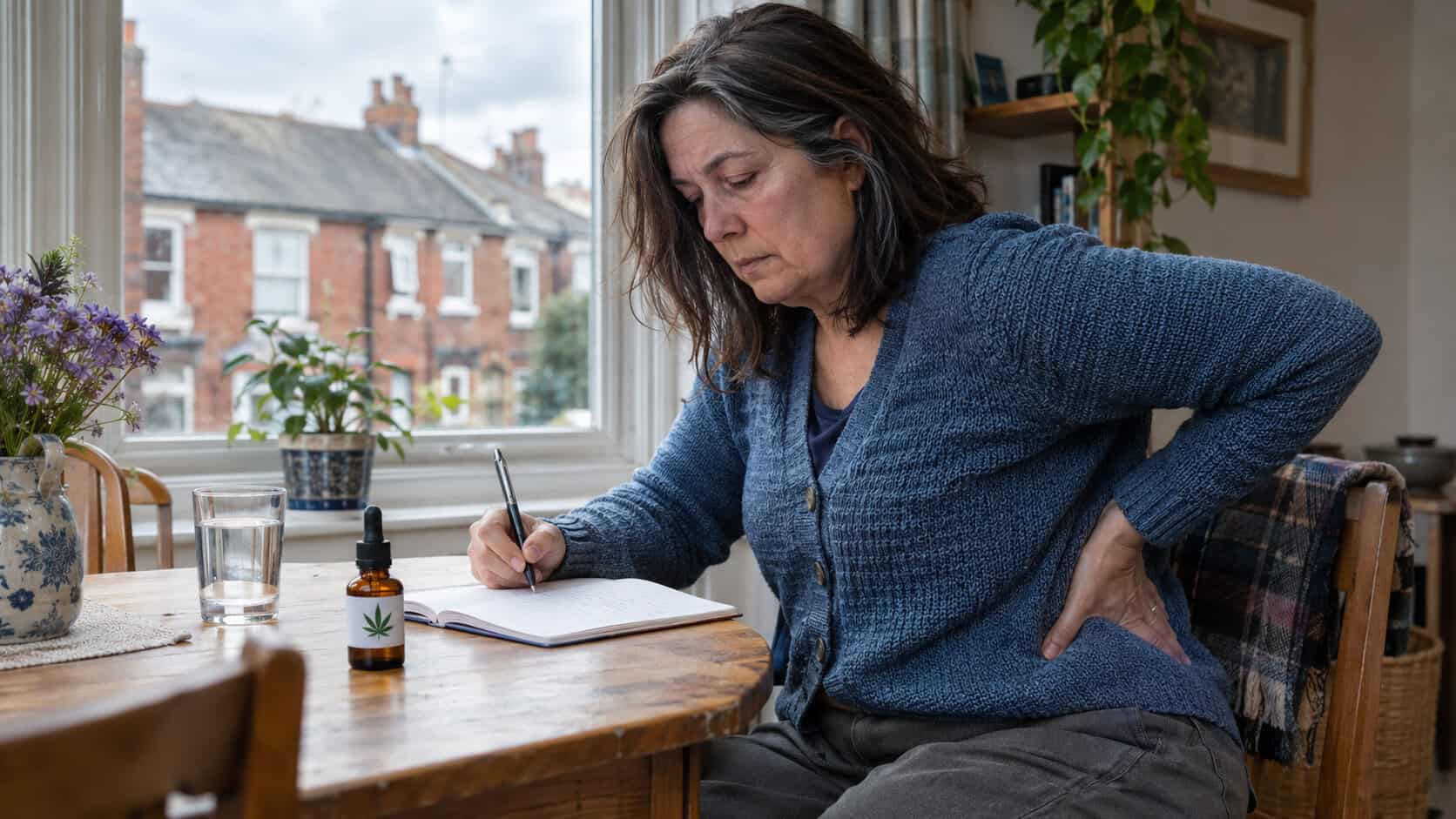
Ask anyone living with chronic pain about a new treatment and the first question is usually not “does it work?” but “for how long?”. A large analysis from the UK Medical Cannabis Registry tries to answer exactly that for cannabis for chronic pain. Instead of reporting one average, researchers followed 3,744 patients for up to 24 months and sorted their pain scores into five distinct trajectories. On average, every group ended the two years a little better off than it started. But for just over half of the patients, the early relief faded.
The study, led by Simon Erridge with colleagues from Imperial College London and Curaleaf Clinic, appears in the October 2026 issue of The Journal of Clinical Pharmacology (volume 66, issue 10) and is open access. It draws on the UK Medical Cannabis Registry, a database set up in December 2019 that records outcomes for people across the United Kingdom and the Crown Dependencies who are prescribed cannabis-based medicinal products through Curaleaf Clinic.
Key Takeaways
Across two years, every outcome the registry tracked improved on average: pain severity, how much pain interfered with daily life, quality of life, anxiety and sleep. More than half of the patients reached a pain reduction that clinicians regard as the smallest change a person can actually feel, but only around 15 percent saw their pain severity cut in half. The analysis identified five typical courses, ranging from steady, lasting improvement to a brief dip followed by a return to where patients started. Sleep quality, anxiety and the type of pain condition at the start were more closely linked to how a patient fared than the product or the dose prescribed. Adverse events were reported by 14.37 percent of patients, mostly mild or moderate. Because there was no control group and most participants had stopped returning questionnaires by month 24, the study shows associations, not proof that cannabis caused the improvement.
UK Medical Cannabis Registry chronic pain study: who was included and what was measured
By the data cut-off on 6 January 2025, 34,563 people were enrolled in the registry. The researchers kept only those whose main reason for treatment was chronic pain, who had been enrolled for at least two years and who had completed baseline questionnaires. That left 3,744 patients. Their average age was 46, and 58.01 percent were men. The most common diagnoses were chronic non-cancer pain (60.79 percent) and neuropathic pain, meaning pain caused by damaged or misfiring nerves (16.03 percent). One social detail stands out: 41.67 percent were unemployed.
Just as important for reading the results, most patients were not new to cannabis. 57.48 percent were using cannabis before they started prescribed treatment, and another 15.76 percent had used it in the past. Only about a quarter had never tried it.
Patients filled in standard questionnaires at baseline and at 1, 3, 6, 12, 18 and 24 months. The main tool was the Brief Pain Inventory, which asks people to rate their pain from 0 (no pain) to 10 (the worst pain imaginable) and, separately, how much pain gets in the way of work, sleep, mood, walking and relationships. Further questionnaires covered quality of life, anxiety and sleep.
What makes this study different is its method. The team used a technique called longitudinal k-means clustering. Picture laying all 3,744 pain curves on top of each other and letting an algorithm group the ones with the most similar shape, a bit like sorting hiking routes by their elevation profile rather than just noting their average height. The number of groups was not chosen in advance; a statistical test picked it. It came out as five.
What the averages show after two years
Looked at as a whole, the cohort’s pain severity fell from 5.97 to 4.86 points. Pain interference dropped from 6.87 to 5.38. The quality-of-life index rose from 0.30 to 0.53, the anxiety score fell from 8.51 to 4.83 and the sleep score climbed from 3.80 to 5.73.
Researchers often express the size of such changes with a measure called Cohen’s d, where 0.2 is considered small, 0.5 medium and 0.8 large. At 24 months, it was 0.57 for pain severity, 0.59 for pain interference and 0.76 for quality of life, all in the moderate range.
What does that mean for an individual? At two years, 54.62 percent achieved at least a one-point drop in pain severity, the threshold usually treated as the smallest noticeable improvement. 34.32 percent achieved a reduction of at least 30 percent, and 14.88 percent halved their pain. For pain interference the shares were higher, with 62.77 percent crossing the noticeable threshold.
There is an important caveat behind these numbers. Only 1,309 patients, or 34.96 percent, actually returned the pain questionnaire at 24 months. The researchers filled the gaps statistically using a method called multiple imputation. When they analysed only the patients with real two-year data, pain severity fell from 5.86 to 4.55 points and 56.68 percent reached the noticeable threshold.
Five pain trajectories: who kept the benefit and who did not
The real news is in the five groups, which the authors label A to E.
Group A was the largest, with 956 patients. It started with moderate pain at 5.85 points, reached its best score of 5.12 at three months, and then drifted back. After two years it stood at 5.79, essentially unchanged.
Group B, with 946 patients, began at 5.10 and fell sharply to 3.67 by month three. The effect then wore off, ending at 4.44, a net drop of 0.66 points and below the threshold for a noticeable change.
Group C, with 679 patients, had the most severe pain at the start, 7.72 points, and improved slowly and modestly to 6.30.
Group D, with 675 patients, also started high at 6.86 points and showed the largest and most sustained improvement of all, down to 4.03, a fall of 2.84 points.
Group E was the smallest, with 488 patients. It started with the mildest pain, 4.26 points, improved within the first month and held that level to the end, finishing at 2.57.
Groups A and B together make up just over half of the cohort, and in both the early improvement did not last. The authors draw a practical conclusion: initial relief after starting cannabis-based treatment cannot be assumed to persist, and response should be reassessed in a structured way over time.
How unusual are the sustained gains in groups C, D and E? The authors compare them with the Norwegian HUNT pain study, which found that people with moderate to severe chronic pain have only about an 8 percent chance of recovering within a year without a specific intervention. The registry trajectories look better than that. Whether the treatment is the reason is something an uncontrolled study cannot settle.
Sleep, anxiety and diagnosis predicted more than product or dose
Which baseline features were linked to a patient’s later trajectory? Sleep and anxiety stood out. Patients who slept poorly at the start had 2.24 times the odds of reaching a noticeable pain reduction compared with those who slept well. Severe anxiety at baseline was linked to odds of 1.30. That sounds counterintuitive, but there are two plain explanations. People who start in a worse place have more room to improve. And better sleep and less anxiety may change how pain is experienced and how much it disrupts daily life. Fittingly, the link was stronger for pain interference than for raw pain severity. For a wider look at the evidence on cannabis and sleep, see our piece on the Cochrane review and two years of UK registry data on insomnia.
Poor sleep, severe anxiety, unemployment and an opioid prescription at baseline were more common in groups C and D, the two groups with the highest starting pain, one of which improved slowly while the other improved strongly. The authors read these features as markers of a more severe and complex condition rather than as signs that someone will or will not respond.
Cancer pain and neuropathic pain were associated with group E, the group that improved quickly and stayed better. For nerve pain, that fits other research in which neuropathic pain shows some of the clearest signals. For cancer pain, the authors urge caution. These patients were the least likely to keep filling in questionnaires, so their curves rely more heavily on estimated values, and ongoing cancer treatment may also play a part. Women and older patients were less likely to be in group E.
Equally telling is what barely mattered: product type and dose. These factors largely dropped out of the statistical models. That does not mean they are irrelevant, since doses are adjusted individually, often precisely because the effect is wearing off. Median daily THC dose rose from 19 to 126.50 milligrams over the study, while CBD rose from 15 to 20.53 milligrams. The authors raise the possibility of tolerance, especially as most patients were already cannabis users. Why people react so differently to cannabinoids in the first place is the subject of our article on genetics and personalised cannabis treatment.
One limit applies to the predictions themselves. The models separated the groups only modestly, with an accuracy score (AUC) between 0.54 and 0.72, where 0.5 would be a coin toss. That is not good enough to forecast an individual patient’s course.
Side effects and opioid use in the registry
538 patients (14.37 percent) reported at least one adverse event, adding up to 4,898 events in total. Of these, 41.38 percent were mild, 43.75 percent moderate, 14.70 percent severe and 8 events (0.16 percent) life-threatening or disabling. The most common were fatigue (10.68 percent of patients), dry mouth (8.09 percent), lethargy and sleepiness (8.01 percent each).
Older patients, women, people whose main diagnosis was hypermobility-related pain and those on the highest CBD doses were more likely to report side effects. Patients who were already using cannabis before treatment reported fewer, probably because they were used to its effects. The authors note that side effects may be undercounted, because a missing report was treated as no event.
On opioids, patients who had them prescribed at baseline were taking an average of 33.09 milligrams of oral morphine equivalent per day. By two years, 302 of them (22.66 percent) had reduced their dose by a clinically meaningful amount. Doses of gabapentinoids, a class of nerve-pain drugs, also fell from month six onward.
How much weight can the findings bear?
The study is large and long, but it has clear limits, which the authors themselves set out. There was no control group and no blinding, so everyone knew they were receiving cannabis, which invites expectation effects. Patients chose cannabis treatment themselves, and nearly three quarters already had experience with it, so people who do not tolerate cannabis or get nothing from it are probably underrepresented. Then there is regression to the mean: people who start treatment at a particularly bad moment often score better later, with or without a treatment effect. And only about a third supplied real data at two years; the rest was estimated, which can distort results if dropouts differ from those who stay.
Interests also need flagging. According to their disclosures, all authors work for Curaleaf: most at Curaleaf Clinic, which runs the registry, while Mikael H. Sodergren, who leads the research group at Imperial College London, is chief medical officer of Curaleaf International.
How does this fit with controlled trials? A widely cited BMJ meta-analysis of 32 randomised trials found only a small advantage for non-inhaled medical cannabis over placebo: the share of patients reaching a noticeable reduction in pain was about 10 percentage points higher. The registry authors suggest that such small average effects may hide a wide spread, with some people benefiting a lot and others hardly at all. The five trajectories make that spread visible. They cannot prove that cannabis caused the improvement. Similar questions came up in a 10-year study of medical cannabis for chronic low back pain and in an earlier UK registry analysis of fibromyalgia.
What the UK findings mean for patients in the UK and the US
Specialist doctors in the United Kingdom have been allowed to prescribe cannabis-based medicinal products since November 2018. Yet the National Institute for Health and Care Excellence does not recommend them for chronic pain in its guideline NG144. As a result, nearly all UK prescribing happens privately, a pattern our report on 1.7 million UK cannabis prescriptions describes in detail. The registry patients are therefore a self-paying, private-clinic population, which limits how far the results can be generalised.
In the United States, the federal picture shifted in April 2026, when a final rule from the Drug Enforcement Administration moved marijuana in FDA-approved drug products and marijuana covered by a qualifying state medical cannabis license from Schedule I to Schedule III of the Controlled Substances Act. A broader proceeding on all remaining marijuana was still under way at the time of writing. Schedule III status does not make any cannabis product an approved treatment for chronic pain: the FDA has not approved a cannabis-derived drug for that indication, and access still runs through state medical programs and their own rules.
For both countries, the study raises a practical question that matters more than headlines about whether cannabis “works”: how long should a patient and doctor watch before judging the result? The five trajectories suggest the first weeks say little. For just over half of the cohort, things looked better at three months than at two years.
Frequently Asked Questions
The two main compounds, THC and CBD, act on the pain system at several levels. THC binds to cannabinoid receptors in nerves, the spinal cord and the brain, where it can dampen the transmission of pain signals and change how distressing pain feels. CBD works mostly through other receptors. In controlled trials the average effect on chronic pain is small, and the UK registry study shows that very different individual courses sit behind that average.
There is no general answer, and this study does not offer one. In fact, product type and dose were less closely linked to a patient’s course than characteristics of the patients themselves, such as sleep quality, anxiety and the type of pain condition. Whether any treatment is appropriate is a decision for the treating clinician in each individual case.
14.37 percent reported at least one adverse event, mostly mild or moderate. The most common were fatigue, dry mouth, lethargy and sleepiness. Older patients, women and people on high CBD doses were affected more often. Because missing reports were counted as no event, the true figures may be higher.
Since November 2018, cannabis-based medicinal products can legally be prescribed in the UK, but only by doctors on the specialist register. NICE does not recommend them for chronic pain, so NHS prescriptions for this indication are rare and most patients obtain them through private clinics at their own expense. Possessing or growing cannabis without a prescription remains illegal.
Legal Disclaimer
This article is for information only and describes the findings of a scientific study. It is not medical advice and does not replace consultation with a qualified healthcare professional. Nothing in it is a recommendation to use cannabis or cannabis-based products, and it makes no claim that cannabis can treat, cure or prevent any condition. Laws on medical cannabis differ between countries and, in the United States, between states, and they change over time. Readers are responsible for checking the rules that apply where they live. The results described come from an observational study without a control group and cannot predict how any individual will respond.