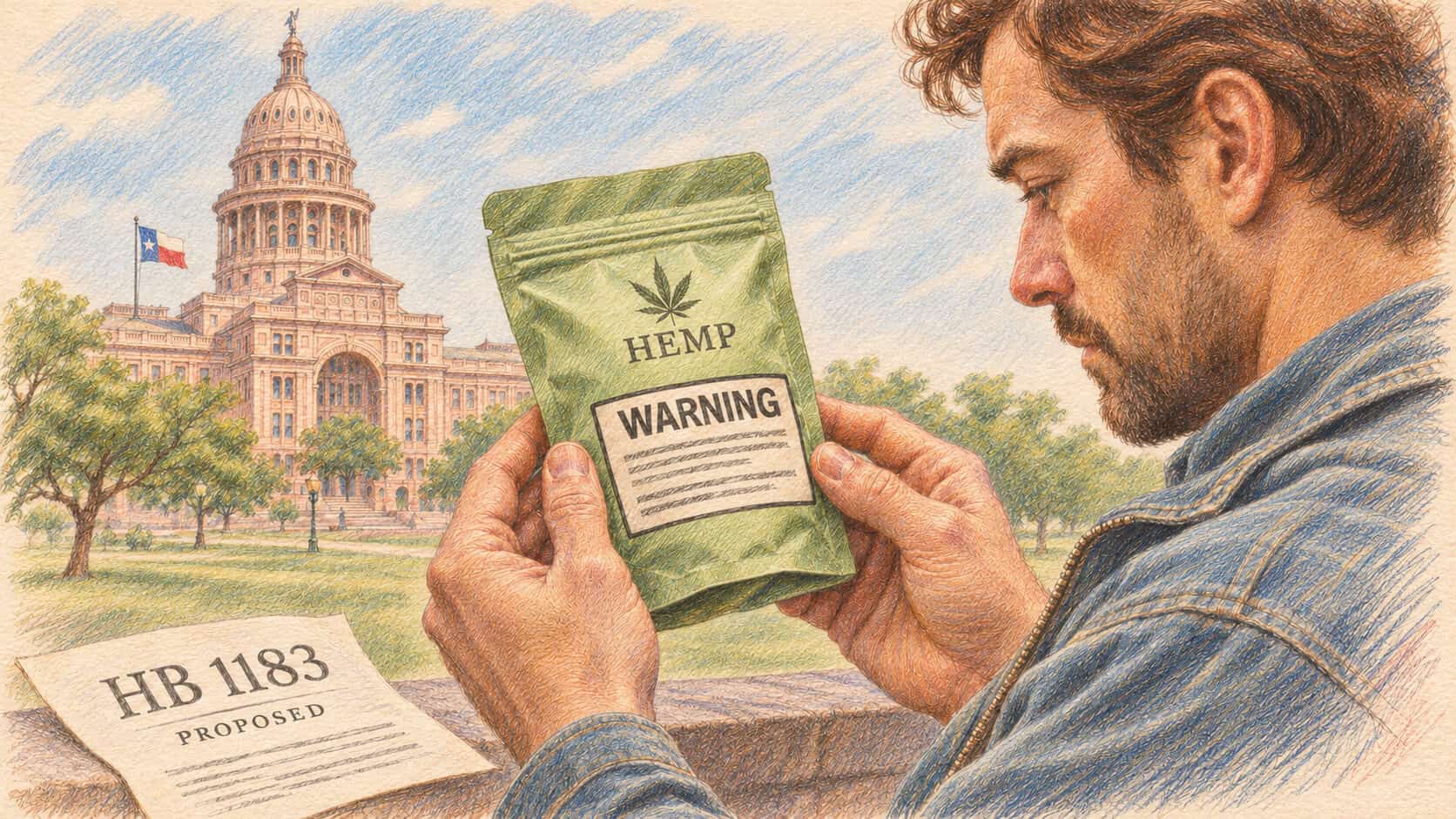
Is weed legal in Texas? No. Recreational marijuana is illegal everywhere in the state, and possessing up to two ounces is a Class B misdemeanor that can bring up to 180 days in jail and a fine of up to $2,000. Texas does run a limited medical program, the Texas Compassionate Use Program (TCUP), which since September 2025 covers chronic pain, cancer, PTSD and a dozen other conditions. Hemp is where the rules have moved fastest: delta-8 is now treated as a Schedule I drug, THC vapes can no longer be sold, and smokable THCA flower has been all but pushed off store shelves.
Where is it legal? See our state-by-state map and guide: Where Is Weed Legal in the US?
Last checked: 18 November 2026.
The basic rule sits in section 481.121 of the Texas Health and Safety Code, which sets penalties by the weight of marijuana found on you. The medical side is governed by House Bill 46, which expanded TCUP, and by the patient registry run by the Texas Department of Public Safety. This guide puts those sources together with the latest court rulings, state hemp rules and federal changes. The newest addition is House Bill 1183, filed on 16 November 2026 for next year’s legislative session, which would require rotating health warnings on hemp THC edibles; it has its own section below. Just before that, on 3 November 2026, Houston’s voters approved a ballot measure that makes misdemeanor marijuana possession the lowest priority for the Houston Police Department and bans no-knock raids, as Ganjapreneur reported the next day. Polling on legal marijuana, which this page has tracked since 2025, has its own section further down.
Key Takeaways. Marijuana remains illegal for recreational use in Texas, and the penalty grows with the amount: a misdemeanor up to four ounces, a felony above that. THC concentrates and vape cartridges are treated far more harshly than flower, so even a small cartridge can lead to a felony charge. Medical cannabis is available only to permanent Texas residents registered in TCUP, with products capped at 10 mg of THC per dose. City ordinances that tried to stop marijuana arrests in Austin, San Marcos, Dallas and Denton have been struck down, repealed or suspended. Houston’s new cannabis decriminalization ballot measure, backed by about 71% of voters in unofficial returns, takes a softer route: it tells city police to treat misdemeanor possession as their lowest priority, but it does not legalize marijuana, does not forbid arrests and does not cover sheriff’s deputies or state troopers. Hemp THC is legal only in narrow forms for adults 21 and over, and a new federal hemp definition due on 11 December 2026 could remove most of what is left. A bill filed for the 2027 session, HB 1183, would add one of eleven rotating health warnings, on risks such as cannabis poisoning in children, psychosis and dependence, to hemp edibles that contain more than 10 micrograms of delta-9 THC per gram, starting 1 September 2027; for now it is only a proposal, not law.
Is Weed Legal in Texas? The Law at a Glance
| Question | Status |
|---|---|
| Recreational use | Illegal statewide |
| Penalties by amount | Up to 2 oz: Class B misdemeanor (up to 180 days, $2,000). 2–4 oz: Class A misdemeanor (up to 1 year, $4,000). Over 4 oz: felony |
| THC vapes and concentrates | Penalty Group 2 controlled substance: under 1 gram is already a felony |
| Medical cannabis (TCUP) | Limited low-THC program for permanent Texas residents; up to 10 mg THC per dose |
| City decriminalization | Austin and San Marcos ordinances struck down; Dallas suspended; Denton repealed; Houston’s Prop A makes possession the lowest police priority but not legal |
| Hemp THC products | 21+ only; delta-8 banned as Schedule I; vape sales banned; THCA flower restricted |
| Hemp warning labels | State health department rule requires five general warnings; HB 1183 (filed, not law) would add rotating health warnings from 1 September 2027 |
| Out-of-state medical cards | Not recognized |
| Driving | DWI if your normal faculties are impaired; no fixed THC limit |
Penalties for Marijuana Possession in Texas
Texas weed laws spell the word “marihuana”, and section 481.121 grades possession strictly by weight:
- 2 ounces or less: Class B misdemeanor, up to 180 days in jail and a fine of up to $2,000.
- More than 2 and up to 4 ounces: Class A misdemeanor, up to one year in jail and a fine of up to $4,000.
- More than 4 ounces and up to 5 pounds: state jail felony.
- More than 5 and up to 50 pounds: third-degree felony.
- More than 50 and up to 2,000 pounds: second-degree felony.
- More than 2,000 pounds: first-degree felony, with 5 to 99 years or life in prison and a fine of up to $50,000.
Most people stopped with an amount for personal use fall into the first tier. A Class B conviction still means a criminal record, which can follow you into job and housing applications.
Concentrates are a different story. Wax, shatter, oils, edibles made with extract and THC vape cartridges are not treated as “marihuana” but as tetrahydrocannabinol, which the Texas State Law Library notes is classed in Penalty Group 2 of the Texas Controlled Substances Act. Under that group, possession of less than one gram is a state jail felony, punishable by 180 days to two years in a state jail and a fine of up to $10,000. A single vape cartridge can weigh more than a gram, which makes vapes the riskiest form of cannabis to carry in Texas.
Some counties and cities use cite-and-release for low-level possession: the officer writes a ticket instead of taking you to jail. That is a local policy choice, not a right, and the charge itself is the same misdemeanor.
Is Weed Legal in Houston? Prop A, the Cannabis Decriminalization Ballot Measure
Is weed legal in Houston? No, and that did not change on election day. On 3 November 2026, Houston voters approved Proposition A, a citizen-initiated amendment to the city charter that its backers call the Houston Freedom Act. Unofficial returns reported by KPRC Click2Houston showed 412,934 votes for and 164,709 against, or 71% to 29%, with 69.7% of precincts reporting, and Houston Public Media put support at more than 70% the next morning. These numbers are not final until the vote is canvassed. The measure reached the ballot after activists handed City Hall nearly 40,000 petition signatures, according to the Houston Chronicle. The petition drive was run by Ground Game Texas, the same group behind the earlier city measures in Austin, San Marcos, Killeen, Elgin and Denton.
Calling it decriminalization is a stretch, and the difference matters if you live in or visit Houston. Decriminalization in the strict sense means the act stops being a crime. Prop A does not touch the crime at all. It changes how one police department ranks it on its to-do list.
What the Houston Freedom Act says
The full text published by the City of Houston adds a new article to the city charter. Its main parts:
- Lowest priority. The Houston Police Department must make Class A and Class B misdemeanor marijuana possession, meaning up to four ounces, its “lowest possible enforcement priority”, and the city must reflect that in its budget, police manual and procedures. The rule applies unless and until a binding state or federal court decision requires otherwise.
- Discretion stays. The city backs diversion, such as treatment referrals or community service, where the law allows it, while officers and prosecutors keep their power to enforce state law. Officers may still seize what they believe is marijuana, but they must write a report explaining why.
- Lab tests on a budget leash. The city must report how much money and staff time goes into testing the THC level of seized cannabis. The council may fund such tests when it finds a compelling public-safety reason, for example in a violent felony investigation.
- An audit and yearly reports. A one-time audit of five years of misdemeanor marijuana enforcement, with arrests, citations, the age, sex, race and ethnicity of people charged, and estimated costs, is due within 120 days of the amendment taking effect. Annual reports follow, including how many cases were sent to diversion.
- No-knock warrants banned. Houston officers may not request or carry out a search warrant unless it requires them to knock, announce themselves and wait at least 15 seconds before going in.
- Severability. If a court strikes down one section, the rest stays in force.
The testing clause is less technical than it sounds. Since Texas legalized hemp in 2019, a bag of marijuana and a bag of hemp flower look and smell the same, so proving a misdemeanor case usually requires a lab result showing the THC level, as the Austin Chronicle explained when Austin voted on a similar measure. Think of it as a speed limit that can only be enforced with a radar gun: if the city rarely pays for the radar, few tickets will stick.
Why Houston voted on this now
The trigger was a jump in arrests. Data that Houston Public Media obtained from the police department show officers arrested about 440 people a year for misdemeanor possession under Mayor John Whitmire, who took office in January 2024, compared with an average of about 35 a year from 2021 through 2023. Ganjapreneur had earlier described this as a rise of nearly 1,200%. Whitmire has said personal use is “not a priority of HPD” and argued that Prop A will change little. He has blamed the Harris County District Attorney’s Office for prosecuting more cases; District Attorney Sean Teare has replied that state law limits prosecutors’ ability to decline drug cases. Experts quoted by the Houston Chronicle point to a 2023 state law that lets prosecutors be removed from office if they refuse to pursue whole categories of crime, misdemeanor marijuana possession included. Harris County has run a diversion program since 2017 that lets most people caught with under four ounces avoid a charge by taking a drug education class, the Chronicle reported before the vote.
The warrant half of the measure goes back to the 2019 Harding Street raid, in which Houston officers entered a home on a no-knock warrant obtained with fabricated information and two homeowners were killed. The police department largely stopped using such warrants afterwards; Prop A writes the ban into the charter, where a future chief cannot quietly undo it.
What Prop A does not change
Possession is still illegal under Texas law, and the penalties in the table above apply in Houston as anywhere else. Lowest priority is not a ban: a Houston officer can still arrest or cite you, especially if marijuana turns up alongside another offense. The charter binds only the Houston Police Department, so Harris County sheriff’s deputies, state troopers and police in neighboring cities are not covered.
The measure also stops at Class A and Class B marijuana possession. THC vapes, wax and extract edibles fall under Penalty Group 2, where even small amounts are a felony, and manufactured delta-8 is now a Schedule I substance; neither is covered. Spectrum News noted before the vote that the Houston Freedom Act does not address the new delta-8 felony rules. Driving while impaired is untouched as well.
Can the state block it?
Attorney General Ken Paxton’s lawsuits against other cities leaned on a provision of the Texas Local Government Code that bars cities from adopting a policy under which they “will not fully enforce laws relating to drugs”, as the Killeen Daily Herald summarized his petition. The Austin, San Marcos and Dallas measures told police not to arrest or cite people at all. Houston’s text was written differently: it ranks priorities instead of forbidding enforcement, keeps officers’ discretion, and says it gives way to any binding court ruling. No court has yet decided whether a priority ranking crosses the “fully enforce” line, and as of 5 November no lawsuit against Prop A had been reported. The office that would bring one is also changing hands: Paxton, who ran for the U.S. Senate and lost, leaves in January, and Democrat Nathan Johnson won the race to succeed him. Whether the new attorney general will keep up the state’s challenges to city marijuana measures is not yet known.
Other Texas Cities: Austin, San Marcos, Dallas, Denton and Killeen
Since 2022, voters in several Texas cities approved ballot measures telling local police not to arrest or cite people for small amounts of marijuana. Attorney General Ken Paxton sued them, arguing that cities cannot refuse to enforce state drug law, and so far the state has won.
Austin and San Marcos. In April 2025 the 15th Court of Appeals, a new statewide appeals court created in 2023, ruled that state law preempts both ordinances. The Texas Supreme Court declined to hear the San Marcos appeal in September 2025 and refused Austin’s petition in December 2025, which ended both cases more than three years after voters approved the measures.
Dallas. Voters passed Proposition R, the “Dallas Freedom Act”, with 67% support in November 2024. It barred police from arresting or citing people for up to four ounces. After Paxton sued, the city paused implementation in July 2025 and agreed not to enforce the ordinance while the lawsuit continues.
Denton repealed its ordinance in May 2025, citing legal costs and the Austin ruling. Elgin voided its measure earlier, and officials in Bastrop, Harker Heights and Lockhart declined to put theirs into effect.
Killeen is the exception that is still standing. Its 2022 ordinance, approved by 69% of voters, bars police from arresting or citing people for misdemeanor possession in most cases, and it remains in use while lawsuits filed by Bell County in April 2023 and by the attorney general in January 2024 work through the courts. In its annual report to the city council in July 2026, the police department said it identified 1,077 suspected possession cases in 2025 and made arrests in about 12.1% of them; of the 130 people arrested, 102 had less than two ounces, according to the Killeen Daily Herald.
Not every city has said yes. San Antonio voters rejected a broader charter amendment in May 2023 by 71.63% to 28.37%, and Lubbock voters turned down a decriminalization ordinance in May 2024 by 64.62% to 35.38%.
The practical answer for anyone in these cities, Houston included, is simple: state law applies. Police priorities differ from department to department, but no city ordinance or charter amendment currently protects you from arrest.
Medical Marijuana: The Texas Compassionate Use Program
Texas does not have a full medical marijuana program of the kind found in Oklahoma or New Mexico. It has TCUP, created in 2015 and originally limited to intractable epilepsy. House Bill 46, which took effect on 1 September 2025, was the biggest expansion in the program’s history.
Who qualifies
Patients with epilepsy and seizure disorders, multiple sclerosis, spasticity, ALS, autism, cancer, incurable neurodegenerative diseases, PTSD, chronic pain lasting more than 90 days, traumatic brain injury, Crohn’s disease and other inflammatory bowel diseases, or a terminal illness, including patients in hospice and palliative care.
What patients can get
Products with up to 10 mg of THC per dose and no more than 1 gram of THC per package or inhalation device. The old cap of 1% THC by weight no longer applies. Vaporized or aerosol products are allowed when a doctor decides they are medically necessary, but smoking cannabis remains banned. HB 46 also raises the number of licensed dispensing organizations from 3 to 15 and lets them open satellite storage locations closer to patients.
How to register
Patients must be permanent Texas residents. A physician registered with the Department of Public Safety enters the patient into the Compassionate Use Registry of Texas (CURT), and a licensed dispensing organization can then fill the prescription. There is no medical card to carry: the registry entry is the authorization.
How big the program is
The DPS patient count report for September 2026 shows 174,777 patients listed in the registry since the program began in 2017, up from 135,470 at the end of 2025. These are lifetime counts, so they include people who are no longer active patients. Access is still the weak spot: one dispensary executive told the Texas Tribune that only about 800 of Texas’s roughly 80,000 board-certified physicians had registered to prescribe. DPS gave conditional licenses to nine new dispensing organizations in December 2025 and later added three more, though not all of them are serving patients yet. For comparison with other states, see our breakdown of US medical marijuana patient statistics.
The Hemp Crackdown: Delta-8, THCA and Vapes
In 2019 Texas legalized hemp, defined as cannabis with no more than 0.3% delta-9 THC by dry weight. That definition opened the door to delta-8 gummies, THCA flower and hemp-derived delta-9 edibles, sold in more than 14,000 registered shops. The past year and a half has been a steady rollback:
- June 2025: Governor Greg Abbott vetoed Senate Bill 3, which would have banned all consumable hemp THC. Two special sessions followed without a new law.
- 1 September 2025: Senate Bill 2024 banned the sale of cannabinoid vapes. Selling one is a Class A misdemeanor.
- September 2025 to January 2026: an executive order directed regulators to stop sales to anyone under 21 and require ID checks. The Texas Alcoholic Beverage Commission finalized its rules on 20 January 2026.
- 31 March 2026: a Department of State Health Services rule began counting THCA toward the 0.3% THC limit, which disqualifies almost all smokable hemp flower and concentrates, and raised license fees to $5,000 per retail location and $10,000 per manufacturer. A trial court blocked the rule in April, but the 15th Court of Appeals put it back in effect on 5 June 2026 while the appeal continues. The hemp companies challenging the rule have a court date on 8 December 2026, WFAA reports.
- 31 July 2026: after the Texas Supreme Court sided with the health department on 1 May, the state began treating manufactured delta-8, delta-10, THCP and similar compounds as Schedule I controlled substances, in the same category as heroin and LSD. According to KUT, Austin police treat possession of delta-8 as a state jail felony.
- 16 November 2026: House Bill 1183 was filed for the 2027 session, proposing mandatory health warnings on hemp THC edibles and topicals. It is not law; see the next section.
What remains legal under state law is narrow: CBD products and hemp products with no more than 0.3% delta-9 THC, sold by licensed retailers to adults 21 and older. The THCA picture is murkier than the headlines suggest. Selling most THCA flower now breaks the health department’s rules, but Texas criminal law still separates hemp from marijuana by delta-9 content, so possession of THCA flower is not explicitly a crime, and reporters have found enforcement against shops uneven. That is a gray zone, not a safe harbor: a police officer cannot tell THCA flower from marijuana by looking at it.
Federal law is tightening in two steps. A new federal definition of hemp, passed by Congress in November 2025, counts total THC rather than delta-9 alone and caps finished products at 0.4 mg of total THC per container. The first step took effect on 12 November 2026: hemp products built on cannabinoids the plant cannot make on its own, the synthetic ones, lost federal hemp status that day, as NPR reported. The rest was due on the same date, but a funding law signed on 2 September 2026 pushed most of it to 11 December 2026. Congress could delay again in December; if it does not, most hemp THC drinks and gummies still on Texas shelves will fall outside federal law. Research on why delta-8 spread so quickly in states like Texas is covered in our article on the UC San Diego delta-8 study.
Texas HB1183: The Proposed Hemp Warning Label
The Texas HB1183 hemp warning label proposal is one of the first hemp-specific bills of the new session, and it deals with a single question: what hemp THC packages must tell buyers. Representative Charlene Ward Johnson, a Houston Democrat, filed House Bill 1183 on 16 November 2026, a week after bill filing opened for the 90th Legislature. The text runs to three short sections. It has only been filed: it has not been referred to a committee, and the Legislature does not convene until 12 January 2027.
What the bill would change
Texas already has a labeling law for consumable hemp, section 443.205 of the Health and Safety Code. Today it requires six items on any product that contains, or is marketed as containing, more than trace amounts of cannabinoids: a batch number, a batch date, the product name, a web link to a certificate of analysis, the manufacturer’s name, and a certification that the product’s delta-9 THC content is not more than 0.3%. HB 1183 adds a seventh item, a health warning, in two versions.
For products meant to be eaten or swallowed, such as gummies, drinks, capsules and tinctures, the warning applies when the product contains more than 10 micrograms of delta-9 THC per gram. The package must carry one of eleven warnings, picked at random or by a rotation the Department of State Health Services approves. It works much like the rotating health messages many countries print on cigarette packs: a buyer sees a different warning from one package to the next, so no single message fades into the background.
For topical products, such as creams and balms, the same threshold triggers one fixed warning.
The eleven rotating warnings for hemp edibles
The bill spells out every word. In plain terms, the edible warnings say:
- Keep out of reach of children: consumable hemp products can cause cannabis poisoning that can be life-threatening to children, especially those younger than five.
- It can take up to four hours to feel effects from eating or drinking a hemp product, and consuming more before feeling an effect can cause cannabis poisoning, including severe anxiety and panic attacks.
- Using cannabis while younger than 25 can harm brain development, worsening attention, concentration and memory, especially with daily or near-daily use.
- Using cannabis while younger than 25 increases the risk of mental disorders like psychosis and schizophrenia, and the risk grows with frequency of use.
- Cannabis can cause psychotic symptoms like severe paranoia, with the greatest risk under 25 or with higher-THC products.
- Daily or near-daily use can lead to dependence, which also increases the risk of anxiety and depression.
- Cannabis can be addictive, and the risk rises with the amount of THC.
- Long-term use increases the risk of anxiety and depression, more so the more often you use.
- The higher the amount of THC, the greater the risk of adverse effects such as paranoia, anxiety and dependence.
- Do not use cannabis if pregnant or breastfeeding; it can harm a baby’s growth and development.
- Do not drive under the influence of cannabis.
The topical warning tells users not to swallow the product or apply it internally or to broken, irritated or itching skin, and says the health effects and risks of cannabis topicals are not fully known.
On the package itself the text would appear in capital letters, each warning opening with the word “WARNING”.
How low is 10 micrograms per gram?
Very low. A microgram is a millionth of a gram, so 10 micrograms per gram equals 0.001% by weight. The state’s legal ceiling for hemp, 0.3%, equals 3,000 micrograms per gram, which puts the warning trigger 300 times below the legal limit. In practice, almost any hemp product designed to produce a high would cross it, and so would many full-spectrum CBD oils, which keep a little of the plant’s natural delta-9. Products with no measurable delta-9, such as CBD isolate, would not need the new warning.
One detail sets the trigger apart from other Texas hemp rules. Since March 2026 the health department judges compliance by total THC, which counts THCA. HB 1183 measures only delta-9.
How HB1183 compares with today’s hemp labels
Hemp labels in Texas already carry warnings, but generic ones. Since 31 March 2026, health department rule 25 TAC §300.402 has required five statements: keep out of reach of children; the product may contain THC and can cause a failed drug test; all THCs have psychoactive properties; pregnant or nursing women should consult a healthcare provider before use; and the product has not been evaluated by the FDA, according to the adopted text published in the Texas Register on 20 March 2026.
HB 1183 goes further in three ways. It names specific harms, such as poisoning in young children, psychosis, dependence, depression and impaired driving, where the current rule speaks in general terms. It hardens the pregnancy message from “consult a healthcare provider” to “do not use”. And it would write the warnings into state law, which a future agency cannot quietly soften by changing its own rules.
Some of the language follows public-health advice used elsewhere. The four-hour line, for example, matches Health Canada’s consumer guidance, which says it can take up to four hours to feel the full effects of eating or drinking cannabis.
How strong is the science behind the warnings?
The bill does not cite studies, and the evidence behind its eleven lines is not equally strong. The slow onset of edibles and the danger of accidental poisoning in small children are well documented. The links between heavy cannabis use before age 25 and psychosis, dependence, anxiety or depression come mostly from observational research: it shows a consistent association that grows with frequency of use and THC strength, but on its own it cannot prove that cannabis is the cause in every case. Advice against use in pregnancy reflects caution by medical bodies more than a large body of trials, which cannot ethically be run on pregnant women. A warning label is a public-health message, not a diagnosis, and none of these statements predicts what will happen to any one person.
Are THC gummies legal in Texas, and would they carry the warning?
Today, hemp-derived delta-9 gummies and THC drinks that stay within 0.3% delta-9 by dry weight can still be sold in Texas by licensed retailers to adults 21 and over. Delta-8 gummies cannot, since delta-8 is now a Schedule I substance. If HB 1183 passes in its current form, delta-9 gummies and drinks over the 10-microgram threshold would need one of the rotating warnings on every package sold from 1 September 2027.
The bigger question is federal. If the new federal hemp definition takes full effect on 11 December 2026, most gummies and drinks on Texas shelves will lose federal hemp status, and a Texas label law would then govern a much smaller market. A label rule only matters for products that can still be sold legally, so how much HB 1183 would change in practice depends on what Congress does first.
Is HB1183 law yet?
No. A filed bill is a starting point. To become law, HB 1183 needs a committee hearing, votes in both the House and the Senate, and the signature of the governor, who from January 2027 will be Democrat Gina Hinojosa. Bills can be amended at every stage, so the threshold, the wording and the list of warnings may change. If it passes as written, it would take effect on 1 September 2027 and apply to any consumable hemp product distributed or sold on or after that date, regardless of when it was made.
HB 1183 is not the only cannabis bill already waiting. On 9 November, the first day of prefiling, Democratic lawmakers filed House Bills 362 and 369 and Senate Bill 237 to legalize and regulate cannabis for adults 21 and older, KRLD reported.
Driving After Using Cannabis in Texas
Texas has no per se THC limit for drivers, unlike the 0.08 blood alcohol limit. Instead, Penal Code section 49.01 defines “intoxicated” as not having the normal use of your mental or physical faculties because of alcohol, a controlled substance, a drug or any other substance. If an officer believes cannabis has impaired you, you can be charged with driving while intoxicated. The case then turns on the officer’s observations and any test evidence, not on a fixed number.
Being a registered TCUP patient does not help here. Section 49.10 says it is no defense that you were legally entitled to use the substance.
Rules for Visitors
No reciprocity. TCUP is open only to permanent Texas residents. A medical card from another state gives no protection in Texas.
Driving in from New Mexico, Colorado or Oklahoma. Cannabis bought legally in a neighboring state becomes illegal the moment you cross into Texas, and carrying it across state lines also breaks federal law.
Vapes and edibles. Because concentrates fall into Penalty Group 2, a vape pen or a bag of extract-based gummies carries a heavier risk than a small amount of flower. Delta-8 products bought elsewhere are now Schedule I substances in Texas.
Houston and other big cities. Local police priorities vary, but they are not a legal shield. Houston’s Prop A covers only city police and only misdemeanor flower possession; if you are stopped by a state trooper on the highway or by police in a neighboring city, the ordinary state rules apply without any local softening.
Federal Status: Schedule III and the Stalled DEA Hearing
Under federal law, marijuana is still a controlled substance. Following an executive order signed in December 2025, the Justice Department and the Drug Enforcement Administration moved FDA-approved and state-licensed medical marijuana to Schedule III in April 2026, a less restrictive category. All other marijuana remains in Schedule I. A federal appeals court refused in September 2026 to suspend that medical order while it is challenged.
A separate DEA hearing on rescheduling all marijuana took testimony from 29 June to 15 July 2026. On 29 September the administrative law judge stayed the proceedings at the request of three opponents of rescheduling, who wanted a new Government Accountability Office report added to the record. On 22 October Judge Derek Julius refused to reopen the hearing but admitted the report and allowed short briefs on it, with replies due on 5 November. The stay ends when that briefing closes; no date has been set for his recommendation.
For Texas, the open question is whether the low-THC products sold through TCUP count as “state-licensed medical marijuana” under the April order. That has not been settled. Either way, federal rescheduling does not change Texas criminal law, which is what police in the state enforce.
What Texans Think: Polls on Legal Marijuana
Texas voters have backed some form of legal marijuana in poll after poll, yet the state keeps saying no. The gap between public opinion and state law is one of the starkest in the country.
The University of Texas poll: 84% back some form of legal cannabis
The April 2025 University of Texas/Texas Politics Project poll (1,200 registered voters, 18–28 April 2025) found that 84% of registered voters said cannabis should be legal in at least some form. Here is how that support breaks down: 35% believe small amounts should be legal for any purpose, 16% support full legalization for any amount and any purpose, and 33% support legalization for medical use only. Only 15% think marijuana should remain completely illegal.
Republicans and Democrats
Support crosses party lines, but a clear divide remains. Among Democrats, 65% favor some form of recreational legalization, with 42% backing small amounts and 23% endorsing full legalization. Republican voters are more divided: 21% favor complete prohibition, 39% support legal cannabis for medical purposes only, and 40% favor allowing recreational use to some degree.
Less regulation, not more
The same survey asked which issues the state should regulate less. Cannabis came second, just behind gambling: 43% of Texans want less regulation of marijuana, 30% want stricter laws, 18% prefer to keep the laws as they are and 8% are unsure.
The hemp ban split voters
In spring 2025, as Lieutenant Governor Dan Patrick pushed to ban consumable hemp THC, the poll found that 50% of voters opposed banning these products, 35% of them strongly, while 34% supported the ban. Question wording matters here: a University of Houston survey earlier that year found 55% backing a ban on what it described as unregulated THC consumables. In June 2025, a follow-up Texas Politics Project poll found 54% supporting more qualifying conditions for the medical program, including 59% of Republicans.
Newer surveys
The University of Houston Hobby School found in early 2025 that 79% of Texans support legal medical marijuana with a prescription, 69% support decriminalizing personal possession and 62% support legal recreational sales for adults 21 and over, including 53% of Republicans. In February 2026, a Texas Politics Project poll of 1,300 registered voters (2–16 February) found that 40% disapproved of how state officials handle marijuana and THC laws, while 29% approved. On 3 March 2026, a non-binding proposition on the Democratic primary ballot to legalize cannabis for adults and expunge past low-level records passed with 80% “yes”. And a Fabrizio, Lee & Associates survey of 1,000 registered voters on 1–2 April 2026, reported by Fox 7 Austin, found 75% in favor of legal medical marijuana.
These polls are not directly comparable. They use different samples, mostly online panels, and different questions, and the primary vote reflects only people who chose the Democratic ballot. The direction is consistent, though: majorities back medical access, and most Texans favor at least some legal use. Houston’s 71% vote for Prop A fits the same pattern, with one caveat: the ballot bundled the marijuana policy with the no-knock ban, so it is impossible to say how much of the support was for each half. For the national picture, see our roundup of key facts on marijuana legalization in America.
What Comes Next
The 3 November 2026 election changed who will run Texas. Democrat Gina Hinojosa defeated Governor Greg Abbott, Democrat Vikki Goodwin unseated Lieutenant Governor Dan Patrick, who led the 2025 push to ban hemp THC, and Democrat Nathan Johnson won the race for attorney general, according to NBC News projections. They take office in January 2027. That shifts the politics, not the law: Texas has no citizen-initiative process, so any change to marijuana penalties, the medical program or hemp rules still has to pass both chambers of the Legislature, which next meets in regular session on 12 January 2027. Bill filing for that session is already under way, with adult-use legalization bills and HB 1183’s hemp warning labels among the first cannabis proposals. Our explainer on what the 2026 midterms change for cannabis legalization, state by state covers the wider picture, including the new Congress.
Until then, the fights are in the courts and in Washington. The appeal over the health department’s hemp rules is still before the 15th Court of Appeals, with the industry’s case due back in court on 8 December. The Dallas lawsuit and the Killeen cases are unresolved, and Houston’s Prop A has yet to face a legal test. The DEA hearing on full rescheduling is waiting on a recommendation, and the federal hemp deadline of 11 December 2026 could be pushed back again or take effect. In Houston, the first audit of five years of marijuana enforcement, due within 120 days of Prop A taking effect, will show whether arrests actually fall. We will update this guide as those decisions land.
Frequently Asked Questions
No. Recreational marijuana is illegal throughout Texas, including in Houston, Austin and Dallas. Only patients registered in the Texas Compassionate Use Program can legally use low-THC cannabis, and only in the forms the program allows.
Up to two ounces is a Class B misdemeanor with up to 180 days in jail and a fine of up to $2,000. Between two and four ounces is a Class A misdemeanor. More than four ounces, or any amount of THC vape or concentrate, can be charged as a felony.
No, and it is not decriminalized in the legal sense either. Prop A, approved on 3 November 2026, makes misdemeanor possession of up to four ounces the Houston Police Department’s lowest enforcement priority, but possession is still a crime under state law, officers can still arrest or cite, and sheriff’s deputies and state troopers are not covered. In Austin the city ordinance was struck down, and Dallas has agreed not to enforce its own while the state’s lawsuit continues.
Delta-8 is not. Since 31 July 2026 the state treats manufactured delta-8, delta-10 and THCP as Schedule I controlled substances, and possession can be charged as a state jail felony. THCA flower can effectively no longer be sold: since the 31 March 2026 health department rule, THCA counts toward the 0.3% THC limit. Possessing it is not explicitly a crime under state law, but police may not be able to tell it apart from marijuana.
Sources
- Texas Health and Safety Code § 481.121 and Texas Penal Code §§ 49.01 and 49.10
- Texas State Law Library, Cannabis & the Law research guide, updated August 2026
- Texas Legislature Online: HB 46, SB 3 and SB 2024, 89th Legislature
- Texas Legislature Online: HB 1183 introduced text and bill history, 90th Legislature (filed 16 November 2026)
- Texas Register, DSHS adopted consumable hemp rules, including 25 TAC §300.402 (20 March 2026)
- Health Canada, Cannabis consumer information sheet: edibles
- Texas Department of Public Safety, Compassionate Use Program and patient count report, September 2026
- City of Houston, Proposition A charter amendment text and ballot language (November 2026 election)
- Ganjapreneur, Houston votes to deprioritize low-level cannabis crimes (4 November 2026) and report on Houston arrest numbers
- KPRC Click2Houston, Houston voters approve Proposition A (4 November 2026, unofficial returns); Houston Public Media, Prop A passes (3–4 November 2026)
- Houston Chronicle, Houston voters curb low-level marijuana enforcement (November 2026) and what to know about Proposition A (October 2026); Spectrum News, THC legal efforts in Houston (21 August 2026); Austin Chronicle, Austin’s 2022 Prop A and THC testing
- Killeen Daily Herald, annual report on Killeen’s marijuana ordinance (21 July 2026); Ballotpedia, San Antonio Proposition A (May 2023) and Lubbock Proposition A (May 2024)
- NBC 5 Dallas-Fort Worth, Texas election results (4 November 2026)
- KRLD, Texas Democrats file bills to legalize adult-use cannabis and home growing (10 November 2026)
- Texas Tribune, TCUP expansion and patient numbers (12 January 2026), TABC hemp rules (20 January 2026) and delta-8 ban (30 July 2026)
- Texas Public Radio, DSHS hemp rule back in effect (9 June 2026); KUT, delta-8 enforcement in Austin (28 July 2026); WFAA, smokable hemp hearing set for December (October 2026)
- Community Impact, Texas Supreme Court declines Austin’s petition (December 2025); Marijuana Moment, San Marcos appeal declined (September 2025); NORML, Dallas pauses Proposition R (July 2025)
- Vicente LLP, federal hemp definition delayed to 11 December (September 2026); NPR, Some states get a head start on upcoming federal hemp ban (12 November 2026)
- DEA, marijuana rescheduling regulatory actions and stay and briefing order (29 September 2026); NORML, judge denies request to reopen the hearing (22 October 2026)
- Polls: Texas Politics Project, April 2025 and June 2025; University of Houston Hobby School, February 2025; Marijuana Moment on the February 2026 poll; GreenState on the March 2026 primary; Fox 7 Austin on the April 2026 survey
Last checked: 18 November 2026.
Disclaimer: This guide is for general information only and is not legal advice. Marijuana and hemp rules in Texas are changing through court rulings, agency rules, local ballot measures, new bills and federal law, sometimes within weeks. A filed bill such as HB 1183 is a proposal and may change or fail before it becomes law. For decisions about your own situation, speak to a licensed Texas attorney.