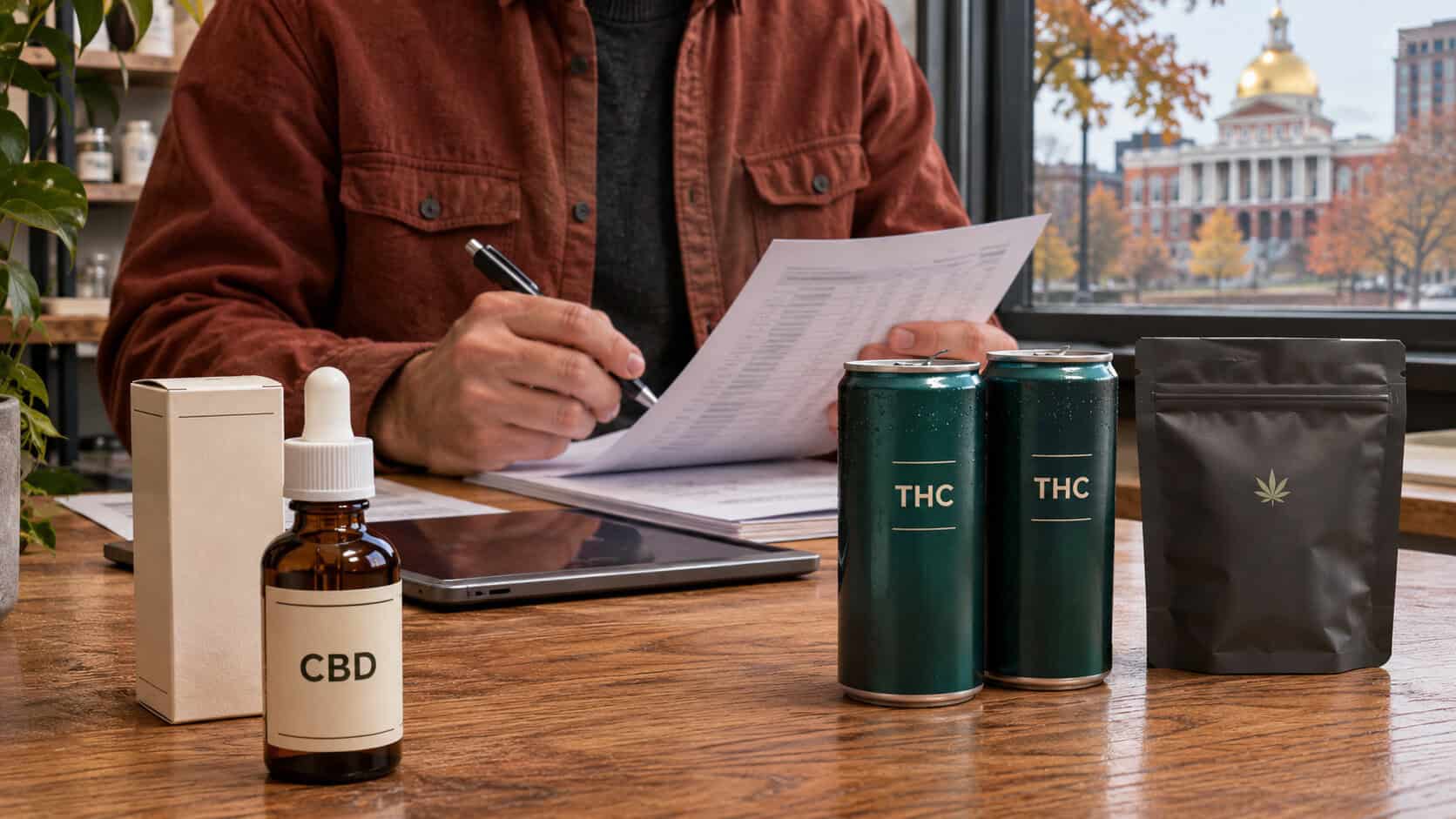
For years, buying a THC gummy in Massachusetts depended a lot on which door you walked through. In a licensed cannabis store, the product was tested, labelled, taxed and sold only to adults over 21. At a convenience store or vape shop down the road, a hemp-derived gummy with a similar effect could sit by the register with none of those guarantees. The question of Massachusetts Cannabis Control Commission hemp oversight — whether the state’s marijuana regulator should take charge of that second shelf — has hung over the market since at least 2024. On November 17, 2026, the regulator answered it: yes, and it wants the job.
According to The Boston Globe, the Commission agreed that it should regulate intoxicating hemp-derived cannabinoid products. It also recommended that non-intoxicating hemp products move through the CCC’s licensed supply chain and be sold both inside and outside its licensed stores. The Massachusetts Department of Agricultural Resources (MDAR) would keep control of hemp farming. Commissioners voted unanimously to approve a report on the hemp-derived cannabinoid market and asked staff to bring draft regulations to the agency’s December 10 meeting.
Key Takeaways
The Cannabis Control Commission (CCC) has formally recommended that intoxicating hemp products — THC gummies, drinks and similar items made from hemp rather than marijuana — fall under its authority, while farmers stay with MDAR. Non-intoxicating products such as CBD would pass through the CCC’s supply chain but could be sold beyond licensed cannabis stores, a step commissioners acknowledged requires the Legislature to change the law. Nothing changes on store shelves today: the Commission approved a report and recommendations, not binding rules, and draft regulations are only due on December 10, with the state’s statutory report deadline falling on December 15, 2026. Meanwhile, the federal government is tightening the definition of hemp on December 11, 2026, which will push most intoxicating hemp products out of the legal hemp category nationwide. For shoppers, the practical direction of travel is clear — intoxicating hemp is heading toward the same rules as marijuana — but the details, timing and enforcement are still open.
Why Massachusetts Hemp Oversight Became a Problem
The root of the problem is a split in the rulebook. In Massachusetts, marijuana is overseen by the CCC, while hemp — cannabis with very low THC — belongs to MDAR, the state’s agriculture department. That arrangement worked when hemp meant fibre, seeds and CBD oil. It started to creak once manufacturers learned to extract or convert cannabinoids from hemp into products that get people high.
Think of it like two inspectors responsible for two halves of the same building, with a corridor in the middle that neither one thinks is theirs. Intoxicating hemp products lived in that corridor. MDAR regulated the crop, the Department of Public Health regulated food safety, and the CCC regulated marijuana — but no agency clearly owned a THC seltzer made from federally legal hemp and sold in a liquor store.
The state did try to close the gap. On May 29, 2024, the Department of Public Health and MDAR issued a joint advisory stating that food and beverages containing hemp-derived CBD or THC could not be manufactured or sold in Massachusetts, and asked local boards of health to enforce it. The Alcoholic Beverages Control Commission warned its licensees that selling such products could put their liquor licences at risk. Enforcement in liquor stores improved, but in gas stations, smoke shops and corner stores it depended on local health boards, many of them short of staff and money.
The Commission itself long argued that intoxicating hemp sat outside its jurisdiction. That changed when lawmakers handed it the question directly.
What the Legislature Asked the Commission to Do
On April 19, 2026, Governor Maura Healey signed H.5350, An Act Modernizing the Commonwealth’s Cannabis Laws, which became Chapter 65 of the Acts of 2026. The law restructured the Commission — shrinking it from five members to three, all appointed by the governor — and doubled the adult possession limit from one ounce to two. It did not write hemp rules. Instead, as the Legislature’s fact sheet explains, it directed the CCC to study unregulated sales of hemp-infused products and cannabinoids and recommend how Massachusetts should regulate them, with the report due by December 15, 2026.
That is what makes this week’s vote significant. Earlier drafts of the bill in the House had spelled out a detailed hemp framework, including rules for hemp beverages and CBD. The final law dropped them and sent the issue back to the regulator. The Commission has now told lawmakers, in effect, “give this to us.”
It is also a regulator with a fresh public mandate. On November 3, 2026, voters rejected Question 8, which would have ended adult-use marijuana sales, by roughly three to one — Axios reported 75.8% voting no. The legal market the CCC supervises is not going anywhere, and its rulebook is the obvious template for whatever replaces the hemp free-for-all.
Intoxicating Hemp Products: From the Corner Store to the Cannabis Store
The core recommendation is simple: if a hemp product can get you high, the CCC should regulate it.
The report itself sits behind the Commission’s meeting materials, and the draft regulations have not yet been published, so the exact rules are unknown. What we do know is what CCC oversight already looks like for marijuana. Products sold through its system are tested by licensed independent laboratories, carry labels listing cannabinoid content, are sold only to adults 21 and over, and can be pulled from shelves if they fail. That system is not perfect — the Commission’s own shelf audit found that 13 of 63 flower products tested fell outside the state’s label-accuracy window — but it exists, which is more than can be said for most hemp sold outside dispensaries.
If the recommendations become law, the likeliest outcome for shoppers is that intoxicating hemp products either enter that tested, age-gated system or leave the market. Which products survive, which licences sellers would need and how quickly the change happens will depend on the draft regulations and on what the Legislature is willing to pass.
Non-Intoxicating Hemp and CBD: A Wider Shelf, With Conditions
The second recommendation is the more surprising one. Rather than locking all hemp products inside cannabis stores, the Commission wants non-intoxicating hemp items to travel through its licensed supply chain but be sold both in and beyond its retailers.
Commissioner Xiomara DeLobato framed it partly as an economic opportunity for licensed operators — an additional revenue stream and a way for cannabis brands making non-intoxicating hemp products to build recognition in ordinary retail. She described it from a social justice angle, saying the agency was “being intentional with where we have potential revenue.” In plain terms: the companies that already pay for compliance would get first access to a larger market, rather than out-of-state hemp brands that pay for none of it.
There is a catch. Commissioners acknowledged that selling these products outside CCC-licensed establishments would require statutory changes. It is also worth remembering that, under the 2024 health advisory, adding hemp-derived CBD to food and drinks remains off-limits in Massachusetts. A wider CBD shelf is a proposal, not a promise.
THC Drinks in Massachusetts and the December 11 Federal Deadline
State plans are colliding with a federal clock. In November 2025, Congress rewrote the legal definition of hemp. As the Congressional Research Service explains, the new definition excludes finished hemp products containing more than 0.4 milligrams of total THC per container, as well as products with cannabinoids the plant cannot naturally produce. In September 2026, Congress delayed most of those changes until December 11, 2026; the exclusion for cannabinoids the plant cannot make on its own took effect as originally planned on November 12.
For context, a typical hemp THC drink contains several milligrams of THC per can, which is why we described the coming rule as a near-total ban on the beverage category. Washington has not finished arguing about it. On November 17 — the same day as the Commission’s vote — Senators Tim Sheehy and Amy Klobuchar introduced the Hemp Guardrails Act, which, according to Cannabis Business Times, would regulate hemp-derived cannabinoid products rather than ban them while prohibiting smokable hemp flower, delta-8, delta-10 and synthetic cannabinoids.
Other states are already improvising. New Jersey gave liquor stores a short window before its own ban on intoxicating hemp drinks, now aligned with the December 11 date, and small cannabis businesses in Maine are watching the same deadline threaten their bestselling hemp products. Massachusetts is taking a different route: instead of a ban written by lawmakers, a regulator asking to absorb the category. How that fits with the federal picture depends on what Congress does before December 11 — and the CCC’s draft regulations arrive just one day earlier.
What This Means for Shoppers Right Now
The honest answer is: not much has changed yet, and a lot may change soon.
If you buy THC products from a licensed Massachusetts cannabis store, your experience should not change. State-licensed marijuana is governed by state law, not the federal hemp definition. If you buy hemp-derived THC gummies or drinks from a corner shop or online, those products already sit in a legal grey zone in Massachusetts and, from December 11, most of them will fall outside the federal hemp definition as well. If you use CBD products, the Commission’s plan could eventually make them more widely available through regulated channels — but only if the Legislature agrees.
There are also real limits to what we know. The Commission’s vote approved recommendations, not regulations. Its full report, the draft rules and the Legislature’s response are all still to come, and enforcement in the past has depended heavily on under-resourced local boards of health. For a broader view of how marijuana itself is treated across the country, see our state-by-state guide to where cannabis is legal in the US.
FAQ
Not in food or drinks. Since a May 2024 advisory from the Department of Public Health and the Department of Agricultural Resources, Massachusetts has treated the manufacture and sale of food and beverages containing hemp-derived THC or CBD as unlawful, with enforcement led by local boards of health and the alcohol regulator for liquor licensees. THC products legally sold in the state come through the Cannabis Control Commission’s licensed system, where buyers must be 21 or older. The Commission has now recommended taking over regulation of intoxicating hemp, but its proposals do not take effect until regulations are adopted and, where needed, the Legislature changes the law. Separately, from December 11, 2026, most hemp products containing more than 0.4 milligrams of total THC per container fall outside the federal definition of hemp.
THCA is the non-intoxicating acid form of THC that turns into THC when heated, which is why high-THCA “hemp” flower can be smoked for the same effect as marijuana. The updated federal definition measures total THC, which includes THCA, so most high-THCA flower stops qualifying as hemp once the main federal changes take effect on December 11, 2026. In Massachusetts, flower with intoxicating levels of THC is legally sold through licensed cannabis stores, not as hemp.
No. The state’s hemp programme does not allow hemp-derived delta-8 THC products to be processed or sold in Massachusetts, because delta-8 is typically made by chemically converting CBD rather than extracted in useful amounts from the plant. The new federal hemp definition also excludes cannabinoids synthesised or manufactured outside the plant once its main provisions take effect.
Yes, with a licence. Hemp cultivation and processing are licensed by the Massachusetts Department of Agricultural Resources, and the Cannabis Control Commission has recommended that MDAR keep that role. Hemp growers must stay within federal THC limits, and growing cannabis with higher THC falls under marijuana law instead, which allows adults limited home cultivation under separate rules.
Disclaimer
This article is journalism intended for general information and education. It is not legal, medical or business advice, and it is not a recommendation to buy, sell, grow or consume any cannabis or hemp product. The regulatory changes described here are recommendations and proposed rules that may change before they take effect, and US federal hemp law is still being debated in Congress. Cannabis remains illegal under US federal law regardless of state licensing. Readers should consult qualified legal counsel about their own situation and a licensed healthcare professional about any health question.