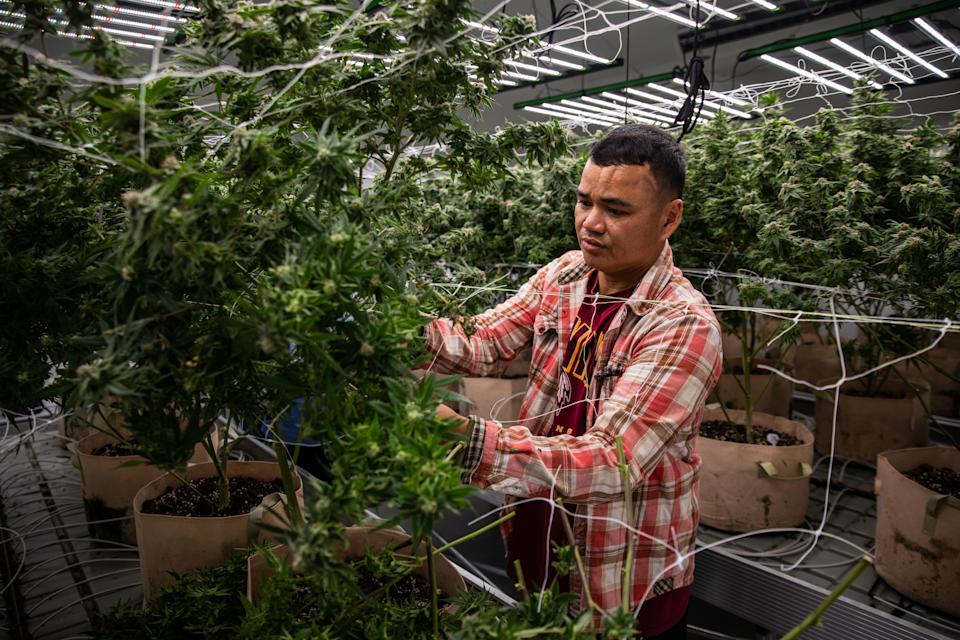
A cannabis company can hold a valid state licence, pay its taxes on time, employ dozens of people — and still get a letter saying its bank account will be closed in thirty days, with no explanation attached. For nearly a decade that experience has been treated as industry folklore, repeated at conferences and in podcast interviews. In September 2026 it stopped being folklore and became a federal finding.
The U.S. Government Accountability Office — the investigative arm of Congress — published Banking Services: Cannabis Businesses Face Access Challenges (GAO-26-107498), completed on 7 August 2026 and released publicly on 8 September. The report was first covered by Marijuana Moment, and the full 44-page document is available directly from GAO. It was requested by Senators Raphael Warnock, Elizabeth Warren, Tina Smith and John Fetterman, and it arrives at an unusual moment: the industry’s own account of being locked out of the banking system now has an official record behind it.
Key Takeaways
The GAO found that obtaining and keeping financial services remains difficult for cannabis-related businesses, even though it could not identify a single case of a bank being punished by a federal regulator solely for serving one. Roughly 1,000 banks and credit unions filed the specific reports that flag cannabis customers in 2024 — a number that grew from 2015 to 2019 and then stayed broadly flat, and that is small against the total number of institutions in the country. Businesses told investigators about accounts closed with little warning, waits of weeks or months to open new ones, and annual fees that in two cases exceeded $100,000. The problems reach past the companies themselves to the people who work in them, who report trouble with mortgages, car loans and life insurance. The evidence base is focus groups and interviews, not a national survey, which means the report describes the shape of the problem convincingly but does not measure how common each piece of it is.
What the 2026 GAO Report on Marijuana Banking Actually Examined
The GAO set out to answer three questions: what guidance federal agencies give banks about serving state-licensed cannabis businesses, what makes an institution decide to take one on or turn it away, and what difficulties those businesses and their staff actually run into.
To get there, investigators ran nine focus groups and eleven interviews covering 74 financial institutions, chosen to span different asset sizes, institution types and policies on cannabis. The people in the room were the ones who would know: each institution’s Bank Secrecy Act officer or its cannabis banking programme manager. Separately, GAO held eight focus groups with owners and managers from 51 cannabis-related businesses, again picked to represent a range of sizes and business types. Agency officials, industry associations and interest groups were interviewed on top of that.
The report also draws a distinction worth holding onto. “Cannabis-related business” (CRB, in the report’s shorthand) covers two very different things: plant-touching companies that grow, manufacture or sell cannabis, and ancillary companies that supply them — equipment vendors, law firms, consultants. Both can find themselves treated as radioactive by a bank, but they are not equally exposed, and as we will see, that distinction quietly undermines the headline number everyone will quote.
The 1,000-Bank Figure and What It Doesn’t Tell You
Since 2014, guidance from the Financial Crimes Enforcement Network (FinCEN) has told institutions how to serve cannabis businesses while staying compliant with the Bank Secrecy Act. In practice that means gathering detailed information on the customer and filing suspicious activity reports on certain transactions — with specific terms included so the filings can be identified as cannabis-related. Federal banking regulators check compliance through BSA examinations.
Those filings are the only national trail of who banks cannabis, and GAO used FinCEN’s analysis of them. The count of institutions filing rose from 2015 to 2019, then held relatively steady through 2024, when about 1,000 banks and credit unions filed. Against the total number of institutions nationwide, that is a small share.
The GAO is careful about what the number means, and the caution matters more than the figure. Filing a report does not mean an institution accepts cannabis businesses as ongoing customers — it may have processed one occasional transaction. Some institutions may not report, or may not realise they are serving a cannabis business at all. And some of the filers serve only ancillary companies, never the plant-touching side. So 1,000 is not a count of banks open for cannabis business. It is a ceiling with an unknown amount of air underneath it.
A Punishment Nobody Could Find
The most striking finding is a negative one. Bankers in GAO’s focus groups repeatedly cited fear of adverse supervisory action from their federal regulator as a reason to stay away. GAO went looking for an example and came up empty.
No civil or criminal penalties were identified against a financial institution solely for serving cannabis businesses. The Department of Justice said its data systems could not easily isolate such cases, so it could not say whether any institution had been investigated or prosecuted on those grounds. Officials from the federal banking regulators and from financial industry associations named no instances. Dozens of institutions that do serve the sector named none either. And the regulators stated they had taken no enforcement action against a supervised institution solely for serving a cannabis business.
That gap between perceived risk and documented risk is the report’s central tension. But “no penalties found” is not the same as “no risk” — cannabis remains a controlled substance under federal law with limited exceptions, and the legal exposure exists on paper whether or not anyone has been made an example of. Banks also gave GAO a much more mundane reason for staying out: the operational workload and compliance burden of BSA obligations. Ongoing due diligence and routine suspicious activity reporting cost money, and for a small institution the maths may simply not work. Some institutions go the other way and take cannabis clients on deliberately — to meet a community need, or because they see a business opportunity in a market with few competitors.
What It Costs When You Do Get an Account
Most of the cannabis operators GAO spoke to did have bank accounts. What they described was not exclusion so much as expensive, fragile inclusion.
Accounts were closed, sometimes with little warning. Participants in seven of eight focus groups described paying monthly or annual account fees, and two participants said they paid $100,000 or more a year. Institutions that serve the sector confirmed the pattern from their side: in every focus group with such institutions, participants said cannabis customers are charged higher fees than other customers. Opening an account was slow — weeks or months before it was operational — and some operators had to approach several institutions before one said yes.
Beyond deposit accounts, businesses reported trouble with loans, investment, payroll services, credit cards and electronic payments. Card acceptance is a structural dead end rather than a negotiable one: two major credit card companies prohibit cannabis purchases outright, which is why so much of the retail trade still moves in cash.
And the exposure follows the people. Industry associations told GAO that individuals working in cannabis can struggle to keep personal bank accounts or obtain car loans, mortgages or life insurance. Treatment can depend on your job title — in two of four focus groups with institutions that do not serve cannabis businesses, participants said they would provide personal banking to a cannabis company’s employees but not to its owners.
Growing a Business Without a Bank: One Operator’s Account
Erin Gore has been describing this landscape for years. She’s the founder of Garden Society, a California-based cannabis brand, and on an episode of Yahoo Finance’s The Big Idea podcast she laid out the behind-the-scenes reality of running a company in a legally grey zone. Speaking to host Elizabeth Gore — her sister-in-law — she described a financial environment that’s less high-risk than actively hostile: no access to bank loans, no retirement plans for employees, and even personal bank accounts shut down without warning.
“What we don’t have is access to credit, and what we don’t have is services around it,” Gore explained. “We cannot get a 401(k). We can’t get a line of credit for payroll. We can’t even finance equipment. And that’s just the beginning.”
Despite the cannabis industry being valued at $38.5 billion in 2024, federal classification of marijuana as a Schedule I drug means most traditional financial institutions want nothing to do with it. That leaves business owners like Gore in a bind — legally operating at the state level, but locked out of the financial infrastructure that most companies rely on. What GAO’s focus groups now show is that her account was not an outlier. It was a data point.
Banking on Workarounds
Gore, like many cannabis entrepreneurs, has had to get creative. Without loans or credit, cash flow has become her lifeline.
One investor once asked her about her “cash-to-cash cycle” — essentially, how long it takes to earn back what you spend on a product. For her branded products, Gore said the best-case scenario is 160 days. That’s a long time to wait for money you’ve already spent.
So she found a smarter way: contract manufacturing. By producing cannabis products for other companies — and getting them to pay for materials and production upfront — she slashed her cash cycle and added a new income stream.
“It covered my overhead and allowed me to reinvest in my brand,” she said. “It made my business more resilient.”
Today, Garden Society is one of California’s leading cannabis companies, but the risks haven’t disappeared. Without bankruptcy protection — another casualty of the industry’s federal status — Gore had no safety net when one of her distributors went under, owing her nearly half a million dollars.
“I don’t have credit. I can’t go to a bank. I’m only dependent on investor contributions,” she said.
Policy in Progress: Would a Safe Harbour Fix It?
Gore isn’t just surviving the system — she’s trying to change it. After almost a decade in the industry, she’s spent years lobbying lawmakers at every level, pushing for policies that reflect the reality on the ground.
The vehicle has been the SAFER Banking Act, introduced in Congress in 2023 to give banks legal cover when working with cannabis companies in states where marijuana is legal. That version stalled. In June 2026, bipartisan members of the House and Senate refiled legislation to protect banks from being punished for serving cannabis businesses.
GAO asked its participants what a safe harbour law would actually change. The answers split. Some thought it would bring institutions off the sidelines. Others said their policies would not move without further reform — federal legalisation, or a reduction in Bank Secrecy Act compliance requirements. Read alongside the finding that no bank has been penalised for cannabis banking in the first place, that split is telling: if the deterrent is partly compliance cost rather than legal fear, removing the legal fear alone leaves part of the problem standing.
“We’re building the plane and flying it at the same time,” Gore said. “No one is better suited than business owners to help shape the rules.”
How Strong Is This Evidence?
The GAO report is authoritative in the sense that matters — it is a federal investigation with named methods and a public paper trail — but it is worth being precise about what it can and cannot support.
The industry-side findings come from eight focus groups with 51 businesses, and the bank-side findings from 74 institutions across focus groups and interviews. Participants were selected to represent a range of sizes and types, not drawn as a random sample. That means phrases like “seven of eight focus groups” describe the discussions GAO held, not percentages of the American cannabis industry. The $100,000-plus annual fee figure comes from two participants; it is real, and it is not a typical bill.
The FinCEN filing data is a genuine national dataset, but as GAO itself explains, it is a proxy for banking relationships rather than a measure of them, and it can overcount and undercount at the same time. The absence of enforcement actions is likewise bounded by what could be checked: DOJ could not search its own systems for the relevant cases, so the finding rests on regulator statements and on nobody in a wide sample being able to name an instance.
None of this weakens the report’s core conclusion. It does mean the honest summary is “a federal investigation documented a persistent, expensive access problem,” not “a federal study measured how many cannabis businesses can’t get bank accounts.”
The Bigger Picture: Growth, Consumers and Local Battles
Financial access is one strand in a broader story. Shifts in consumer behaviour are influencing how companies approach branding and product development — as covered in our look at gender differences in marijuana use. The medical cannabis market continues its upward trajectory, with projections pointing to substantial growth by 2030, creating opportunities and complications for investors and patients alike. Money flows the other way too: an analysis by Yale’s Budget Lab put a number on the federal tax revenue currently going uncollected because of the same federal status that keeps banks away. And as legalisation expands geographically, local pressures such as New Mexico’s cannabis-linked water rights crisis show how environmental and regulatory issues are becoming central to the industry’s sustainability.
FAQ – Cannabis Business and Finance
A1: That obtaining and maintaining financial services remains difficult for cannabis-related businesses, even though GAO found no indication that any financial institution has been penalised solely for serving them. About 1,000 banks and credit unions filed cannabis-flagged suspicious activity reports in 2024, a small share of institutions nationwide, and businesses reported account closures, high fees and slow onboarding.
A2: There is no federal prohibition on doing so, but cannabis remains a controlled substance under federal law with limited exceptions, which creates legal risk on paper and triggers Bank Secrecy Act obligations. FinCEN’s 2014 guidance sets out how institutions can serve these customers compliantly, including enhanced due diligence and suspicious activity reporting. State legality does not remove those federal obligations.
A3: Largely because two major credit card companies prohibit cannabis purchases, which closes off standard card acceptance regardless of what a business’s bank allows. Combined with restricted access to loans, payroll services and electronic payments, that pushes a disproportionate share of the trade into cash.
A4: Entrepreneurs often rely on strategies like contract manufacturing, investor funding and tight cash-cycle management. Some, like Garden Society’s Erin Gore, diversify income streams and shorten the gap between spending on production and getting paid. These are workarounds rather than solutions, and they leave companies without bankruptcy protection or a credit backstop when a counterparty fails.
Legal Disclaimer
This article is journalism, not legal, financial or investment advice. Cannabis remains a controlled substance under U.S. federal law with limited exceptions, and the rules governing financial services to cannabis-related businesses differ between federal and state levels and change over time. Nothing here should be treated as guidance on whether to open, operate or bank a cannabis business, or as a recommendation regarding any company or security mentioned. Businesses and individuals should consult qualified legal and financial professionals licensed in the relevant jurisdiction before acting.